
I've reviewed 50+ B2B marketing campaigns this year.
The ones that failed? They all made the same mistake.
They tried to do everything at once.
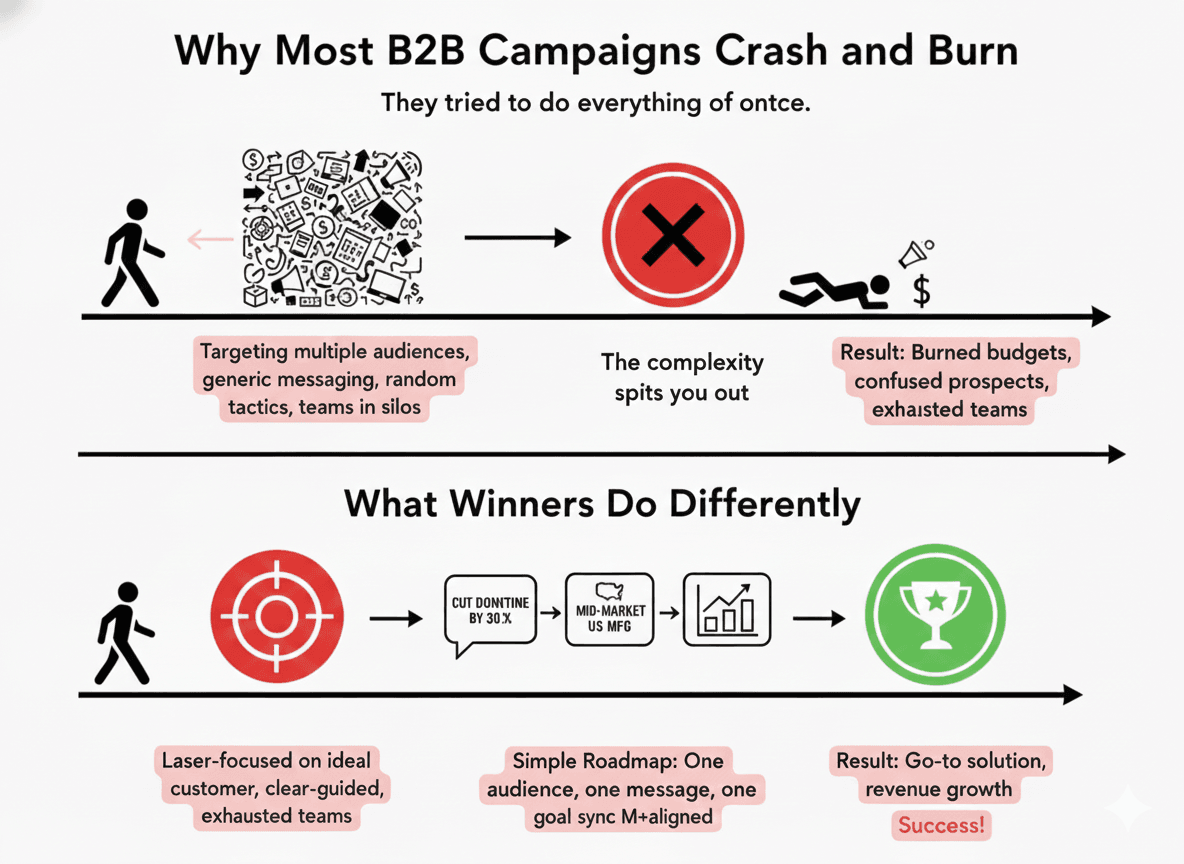
Why Most Campaigns Crash and Burn
The failed campaigns had a pattern:
- Targeting multiple audiences with no clear focus
- Messaging that tried to speak to everyone
- Random tactics without a strategy connecting them
- Teams working in silos, not talking to each other
Marketing launches across five channels at once. Sales complains about unqualified leads. Leadership requests more reports instead of addressing the real issues.
The result? Burned budgets, confused prospects, and exhausted teams going nowhere.
One company spent $50K targeting both enterprise and SMB customers. They converted neither.
Their messaging was too generic, and their sales process couldn't handle both segments at once.
What Winners Do Differently
The successful campaigns?
They kept things simple:
- Clear value proposition solving real problems
- Laser-focused on their ideal customer
- Data guiding every decision
Marketing and sales actually working together
One company I worked with picked only mid-market manufacturing companies in the US. They said no to everything else.
Within 6 months, they became the go-to solution in that niche.
Another winner built everything around one message:
"Cut production downtime by 30%." Every email, every ad, every sales call hammered that single promise.
No fancy tools. No complex automation. Just focus on what actually moves the needle.
Your Simple Roadmap to Better Campaigns
Want to simplify your next campaign?
- Pick one audience and go deep on their challenges
- Craft one strong message speaking directly to them
- Align every tactic to one clear goal
- Keep marketing and sales in sync from day one
I get it. Casting a wide net feels safer. You don't want to miss opportunities.
But here's what I've seen:
The companies that win are the ones brave enough to say no to distractions and focus on execution.
- Start with your most profitable customer segment.
- Build everything around their specific pain points.
- Test your message with real prospects before you go big.
- Get your sales team involved from day one.

About The Author

Stephen Tseng
Co-founder of dminorstudio. regularly writes about the intersection of AI, SEO, and B2B growth strategy.