
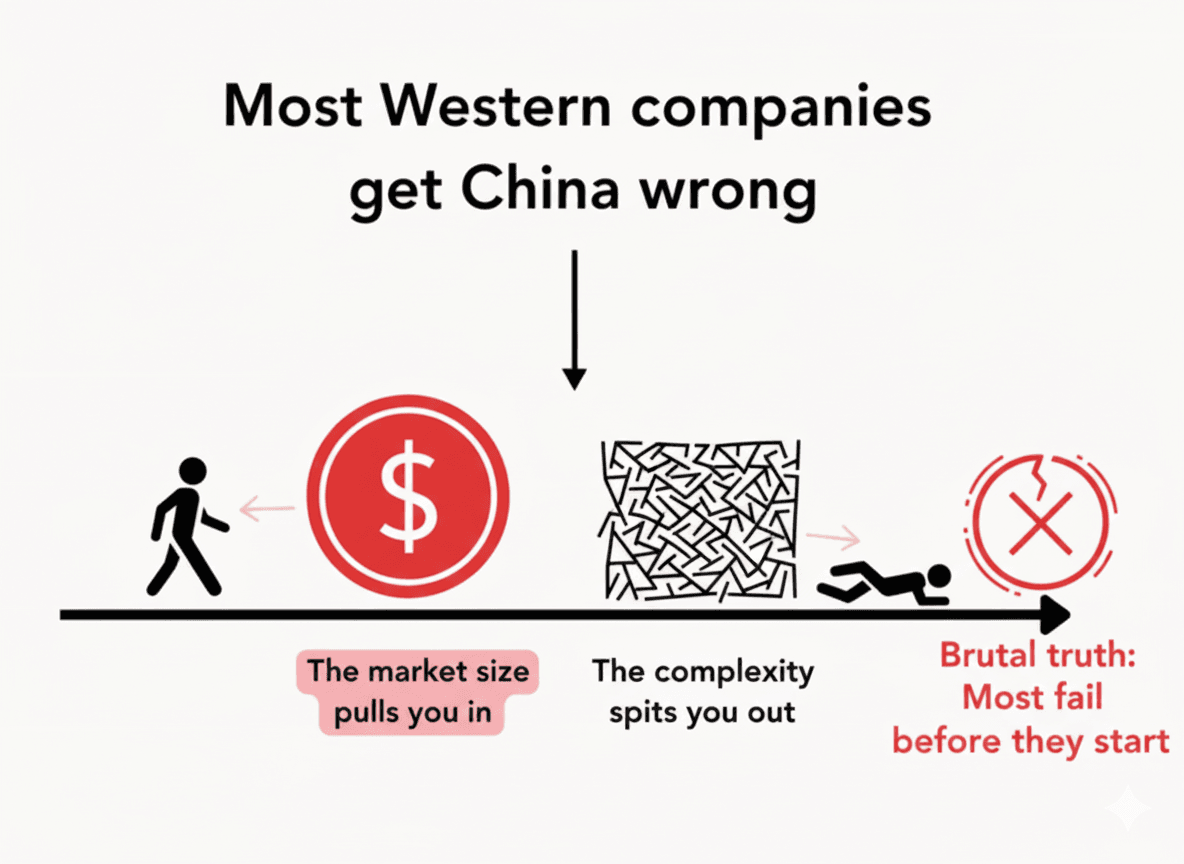
Most Western companies get China wrong.
The market size pulls you in.
The complexity spits you out.
Why Do Western B2B Companies Struggle in China?
Here's what kills Western B2B companies in China:
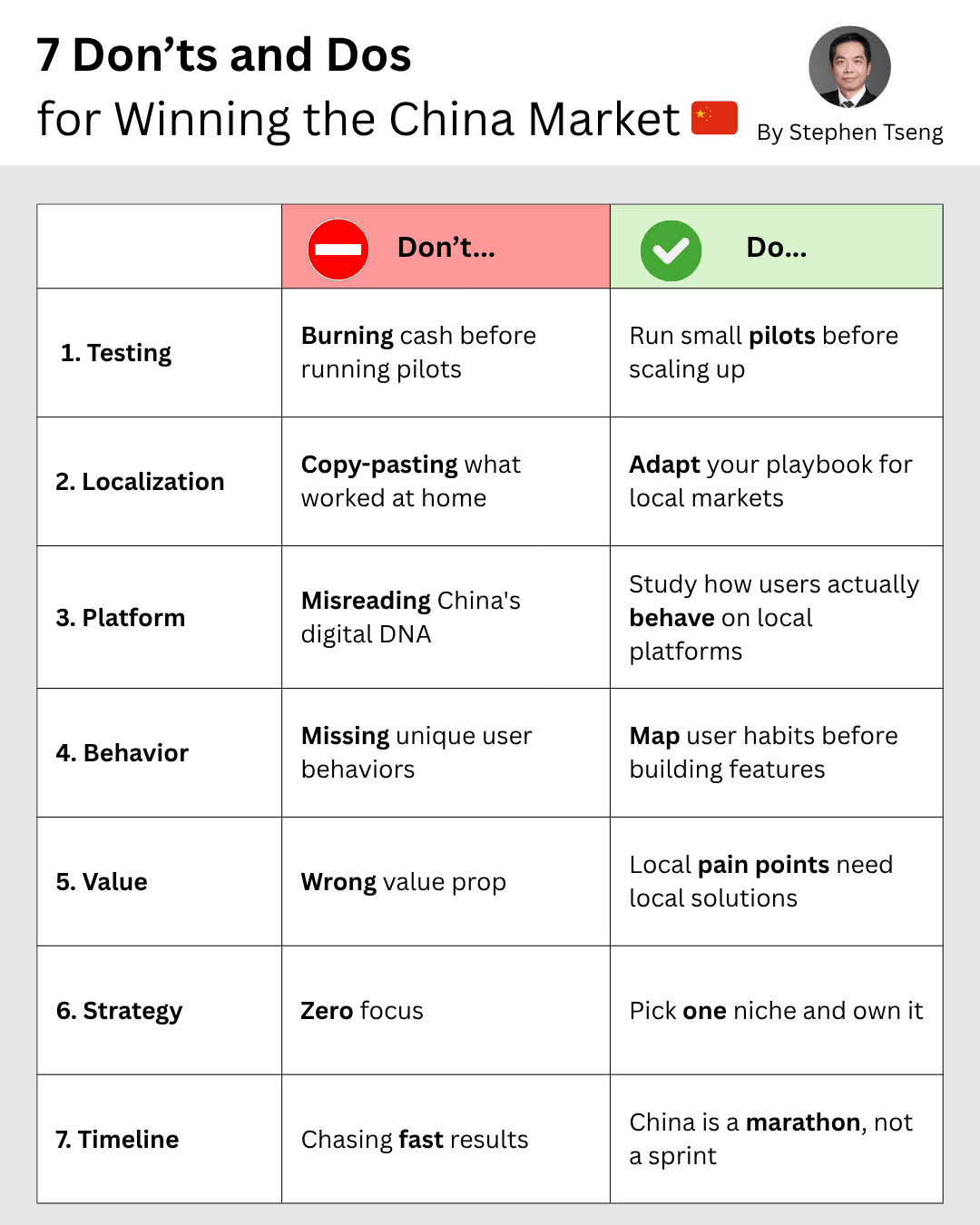
- Burning cash before testing → Run small pilots first. Learn what works before betting big.
- Copy-pasting home playbooks → New York strategies don't work in Shanghai. Different market, different rules.
- Misreading digital DNA → WeChat isn't Facebook. It's a super app—messaging, payments, mini-programs, everything.
- Missing user behaviors → Chinese buyers research differently. They buy differently. They trust differently.
- Wrong value proposition → Local pain points need local solutions. What matters to your US clients doesn't matter here.
- Zero focus → Trying to serve everyone = serving no one. Pick your niche and own it.
- Chasing quick wins → China rewards patience. Think years, not quarters.
What Strategies Actually Work for B2B Success in China?
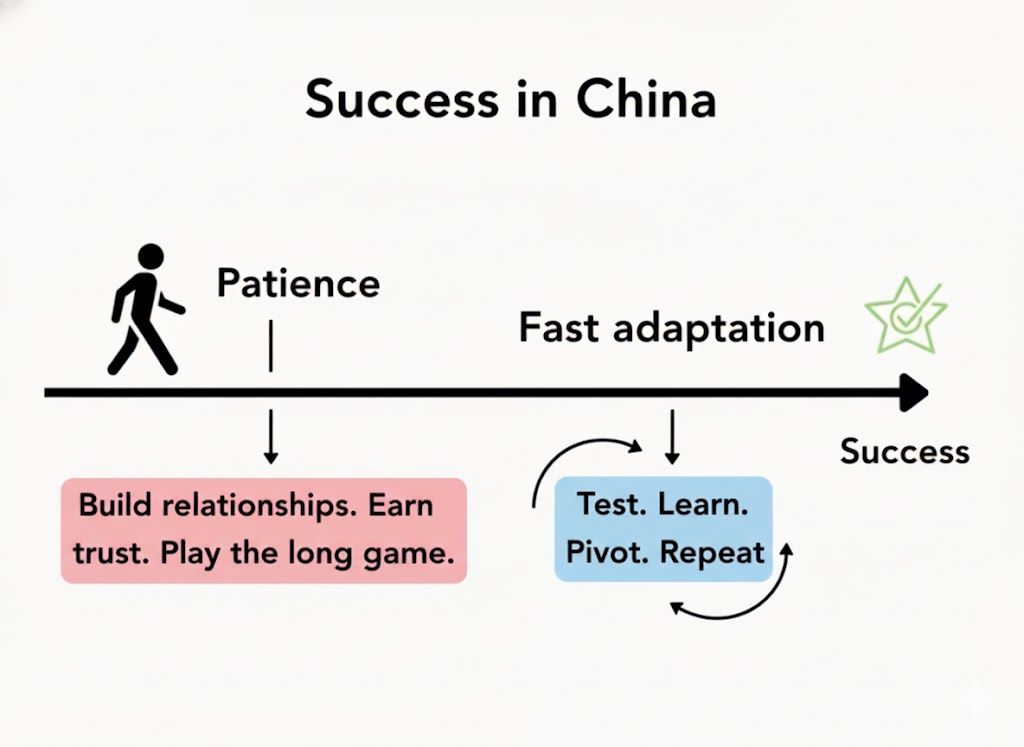
Success in China takes two things:
- Patience → Build relationships. Earn trust. Play the long game.
- Fast adaptation → Test. Learn. Pivot. Repeat.
Forget shortcuts.
Lean into learning.
Winners?
They know China is a marathon.
Research shows that B2B companies entering the Chinese market see 3x higher success rates when they invest in localized digital strategies, including Baidu SEO and PPC, compared to those using generic global approaches.
How Should You Approach the China Market?
Most companies fail because they treat China like any other market.
It's not.
Here's what works:
- Start small → Pilot programs over big launches. Test messaging, channels, and buyer personas before scaling.
- Hire local → They understand the culture, platforms, and buyers. Local teams bridge the gap between your product and Chinese decision-makers.
- Embrace WeChat → It's where business happens. WeChat is not just messaging. It's CRM, payments, content sharing, and lead generation in one ecosystem. Learn more about WeChat marketing strategies.
- Build trust first → Relationships beat transactions every time. Chinese buyers need to know you, trust you, and see proof of your commitment.
- Stay flexible → What worked last year might not work today. Market dynamics shift fast. Adapt or lose.
China isn't impossible.
But it requires a commitment to understanding how China B2B digital marketing differs from Western markets.
What Are the Top 7 Don'ts for B2B Companies in China?
1. Don't launch without local market research
Assumptions kill budgets. Validate your value proposition with real Chinese buyers before investing heavily.
2. Don't ignore platform differences
LinkedIn, Google, and Facebook have limited reach in China. Baidu, WeChat, and Zhihu dominate. Align your strategy with where your buyers actually spend time.
3. Don't skip cultural adaptation
Your US messaging won't resonate. Chinese buyers value trust, relationships, and proof over aggressive sales pitches.
4. Don't expect quick ROI
B2B sales cycles in China are longer. Building brand awareness and trust takes time. Plan for 12-24 months before seeing consistent results.
5. Don't neglect mobile optimization
Over 95% of Chinese users access the internet via mobile. If your site isn't mobile-friendly and WeChat-integrated, you're invisible.
6. Don't rely solely on English content
Chinese buyers prefer content in Mandarin. Translation isn't enough. Content needs to be localized for context, tone, and cultural relevance.
7. Don't go it alone
Partnering with a China digital marketing agency that understands Baidu SEO, WeChat, and local buyer behavior accelerates your entry and reduces costly mistakes.
What Are the Top 7 Dos for B2B Companies in China?
1. Do invest in Baidu SEO early
Baidu controls 70% of search traffic in China. Organic visibility on Baidu builds credibility and drives qualified leads. Start optimizing your Chinese website now.
2. Do build a WeChat official account
WeChat is the center of business communication in China. Use it for content sharing, lead nurturing, and customer service.
3. Do focus on trust signals
Case studies, client testimonials, and certifications matter more in China. Showcase partnerships, industry recognition, and long-term client relationships.
4. Do create Mandarin content regularly
Consistent, high-quality content in Mandarin positions your brand as credible and locally committed. Blogs, videos, and guides tailored to Chinese pain points drive engagement.
5. Do leverage local partnerships
Distributors, industry associations, and local influencers can fast-track your credibility and market access.
6. Do test and iterate constantly
What works in Beijing might not work in Shenzhen. Run A/B tests on messaging, channels, and offers. Learn from data and adapt quickly.
7. Do commit long-term
China rewards persistence. Companies that invest consistently in brand building, SEO, and relationship development see compounding returns over time.
About The Author

Stephen Tseng
Co-founder of dminorstudio. regularly writes about the intersection of AI, SEO, and B2B growth strategy.
FAQ
How long does it take to see results from China B2B marketing?
Most B2B companies need 12-24 months to see consistent lead generation and sales results in China. Building brand awareness, earning trust, and optimizing channels takes time. Companies that commit to long-term strategies outperform those chasing quick wins.
Is Baidu SEO really necessary for B2B companies?
Yes. Baidu dominates search in China with over 70% market share. Chinese buyers use Baidu to research vendors, compare solutions, and validate credibility. Without Baidu visibility, you're invisible to potential clients.
Can I use the same marketing strategy I use in the US?
No. Chinese buyers use different platforms (WeChat, Baidu, Zhihu), have different content preferences, and prioritize trust and relationships over direct sales. Strategies must be localized to succe
Do I need a local team to succeed in China?
Strongly recommended. Local teams understand cultural nuances, platform dynamics, and buyer behavior. They bridge the gap between your global brand and Chinese decision-makers, reducing costly mistakes and accelerating results.
What is the biggest mistake B2B companies make in China?
Launching without local market validation. Many companies assume their product-market fit from the US or Europe will translate directly to China. It rarely does. Test messaging, channels, and buyer personas before scaling.
How important is mobile optimization for the Chinese market?
Critical. Over 95% of Chinese users access the internet via mobile devices. If your website isn't mobile-optimized and WeChat-integrated, you'll lose leads before they even engage with your content.
Should I invest in WeChat marketing for B2B?
Absolutely. WeChat is the primary communication and content platform for Chinese professionals. B2B buyers use WeChat to follow brands, consume content, and communicate with vendors. A well-managed WeChat presence builds trust and nurtures leads.