
Does "China Strategy" give you a headache?
It should.
The traditional advice is overwhelming:
- Complex regulations
- Expensive entities
- Endless hiring headaches.
It feels like you need to bet the company to enter the market.
Most B2B leaders think China entry means doing everything the hard way first:
- Register an entity
- Hire a country manager
- Lease an office.
Then, after all that, maybe you'll get your first client.
But what if you could test the waters without the risk?
- No massive upfront capital
- No long-term lease commitments
- No complex HR nightmares
Why Digital-First Market Entry Works for B2B Companies
This approach frees you from the "all-in" anxiety.
By focusing on digital channels, you can dip your toe in. If the water is warm, you dive.
If it's cold, you step back with minimal loss.
I've watched too many companies lock themselves into expensive infrastructure before they understand the market.
They commit to $80K in setup costs and then pray someone buys. That's not strategy. That's hope.
It changes the conversation from "risk management" to "opportunity discovery."
- Testable budget ($10-20k)
- Flexible timelines (weeks, not years)
- Pause anytime without penalty
The digital-first approach gives you something critical: options.
You can adjust messaging, pivot your target audience, or even exit completely without losing your shirt.
What Chinese B2B Buyers Actually Look For Online
Here's the truth nobody talks about.
Your customers are looking for solutions, not your business license number.
They don't care if you have a Shanghai address yet. Their journey starts with a search engine.
They land on your site, judge your credibility in seconds, and decide whether to engage.
You need to win that digital moment.
- They search on Baidu, not Google
- They judge you by your site speed
- They trust native, educational content
I've seen companies with beautiful offices lose deals because their website took 8 seconds to load.
Meanwhile, competitors with no physical presence won because their landing page was fast, clear, and localized.
Your digital presence is your first impression. If it's slow or feels like a machine translation, you've already lost.
Do You Really Need a Local Entity to Win Chinese Clients?
Let me be blunt.
You don't need a local entity to win your first client.
Agencies and consultants love to sell you "market entry packages" that cost a fortune.
But in 2025, digital access trumps physical presence.
We need to stop confusing "being in China" with "selling to China."
- Presence is digital, not physical
- Credibility comes from content, not an office
- Access is about speed, not paperwork
The old playbook assumes you need to plant a flag before you can start a conversation. That's backwards.
Traditional Market Entry vs. Digital-First Strategy
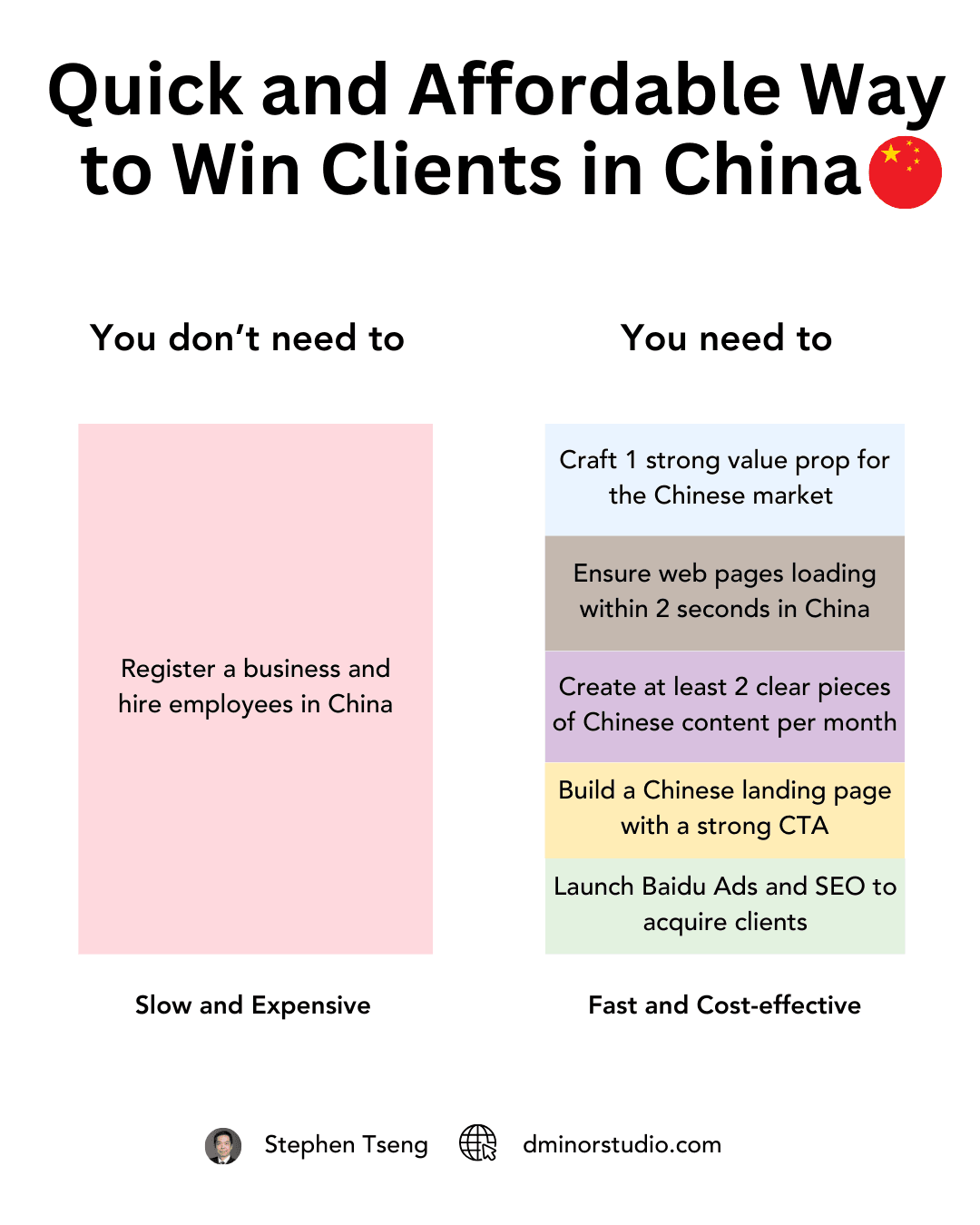
The "Old Way" is slow, expensive, and rigid. It assumes you know exactly what the market wants before you talk to a single buyer.
The "Smart Way" is fast, affordable, and flexible. It assumes you need to learn.
Why lock yourself into fixed costs before you have revenue?
- Old Way: Hire staff, rent office, wait for license
- Smart Way: Build a landing page, run ads, get leads
- Result: Smart Way yields ROI months faster
I've seen it play out dozens of times.
The companies that win are those that test assumptions quickly, learn from real buyer behavior, and adjust before scaling operations.
How to Build a High-Converting Chinese B2B Website
Treat your digital presence as your country manager.
It works 24/7, never sleeps, and talks to thousands of prospects at once.
But it has to be trained well (localized) and healthy (fast loading).
If your website fails, your strategy fails.
- It must load within 2 seconds in China
- It must use native industry terminology
- It must have a clear path to conversion
This isn't about translation. It's about localization.
Your value proposition needs to resonate with how Chinese buyers think, search, and evaluate vendors. A properly optimized B2B website for the Chinese market creates immediate trust and positions your brand as a credible solution provider.
90-Day Digital Market Entry Action Plan
Forget the 5-year plan.
What can you do in the next 90 days?
- Shift your budget from administration to experimentation
- Prove the model works
- Then scale up the operations.
Here is your lean launch pad:
- Launch a targeted Baidu SEO & PPC campaign
- Publish consistent, high-value Chinese articles
- Measure leads, not just traffic
Here is your lean process:
- Start with one strong value proposition
- Build one high-converting landing page
- Run one targeted Baidu advertising campaign
- Get feedback from real buyers
Then iterate.
Validate digitally. Scale physically.
Why wait a year to learn if they want your product?
Find out next month.
About The Author

Stephen Tseng
Co-founder of dminorstudio. regularly writes about the intersection of AI, SEO, and B2B growth strategy.
FAQ
How much does it cost to start B2B digital marketing in China?
You can start with a budget between $10,000 and $20,000 for a 90-day pilot campaign. This covers website localization, Baidu SEO setup, and targeted PPC ads. This is far less expensive than traditional market entry costs like entity registration, office leases, and hiring staff, which typically exceed $100,000 in the first year.
How long does it take to get leads from Baidu marketing?
Baidu PPC campaigns can generate qualified leads within 2 to 4 weeks once your landing page is live and ads are approved. SEO takes longer, typically showing measurable traffic growth within 3 to 6 months. The key is starting with PPC for immediate results while building your SEO foundation for long-term growth.
Can I sell to Chinese companies without a local business entity?
Yes. Many B2B companies successfully generate leads and close deals in China without registering a local entity. You can operate through digital channels, work with distributors, or use export contracts. Once you validate demand and build a client base, you can decide whether registering an entity makes financial sense.
What makes a website credible to Chinese B2B buyers?
Chinese buyers trust websites that load quickly (under 2 seconds), use professional native language (not machine translation), display industry certifications, and provide educational content. They also look for clear contact methods like WeChat QR codes, local phone numbers, and detailed company information. Generic corporate language or slow-loading sites immediately hurt credibility.
Should I use Google Ads or Baidu PPC for the Chinese market?
Baidu PPC is the better choice for reaching Chinese B2B buyers. Google has limited access in China, while Baidu dominates with over 70% search market share. Chinese decision-makers search for solutions on Baidu, not Google. Running Google Ads for China is like advertising on a billboard in an empty desert.
How do I localize my B2B content for Chinese audiences?
Localization goes beyond translation. You need to adapt your messaging to match how Chinese buyers think, search, and evaluate vendors. Use industry-specific terminology, reference local case studies, address China-specific pain points, and format content for mobile-first consumption. Work with native marketing professionals who understand both B2B buying behavior and cultural context.
What digital channels work best for B2B lead generation in China?
Baidu SEO and PPC are the foundation for B2B lead generation in China. WeChat is critical for relationship building and lead nurturing. LinkedIn still works for reaching international teams within Chinese companies. Industry forums, trade platforms like Alibaba, and targeted content marketing round out an effective channel mix. Start with Baidu and WeChat, then expand based on results.