
Why "go all-in on China" is the fastest way to lose money in China
Six months. Half a million dollars. Zero customers.
That's the pattern I keep seeing.
A Western B2B company decides to enter China. Someone on the leadership team says "let's do this right." So they commission a Chinese website with ICP filing. They build out a WeChat ecosystem. They hire a local marketing lead. They budget for compliance, legal, trademark registration.
Add it up and you're at US$150,000 to US$450,000 for the first year, sometimes higher. Serious programs with a WeChat-led content strategy run US$300,000 to US$1.5 million a year. A full WFOE entity, if that's part of the plan, needs 4 to 8 weeks to register and 4 to 8 months to become fully operational.
All of that, before a single Chinese buyer has clicked an ad, filled out a form, or told you whether your product solves a problem anyone in China actually has.
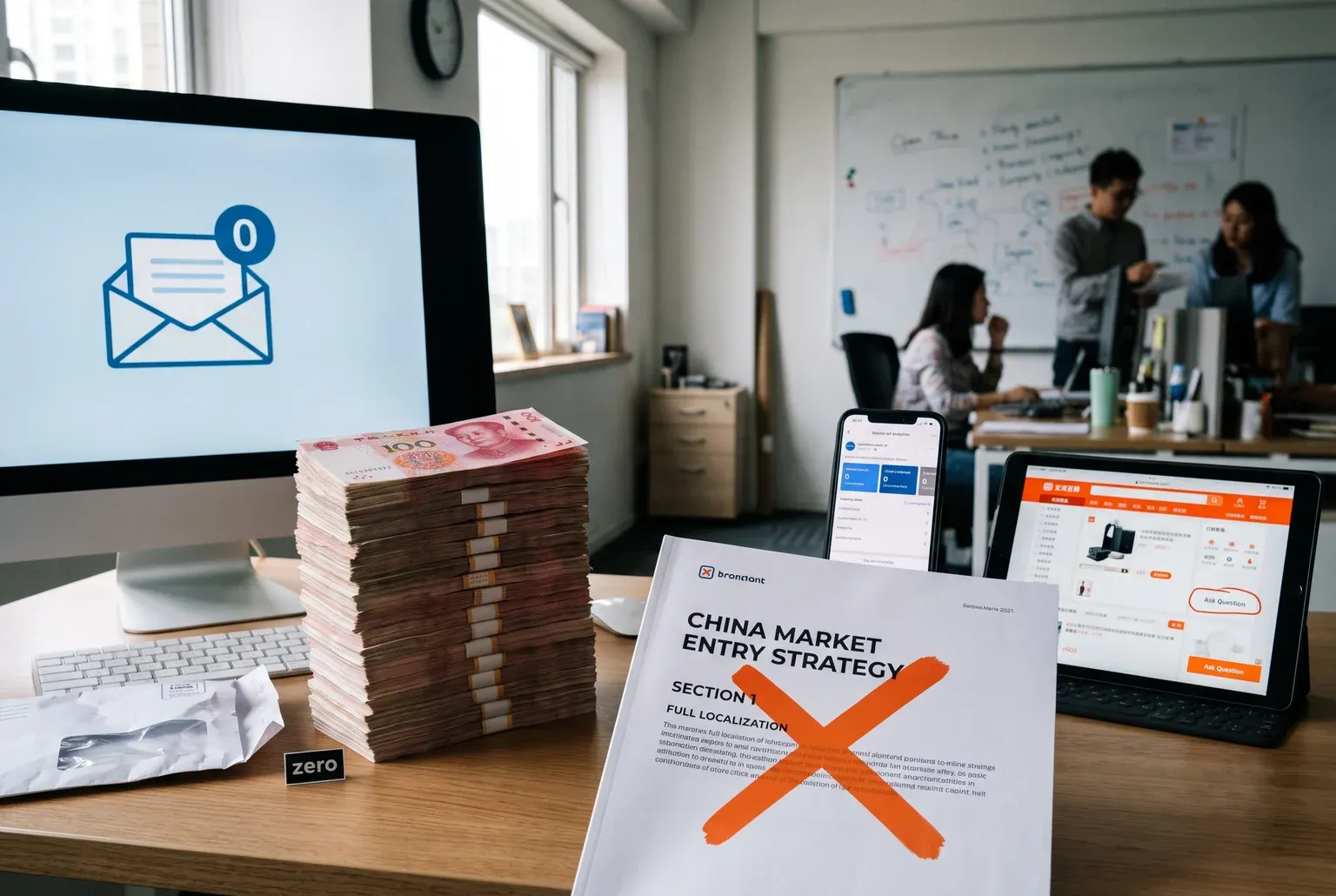
This is the trap. Full localization treats market entry like a construction project: build the whole thing, then open the doors. But demand validation and infrastructure building are two different jobs, and doing the second one first means you're gambling six figures on a guess.
And no, Google won't save you from this decision. Google holds roughly 2% of search share in mainland China. Whatever campaign muscle memory your marketing team has from the US or Europe doesn't transfer here. The market runs on different rails entirely.
There's a cheaper way to find out if China wants what you're selling. It starts with paid search, and it can start for a few thousand dollars, not a few hundred thousand.
Where Do Chinese B2B Buyers Actually Search?
Baidu is not one option among several. It's the platform your test budget should default to first.
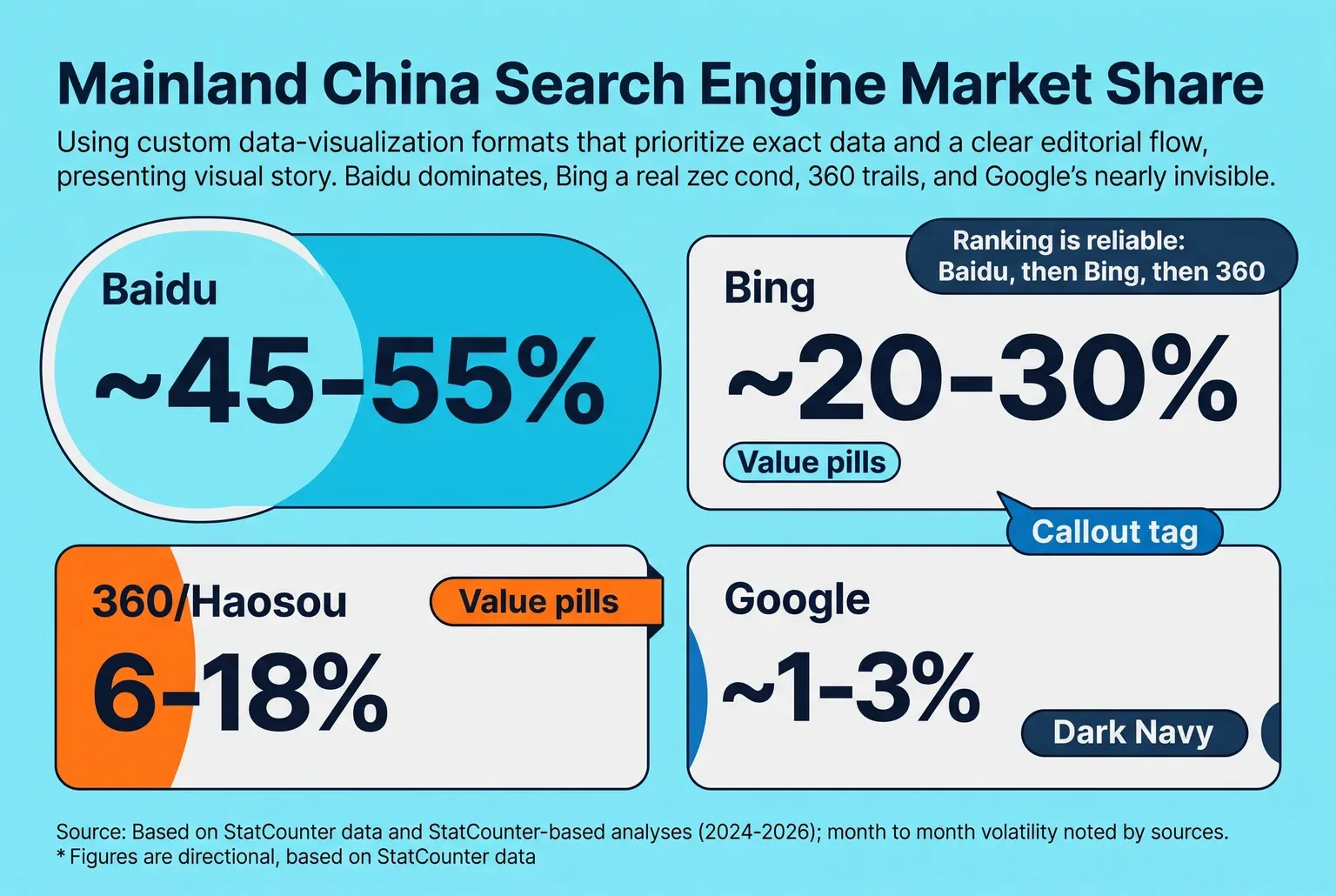
StatCounter's mainland China data puts Baidu at roughly 45-55% of search share, with a November 2024 snapshot at 54.36%. Bing sits second, typically 20-30%, with the same snapshot showing 30.29%. That number surprises people who assume Bing is irrelevant globally. It isn't irrelevant in China, largely because it's accessible without a VPN and ships as the default on many enterprise Windows machines. Third is 360 (also called Haosou), swinging anywhere from 6% to 18% depending on the month. Google, as established, holds under 3%.
Worth a caveat here: these figures all trace back to StatCounter or analyses built on top of it, and several analysts have flagged that StatCounter may misweight traffic for China specifically, given how differently browser and device tracking behaves behind the Great Firewall. Treat the ranking (Baidu, then Bing, then 360) as reliable. Treat exact percentages as directionally right, not gospel.
The mechanics matter as much as the share numbers. Baidu's ad system, called Phoenix Nest (凤巢), runs through e.baidu.com as a keyword-level pay-per-click auction. Ad rank isn't decided by bid alone. It's bid multiplied by a quality score, similar in spirit to Google's Quality Score but with its own weighting. Pricing follows a generalized second-price model: you set a maximum CPC, but you're typically charged close to the minimum needed to hold your position, not your full bid.
Phoenix Nest also supports exact, phrase, and broad keyword matching, negative keywords, minimum bid floors, and quality-based ad disabling, meaning a low-quality ad can simply stop serving regardless of budget. It extends to mobile with the same bid-times-quality logic adapted for smaller ad formats.
For a Western B2B company running a first test, the takeaway is direct: put the majority of budget on Baidu, treat Bing as a real secondary channel worth testing early rather than later, and keep 360 on the radar for phase two once you have data showing where your actual buyers search.
Why You Can't Just Log Into Baidu And Buy Ads
You cannot just log in and buy ads. That's the part almost nobody researching Baidu figures out until they hit the wall.
Baidu Ads runs through two access paths, and both have gates a US or European B2B company usually can't clear alone.
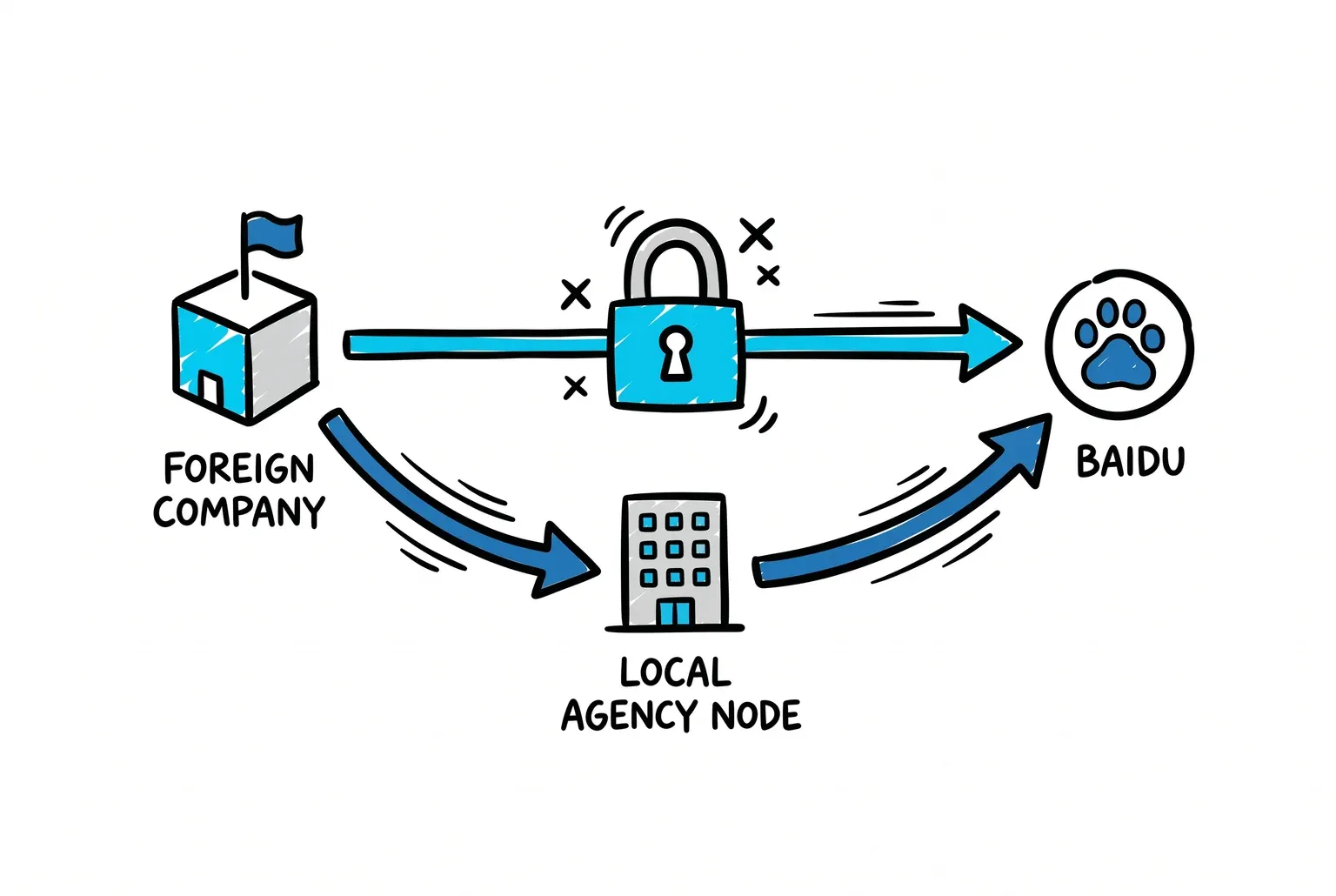
Path one: your company has a registered China business license and an ICP-filed website hosted on the mainland. If you have that, you can, in theory, open an account directly. Most Western B2B companies testing demand don't have this, and shouldn't build it before they know China is worth the investment.
Path two: the one that matters for this guide: companies without a China entity or ICP filing can still run Baidu Ads. They need to go through Baidu's review process to open an account. Normally, it requires more documents and the process is more complicated than Path one.
The agency isn't a nice-to-have here. It's the mechanism that makes path two possible and easier. The agency handles work you can't do from outside China. It screens your industry for restrictions, since finance, healthcare, education, and supplements face extra permit requirements before Baidu will even review an application. It collects your business documents, arranges certified Chinese translation, and submits the qualification review inside Baidu's account system.
Reported costs cluster around an initial deposit of ¥5,000 to ¥7,000, a one-off setup fee near ¥1,200 or US$300 to 500, and ongoing management fees of 10 to 15% of ad spend. Approval typically takes 5 to 10 business days, assuming your documents clear review the first time. The agency stays your liaison after launch too, handling suspensions and policy questions Baidu won't discuss with a non-Chinese entity directly.
How to Run a Baidu Ads Pilot: Four Phases and One Decision Gate
Once your agency relationship is set up, the actual test doesn't need to be complicated. It needs to be sequenced.
Phase 0: Setup, weeks 0 to 2
Input: business documents, industry qualification review, agency onboarding, initial deposit → Output: live Baidu account, a minimum viable landing page in Chinese, tracking in place Baidu Marketing Partners lists the minimum initial deposit at ¥2,400, with a typical testing budget of ¥100 to 300 a day. That's the whole entry price for a real signal from the market. Compare that to the six or seven figure WeChat-led programs from earlier in this guide.
Phase 1: Pilot and demand validation, weeks 2 to 8 or 12
Input: ¥100 to 300/day spend, a narrow keyword set tied to your core offer, one or two landing page variants → Output: impression volume, click data, and initial inbound inquiries Search impression and inquiry data typically becomes usable within 4 to 8 weeks of launch. If your landing page is in Mandarin rather than a translated English page, expect inquiries to show up more reliably in the 8 to 12 week range. Lead costs generally stabilize somewhere in that same 4 to 8 week window, giving you a real cost-per-lead number instead of a guess.
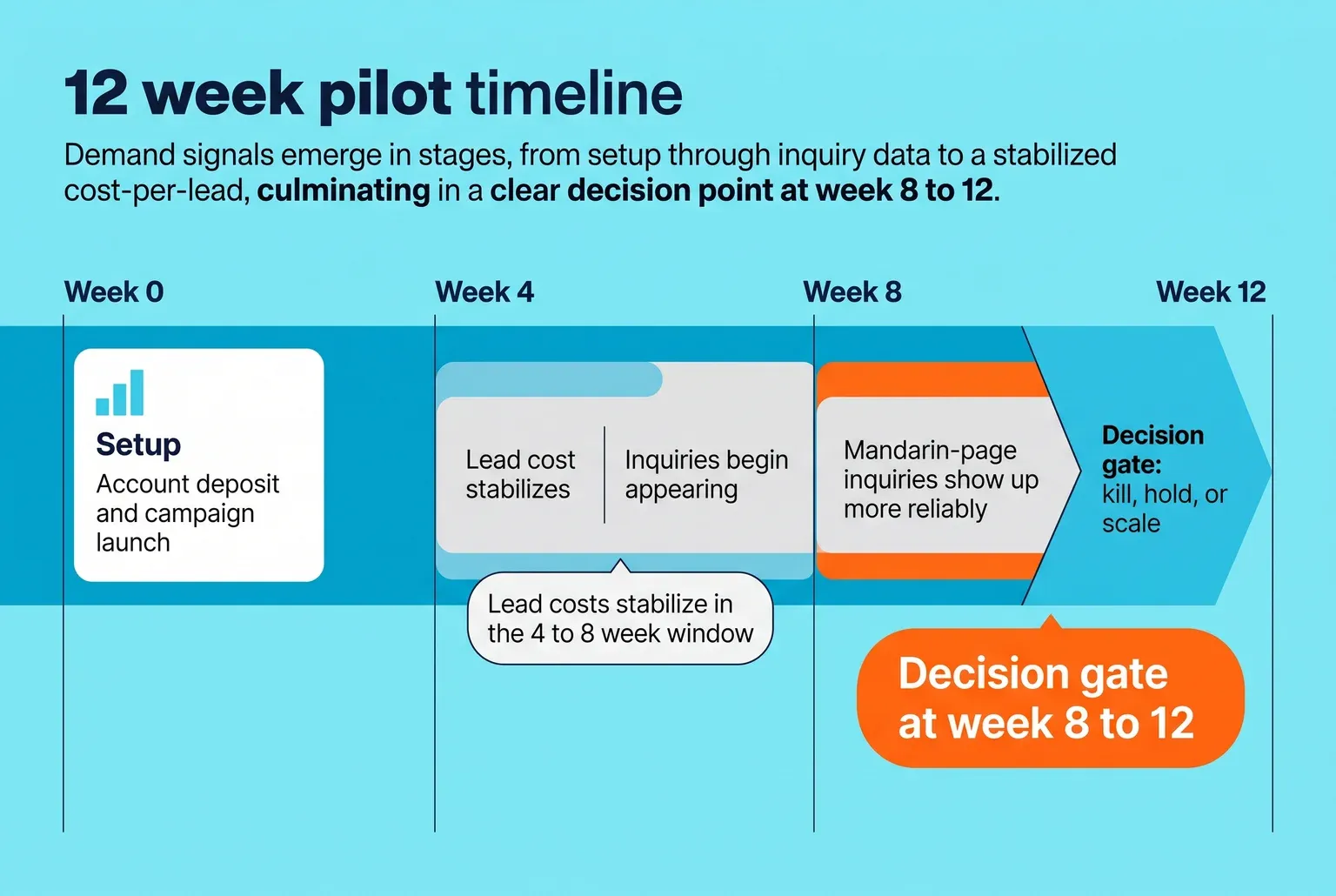
Decision gate: week 8 to 12
This is where you look at the numbers and make one of three calls: kill it, hold at current spend and keep learning, or scale. Not a all-in commitment either way. A budget adjustment based on what the first two months actually showed you.
Phase 2: Scale and channel expansion, months 3 to 6
Input: validated keyword set, stabilized lead cost, confirmed inbound demand pattern → Output: increased Baidu budget, secondary platforms (Bing, 360/Haosou) added, WeChat or Zhihu tested for complementary reach Refine Labs frames this kind of staged rollout around a 4 to 6 week pilot that identifies high-intent segments before budget increases. In the China context, that timeline stretches to match Baidu's slower feedback loop, but the logic holds: expand only after the pilot data tells you where the intent actually is.
Phase 3: Pipeline and ROI validation, months 6 to 18
Input: sustained multi-platform spend, sales team follow-up on inbound leads → Output: qualified deals, revenue attribution, a real case for full localization Industrial, agri-tech, and life sciences companies in China commonly see first qualified deals appear 6 to 18 months after first contact. Paid search gets you the contact fast and cheap. The sales cycle still takes as long as it takes.
Why Chinese Keywords Don't Translate — They Need to Be Rebuilt
Running the pilot on a translated version of your English keyword list is one of the fastest ways to waste that ¥100 to 300 a day.
Chinese text has no spaces between words, so before Baidu's system can match a query to your ad, it has to segment the string into meaningful chunks. That's not your problem to solve directly, but it explains why Chinese search behaves differently from English search at every level, including which "keyword" even means. Search engines built for Chinese index at multiple levels at once, characters, two-character pairs, and full words, because single-token matching performs worse than multi-granularity indexing for this kind of text.
For your keyword list, that means one English term rarely maps to one Chinese phrase. Practitioners working in Baidu SEM regularly report 3 to 20 plausible Chinese translations for a single English industrial or technical term, and picking the wrong one means invisible impressions even with money in the account.
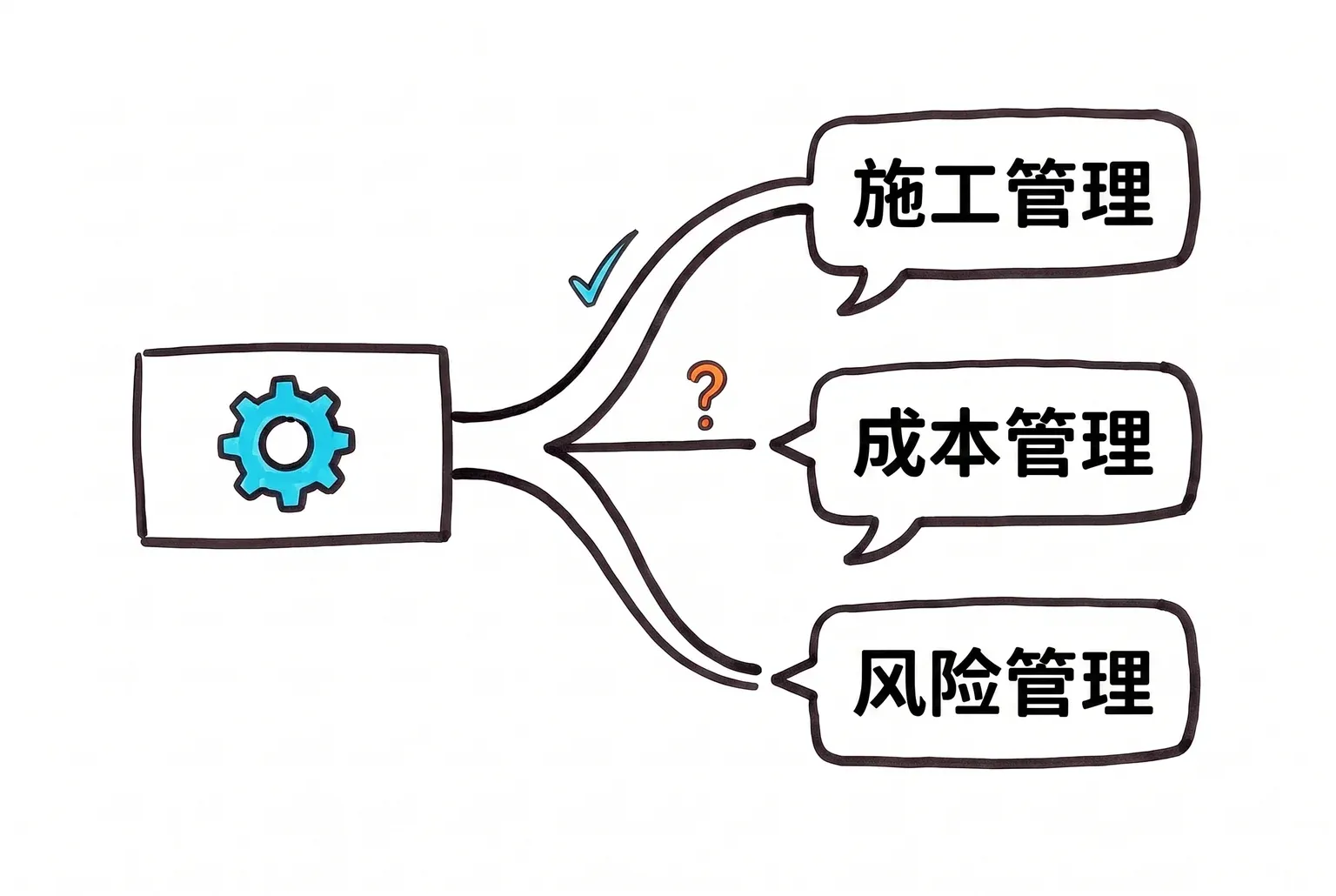
A workable process for the pilot phase:
- Start from native Chinese terms your agency sources, not translated English ones.
- Pull Baidu's autocomplete and related-search data to validate real query patterns, since Chinese queries run ~3.38 characters on average but pack in more meaning per character than English queries do.
- Include bigrams, common collocations, and pinyin or mixed-script variants, since users often type romanized input before an IME converts it.
- Group by intent cluster rather than exact-match lists. Baidu users tend to write conversational, multi-part queries rather than the clipped fragments common in Google searches.
Your landing page doesn't need a full localized site behind it. It needs Simplified Chinese copy written by someone who works in the language daily, mobile-first layout since most Baidu traffic is mobile, and a form or click-to-chat option that matches how Chinese buyers actually make first contact.
What Are the Key Metrics That Decide Your Next Move in China?
By week 8, your pilot has produced actual data. Now you have to read it honestly. Is a 4% CTR good or bad? Is one lead a week a signal or noise? You need thresholds going in, not vibes coming out.
Start with CTR on non-brand keywords. Baidu's B2B accounts commonly run 3 to 8% on generic industry terms and 5 to 12% on product-specific ones, with brand terms much higher. If your non-brand CTR is sitting in the mid-single digits, your keyword and ad copy match is working. Below that, your keyword localization probably needs another pass before you touch the budget slider.
Conversion rate is the number that should really move you. Western B2B search conversion typically runs 3 to 7%, sometimes lower. Baidu B2B campaigns in categories like industrial products and software are commonly reported at 8 to 18%. Hit 8 to 10% or better on your form fills or inquiries, and you're not looking at a fluke, you're looking at a market responding to your offer.
Then check cost per lead against segment norms: roughly ¥50-150 for manufacturing, ¥80-200 for SaaS, ¥100-300 for professional services. Land inside or below your segment's range and your economics work at scale, not just in a small test.
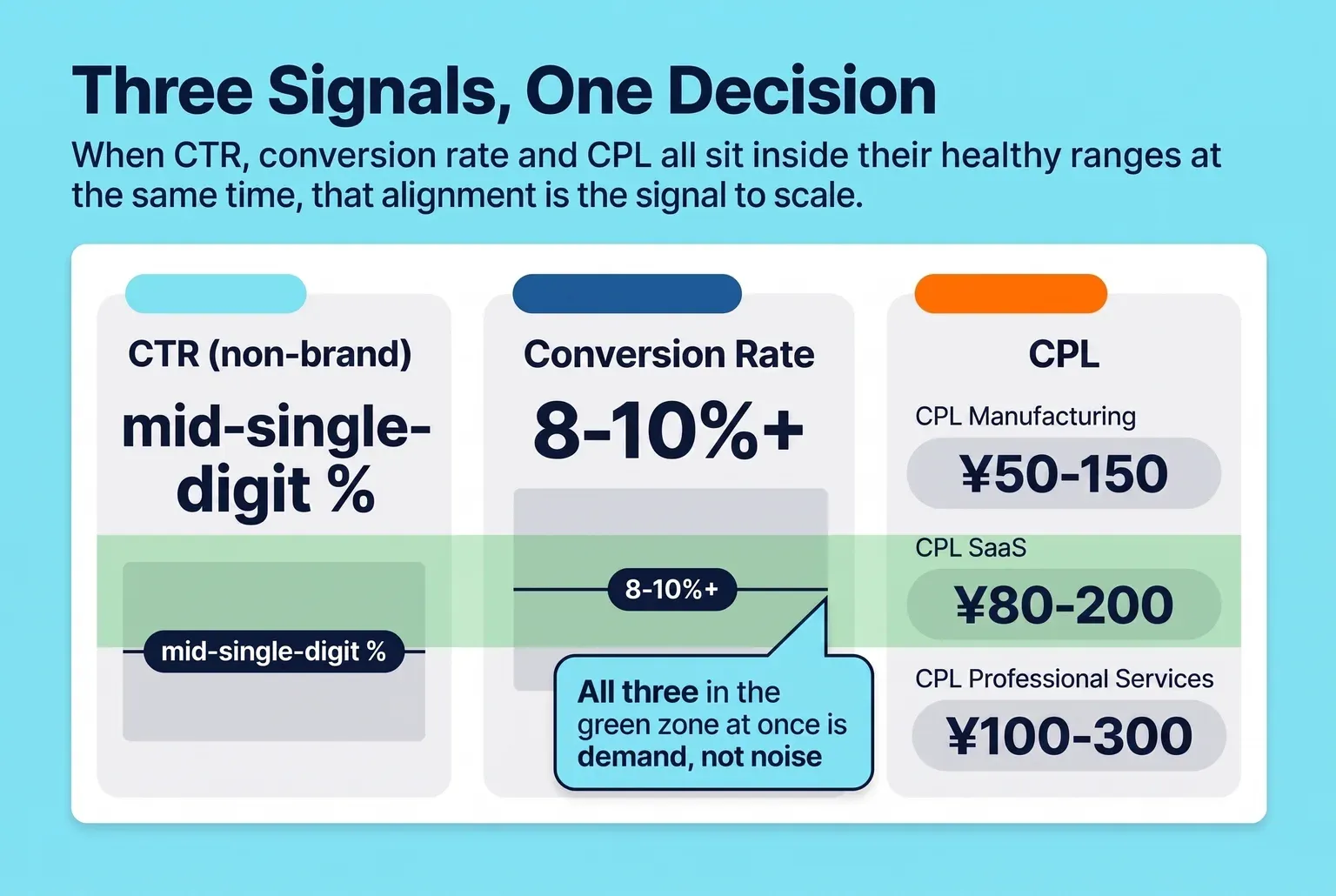
One good week isn't a trend. Wait for 4 to 8 weeks of stable numbers before deciding anything. If CTR, conversion, and CPL all clear their bars at the same time, that's not noise. That's demand, and it's the signal to add budget, add Bing or 360, or start building the WeChat presence that turns inquiries into relationships.
Test Cheap Before You Build Expensive
Here's the whole philosophy in one line: don't build a China strategy on a guess. Build it on a signal.
A Baidu pilot costs a fraction of a WeChat program, a fraction of a WFOE, a fraction of a hire. It gives you an answer in 8 to 12 weeks instead of a bet you carry for years. If the CTR, conversion rate, and CPL numbers clear their bars, you scale. If they don't, you've spent thousands, not hundreds of thousands, finding out.
Most companies skip this step. They localize everything first, launch big, and find out too late that the market didn't want what they built. Paid search flips that order. Demand first, investment second.
So ask yourself: do you actually know if Chinese buyers want what you're selling, or are you assuming they do because it worked in Germany or Ohio?
Run the pilot. Read the numbers. Let the market tell you before you tell your board.
What a Small Baidu Pilot Actually Buys You
Every company that's burned six figures in China started the same way: convinced they already knew the answer. They didn't need to test. They knew their buyers, knew their product, knew the market would respond the way it did in the US or Germany. Most of them were wrong, and they found out after the invoices for the WFOE, the WeChat program, and the localized site were already paid.
A Baidu pilot, run with a local agent, gives you the answer before the invoices arrive. You spend thousands, not hundreds of thousands. You get real CTR, conversion, and CPL numbers from real Chinese buyers clicking on real ads, not a consultant's forecast or a competitor's case study. Add Bing and 360/Haosou once Baidu proves out, and you've triangulated demand across roughly 85% of mainland search traffic without touching a full localization budget.
That's the entire case for paid search as a market-entry tool. It's not a growth channel you bolt on after you've already committed. It's the cheapest, fastest instrument you have for finding out if China wants what you're selling before you bet your budget on the assumption that it does.

Western B2B companies don't fail in China because the market is unknowable. They fail because they skip the step that would have told them the truth early and cheaply. Paid search is that step. Run it before you build anything else. Want to see how this approach works in practice? Explore our Baidu SEO and PPC case studies to see how other B2B companies validated demand in China before committing to full localization.
Sources
- How to do B2B marketing in China — Otrenix (China B2B guide) — Otrenix
- China market entry (advisory) — Altios — Altios
- Search Engine Market Share in China — StatCounter — StatCounter Global Stats
- Search engine marketshare China — JadeMond
- Baidu Phoenix Nest (凤巢) — Baidu advertiser/product pages — Baidu
- Open Baidu Ads Without Chinese Business Licence — DDS Media Services (blog)
- Baidu Pay-Per-Click: How to Get Started with Advertising in China — Choose Oxygen (blog)
- How to Register Baidu PPC Paid Advertising Account Overseas — Soda Global (blog)
- How to Open a Baidu Account for Companies Overseas — Steps — The Digital Tea House (blog)
- FAQ — International Brands (Baidu Marketing Partners) — Baidu Marketing Partners
- China marketing budget planning for B2B companies (based in Europe) — NextportChina
- Paid Search Playbook — Refine Labs
- Chinese IR / segmentation research (CiteseerX PDF) — CiteSeerX
- Keyword research for Baidu — SEO tips (agency blog) — ecinnovations.com
- Character usage in search queries (paper) — The University of Hong Kong (paper)
About The Author

Stephen Tseng
Co-founder of dminorstudio. regularly writes about the intersection of AI, SEO, and B2B growth strategy.
FAQ
Can a foreign B2B company run a Baidu Ads pilot without a China entity?
Yes. A foreign company can usually pursue Baidu Ads through a local agency, subject to Baidu’s account review and industry-specific documentation requirements. This lets a company test Chinese search demand before committing to a mainland entity, an ICP-filed website, or a full localization program.
How much should a B2B company spend to test demand in China?
Start with a tightly scoped Baidu pilot: one offer, a small native-Chinese keyword set, one or two Mandarin landing pages, and a defined test window. The purpose is not immediate scale. It is to establish impression volume, click-through rate, inquiry quality, and cost per lead before expanding investment.
How long should a Baidu Ads demand-validation pilot run?
Run the pilot long enough to distinguish a trend from short-term variance. This article uses an 8-to-12-week decision gate because the first weeks establish account delivery and query relevance, while later weeks provide more stable CTR, conversion, and CPL data for a scale, hold, or stop decision.
Should a company build WeChat before testing Baidu Ads?
No. Test search demand first when the central question is whether Chinese buyers actively seek your offer. Build WeChat, a full Chinese website, local hiring, and entity infrastructure after paid-search data shows repeatable demand and economics that justify a larger China-market commitment.
What CTR and conversion benchmarks should B2B companies expect from Baidu Ads?
For non-brand keywords, Baidu B2B accounts typically see CTRs of 3 to 8% on generic industry terms and 5 to 12% on product-specific terms. Conversion rates for B2B categories like industrial products and software are commonly reported at 8 to 18%, which is higher than typical Western B2B search benchmarks of 3 to 7%.
What industries face extra restrictions when setting up Baidu Ads?
Finance, healthcare, education, and dietary supplements face additional permit requirements before Baidu will review an advertising application. A qualified local agency can screen your industry and prepare the right documentation upfront, reducing the chance of delays or rejections during the account approval process.
How does a Baidu Ads pilot compare to a full China market entry in terms of cost and time?
A Baidu pilot can start for a few thousand dollars and produce usable demand data in 8 to 12 weeks. A full China market entry, including a localized website, WeChat ecosystem, local hire, and entity setup, can cost US$150,000 to US$1.5 million in the first year and take months before generating any buyer signal. The pilot gives you that signal first, at a fraction of the cost.