
What a Baidu Ads Pilot Can and Cannot Tell You
A Baidu Ads pilot can test observable search behavior. It cannot validate your whole China market-entry plan. Keep that line clear before you spend a yuan.
Baidu Ads, known in Chinese as 搜索推广 (search promotion), is Baidu's keyword-triggered, bid-based paid-search product. When someone searches a relevant query, your ad becomes eligible to appear in prominent result positions, marked with a 广告 (ad) label to separate paid slots from organic listings. Ranking depends on your bid and quality-related factors, and standard text ads can be extended with image, brand, and lead-form styles.
If you have run Google Ads, the mental model transfers at a conceptual level. Search intent, an auction, keywords, ad creative, landing pages, and conversion tracking all exist here. The operational details, interface, and rules differ, so treat the similarity as a starting frame, not a shortcut.
Baidu remains the leading general search engine in mainland China by estimated usage, especially on mobile. Third-party trackers put its all-device share around 50.83% in July 2026, with an October 2025 device split of 77.06% on mobile and 36.22% on desktop. These estimates move over time and vary by methodology, so read them as directional signals, not fixed facts.
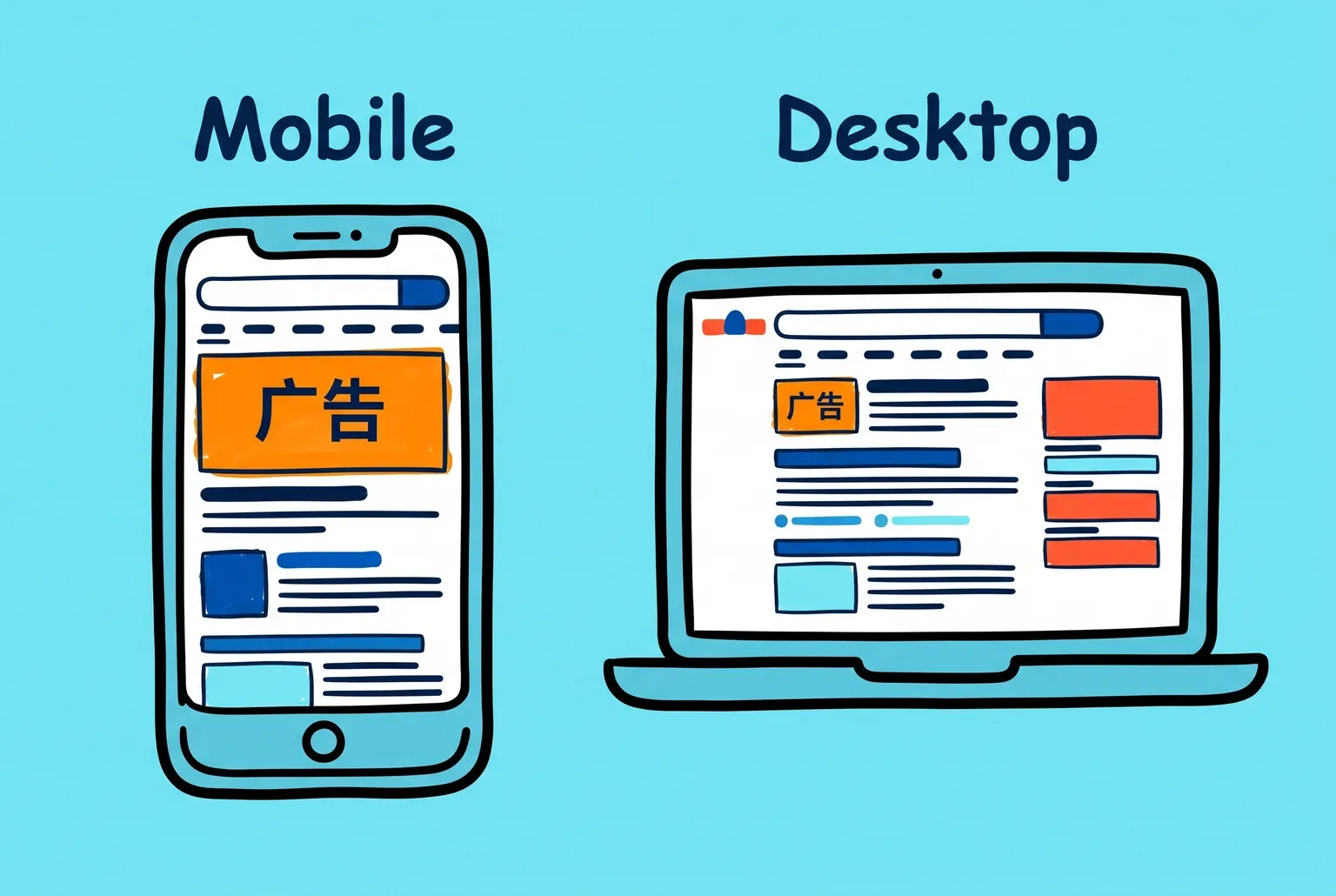
A pilot can reveal three things: whether Chinese buyers are searching for what you sell, which messages earn clicks, and whether prospects take a first conversion action. It cannot establish sales viability, distribution readiness, regulatory feasibility, pricing acceptance, or long-term product-market fit. Those need separate proof.
Are You Ready to Run a Baidu Ads Pilot?
Before you touch a bidding interface, run through a quick readiness check. You are ready to consider a pilot when you can answer yes to most of these:
- A defined Chinese customer profile, not just "China" as a region
- A plausible use case where mainland buyers would search for what you sell
- Internal sales follow-up that can act on an inbound inquiry
- A Chinese-language response path, whether a bilingual rep, distributor, or partner
- An approved test budget you are prepared to lose
- Awareness that your sector may face restrictions, since Baidu classifies certain industries as forbidden for search promotion and treats its sector rules as subject to adjustment
If several of those are shaky, fix them before spending.
How Do Western Companies Actually Open a Baidu Ads Account?
Overseas companies usually reach Baidu Ads through one of three routes: a direct inquiry where Baidu offers it, a Baidu-authorized reseller, or a China-focused agency that manages campaigns for you. For firms without a China legal entity, the official path runs through authorized overseas agencies or resellers, and a Chinese domestic business license is not required to start, because the reseller handles the process. Baidu-authorized Hong Kong partners run a dedicated opening process for exactly this situation.
Keep three things separate in your head. The advertising account is what runs campaigns. The entity used for verification is your registered company, confirmed through corporate documents and bank-based identity checks rather than industry qualifications. The partner managing campaigns is a third party who may hold or co-manage that account. Confusing them is how companies lose control later.

Local expertise earns its fee on the unglamorous work: interpreting current requirements, preparing and translating documents, talking to platform representatives, handling payment in RMB, reviewing your Chinese ad copy, watching for compliance issues, and resolving disapprovals when they hit. Baidu requires true and valid materials such as business license and bank account certificates, often with Simplified Chinese translations and a company stamp.
When choosing a partner, get clear answers on account ownership, fee transparency, your data access, how they translate and source Chinese keywords, reporting cadence, and exit terms if you leave. Ask for a first-party authorization statement from Baidu to confirm reseller status.
Requirements, timing, deposits, and commercial terms change. Date-stamp every specific number a partner quotes you and verify it against current Baidu guidance before you commit.
Why Keyword Research for Baidu Is Market Research, Not Translation
Handing your English keyword list to a translator produces grammatically correct Chinese that Chinese buyers rarely type. A dosing pump exporter might translate "wastewater dosing pump supplier" literally and get a phrase no procurement engineer searches. The buyer is actually typing something like "污水处理用加药泵厂家," where 厂家 signals they want a manufacturer, not a reseller or a definition. That word choice carries buying intent, and a technically accurate translation drops it entirely. Chinese industrial buyers routinely append 厂家 to product queries and search suppliers in combination with an application or qualification, such as "食品级不锈钢管供应商."
Start with the problem, not the product name. List the business problems your product solves and the use cases where a mainland buyer would go looking. Then collect the words real buyers use from sources you can actually read or have someone read for you: Chinese competitor and distributor websites, trade publications, national or industry standards, procurement forums, and your own China-facing sales or support staff. Those teams hear the live vocabulary.
Once you have a seed list, expand it inside Baidu's Keyword Planner, which needs a commercial advertising account and login to the Baidu Ads backend. Enter your seed terms to pull search trends, competition data, and related keywords, and filter by promotion region so you see demand for the provinces or cities you care about. Then have a native B2B specialist review intent, because raw volume tells you nothing about whether a term means what you think.
Group the survivors by theme and by buying stage. Separate informational searches (how something works), commercial and comparison searches, brand and competitor names, application-specific queries, specification searches (like 食品级不锈钢耐腐蚀标准), and supplier or manufacturer queries carrying 厂家, 供应商, or 批发. Procurement-stage terms such as 报价单 and 供应商对比 signal someone close to inquiry.
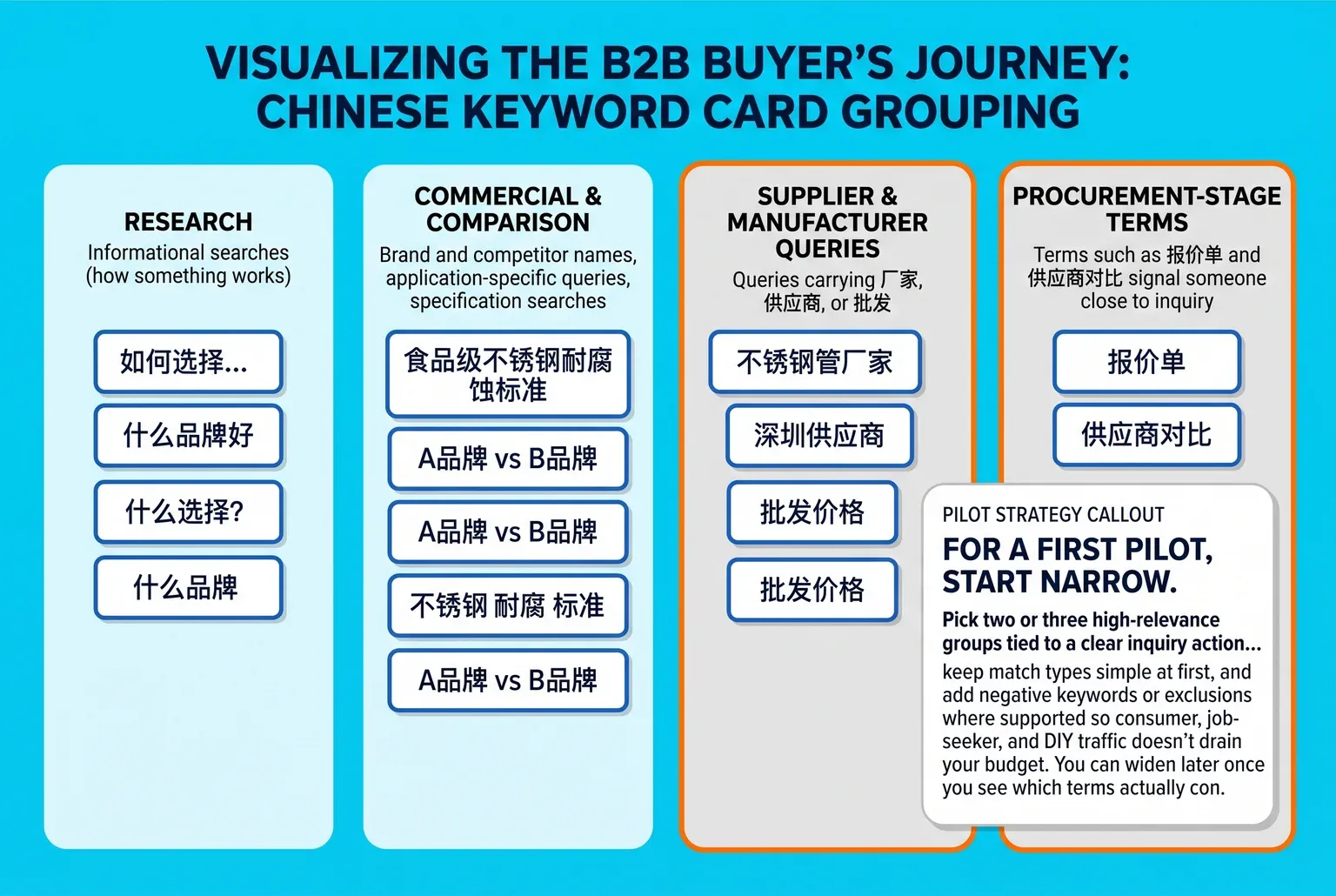
For a first pilot, start narrow. Pick two or three high-relevance groups tied to a clear inquiry action, keep match types simple at first, and add negative keywords or exclusions where supported so consumer, job-seeker, and DIY traffic doesn't drain your budget. You can widen later once you see which terms actually convert.
Build One Honest Chinese Landing Page, Not a Full China Website
A pilot needs one credible Chinese-language page, not a localized website. Localizing your entire site is a separate, larger project you can defer until the pilot tells you it's worth it.
The page has to carry natural Chinese copy written by someone fluent in your industry, a value proposition that matches how mainland buyers frame the problem, enough product or application detail to answer a procurement engineer's first question, some proof (certifications, named clients, specifications), clear company identity, one obvious call to action, basic privacy information, and a contact method your team can actually respond to. A WeChat contact or Chinese phone line nobody answers is worse than none.
Baidu also checks the page during review. Your ad claims, page content, and registered business scope need to line up, and the page must not present itself as an official website if the domain or entity doesn't match. Slow loading counts against you: Baidu's mobile guidance expects first-screen content within about one second, and overloaded floating windows commonly trigger quality flags. A page that loads fine from New York can crawl on a mainland mobile network, which distorts your results before you've learned anything.
For tracking, keep it simple: ad clicks, landing-page sessions, form starts and submissions, plus call or message actions if you use them. Baidu supports several data access methods including JS tracking, API upload, and call tracking, so pick one your developers can handle. Then record the offline outcome in your CRM, because a form fill is not a qualified lead.
Test every tag and form before launch. Confirm compliance and hosting or ICP requirements with local counsel first.
How to Set Up One Small Baidu Campaign You Can Actually Audit
Baidu accounts use a three-layer structure: campaign, ad unit, then keywords and creatives. A campaign holds budget, geography, and scheduling; a unit holds a tight cluster of related keywords and the ads that answer them. Keep your first build deliberately small.
Start with one audience and one offer. Pick a single product or application and the buyer you understand best. Set a limited geographic scope rather than all of mainland China, so your budget concentrates and your data stays readable. Then split into a few units by theme, for example brand terms, a core product line, and a problem-based cluster. Baidu's guidance allows up to 5,000 keywords and 50 creatives per unit, but for a pilot aim for roughly 15 to 30 keywords per unit and about four creatives.
Write the ads in native Chinese that matches the landing page. Do not translate your English copy line by line. Rebuild each ad around how Chinese buyers phrase the search, while keeping your facts and positioning accurate. Skip absolute claims like "best" or "number one"; China's Advertising Law treats superlatives as high-risk and they can trigger rejection.
Add negative keywords to block obvious mismatches, choose a simple manual bidding approach to stay in control, and set a daily budget cap you can afford to lose.
Run one preflight pass before you activate:
- Destination URLs load and point to the Chinese page
- Mobile rendering is clean on a mainland connection
- Form submissions arrive somewhere a person checks
- Tracking fires on clicks and form starts
- Phone number and business hours are correct
- Geographic settings, device priority, and budget cap match your plan
- Every creative has cleared review
Fix flagged items and resubmit rather than rewriting blindly.
How to Run the Baidu Pilot as a Bounded Experiment
Write your hypothesis in one sentence before you spend anything. Something like: procurement engineers at mid-size electronics manufacturers in Guangdong and Jiangsu actively search Baidu for our fiber connector line and will request a quote when they land on a credible Chinese page. That sentence tells you what to test and what would count as a wrong answer. A Baidu PPC pilot works as a controlled test of Chinese search demand before you commit to full localization, and keeping the scope narrow is what makes the result readable.
Test one offer, a handful of high-intent keyword themes, one or two regions, and a single conversion action such as an inquiry form or WeChat contact. Resist adding a second product or a third city partway through.
Run it in four phases:
- Preparation: finalize keywords, ad copy, the Chinese landing page, and tracking. Confirm someone can respond to inquiries in Chinese.
- Limited launch: activate with a low daily cap and watch daily, mainly to catch broken tracking or irrelevant traffic.
- Learning and refinement: prune wasteful terms, tighten negatives, adjust bids. Change one thing at a time so you can read cause and effect.
- Final evaluation: review against your hypothesis and decide.
Set controls in writing. Pick a total loss limit you can absorb without a second approval, a daily budget cap, and an approval checkpoint before any increase. Note that actual daily spend can exceed your set budget by 10 to 20 percent, with the overage refunded to your balance the next day, so leave a little headroom. Define stop conditions ahead of time: obviously irrelevant clicks or a tracking failure warrants pausing the same day, while low-volume B2B terms need several weeks of stable data before the numbers mean anything.
Keep a one-page pilot brief: audience, hypothesis, keyword themes, message, landing page, conversion action, budget boundary, review cadence, owner, and decision date. Put a name and a calendar date on that last line so the pilot ends with a decision instead of drifting.
This tests whether one message reaches one buyer segment through Baidu search. It does not measure the full size or economics of your China opportunity.
How Do You Read Three Layers of Baidu Pilot Data?
A pilot produces numbers at three depths, and each answers a different question.
Traffic quality comes first. Look at your actual search terms report, impressions, and click-through rate, which is clicks divided by impressions. The metric that matters most for a beginner is the irrelevant-query rate. If half your clicks come from students, job seekers, or unrelated industries, your keyword themes are too loose.
Conversion behavior comes second. Check landing-page engagement, conversion rate (conversions divided by clicks), and cost per inquiry. Before you trust any of it, confirm your tracking actually fires. Baidu marketing supports event-based tracking and configured conversion goals, but a mislabeled event will quietly poison every conclusion.
Business quality comes last, and it decides everything. Count valid companies, target roles, sales-accepted leads, real conversations, opportunities, and recurring objections. A Chinese-speaking specialist and your sales team have to review these by hand. Form fills are not validation.
Common patterns read like this:
- Clicks but no engagement: weak keyword relevance or a page that fails to load or convince.
- Engagement but no inquiries: your offer or your credibility is not landing.
- Inquiries but poor fit: targeting or qualification is off.
- Low volume overall: a narrow B2B category, not proof of zero demand.

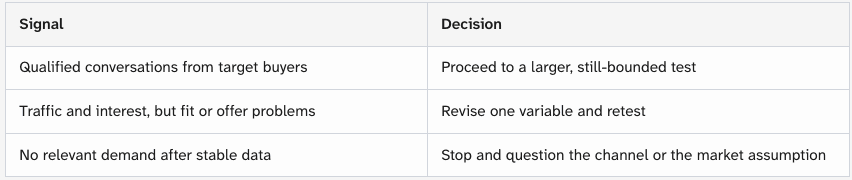
A positive pilot earns you the right to investigate further. It does not justify hiring, distribution, or full localization on its own.
Which of these three layers are you not tracking yet?
Common Baidu Ads Mistakes Western B2B Companies Make
The failures repeat:
- Translating Google keywords instead of rebuilding them in native Chinese
- Sending clicks to an English page instead of a Mandarin one
- Launching before Baidu Tongji is installed and tested
- Counting every form fill as a qualified lead instead of reviewing fit
- Trusting platform dashboards instead of checking your CRM
- Ignoring account ownership and partner fees until they surprise you
- Running with no loss limit
- Reading one short pilot as proof of product-market fit
Getting these basics right separates teams that learn something useful from teams that spend and walk away with nothing. For a deeper look at how Baidu PPC outperforms Google Ads for B2B in China, the channel difference matters before you set your first budget. And if you want to understand the broader paid search landscape in China, reviewing that context alongside your pilot setup will save you from avoidable surprises.
Your Step-by-Step Starting Sequence for a Baidu Pilot
Your starting sequence:
1. Define one narrow hypothesis
2. Check eligibility and access route
3. Research Chinese demand language
4. Build a compliant pilot page
5. Install and test tracking
6. Launch with budget and match controls
7. Review search terms and lead quality
8. Document the decision
9. Name the next evidence you need
Which assumption about Chinese demand do you most need to test first?
Sources
- 百度推广聚屏广告物料审核与开户资质要求!_百度推广 — Baidu
- 百度推广关键词规划师在哪里?怎么使用_百度营销 — 百度营销
- 百度移动搜索落地页白皮书5.0《节选》 - 腾讯云开发者社区-腾讯云 — Tencent Cloud
- 搜索oCPC前期准备工作+投放包搭建步骤|如何使用百度oCPC做推广?_百度广告推广 — 百度营销中心
- 账户搭建及优化全流程,投放必看!(附结构图)-百度营销学堂 — Baidu
- 市场监管总局关于发布《广告绝对化用语执法指南》的公告 — State Administration for Market Regulation (SAMR)
- Test Before You Localize: Baidu Ads as China Market Entry — dminorstudio
- 百度推广扣费规则解读_百度推广 — 百度
- 百度搜索推广最全术语解释!推广专业术语解释_百度营销 — 百度营销
- 百度-搜索推广-神策分析帮助中心| 数据分析使用手册 — Sensors Data
About The Author

Stephen Tseng
Co-founder of dminorstudio. regularly writes about the intersection of AI, SEO, and B2B growth strategy.
People usually ask...
Do Western companies need a Chinese business license to run Baidu Ads?
No. Overseas companies without a China legal entity can open a Baidu Ads account through a local agency. The reseller handles the verification process using your corporate documents, including business license copies and bank account certificates. A Chinese domestic business license is not required, but Baidu does require valid and true supporting materials, often with Simplified Chinese translations and a company stamp.
How much should a Western B2B company budget for a first Baidu Ads pilot?
There is no fixed number, but the right framing is: set a total loss limit you can absorb without seeking a second approval. A Baidu pilot is a paid experiment, not a revenue channel. Keep the daily cap low enough that you can run for several weeks without pressure to scale before you have clean data. Also note that actual daily spend can run 10 to 20 percent above your set cap, with the overage refunded to your balance the next day, so build in a small headroom buffer.
How long should a Baidu PPC pilot run before you can draw conclusions?
Narrow B2B keyword categories generate low traffic by nature. A few days of data tells you almost nothing. You typically need at lest 8-12 weeks of stable running to see a reliable pattern in search terms, click behavior, and inquiry quality. Set a calendar date for your final evaluation before you launch, so the pilot ends with a decision rather than drifting indefinitely.
What is the biggest difference between Baidu Ads and Google Ads for B2B?
The mental model transfers at a conceptual level: search intent, an auction, keywords, ad creative, landing pages, and conversion tracking all exist on both platforms. The operational differences are significant though. The interface, compliance rules, keyword research process, account opening requirements, and content standards are all different. Chinese industrial buyers use distinct vocabulary and buying-signal language that does not map cleanly to English translations. Building keywords from native Chinese search behavior, not from translated English terms, is one of the most important shifts to make.
Can a Baidu Ads pilot replace a full China market entry strategy?
No. A Baidu Ads pilot tests whether Chinese buyers are searching for what you sell, which messages earn clicks, and whether prospects take a first conversion action. It cannot establish sales viability, distribution readiness, regulatory feasibility, pricing acceptance, or long-term product-market fit. A positive pilot result earns you the right to investigate further. It does not justify hiring, building distribution, or launching a full localized site on its own.
What happens if Baidu rejects your ads or landing page?
Baidu reviews ad creatives, landing pages, and business scope for compliance before ads go live. Common rejection reasons include mismatches between ad claims and page content, absolute superlative language (like "best" or "number one"), pages that load too slowly on mobile, and materials that do not match the registered entity. When a rejection happens, check all three layers: your creative, your qualifications, and your landing page. Fix the flagged item and resubmit rather than rewriting blindly.
Which Chinese industries or sectors face Baidu Ads restrictions?
Baidu classifies certain industries as forbidden or restricted for search promotion, and those rules are subject to adjustment over time. Sectors commonly affected include financial services, medical and pharmaceutical products, legal services, and certain education categories. Before starting a pilot, confirm your industry's eligibility with a Baidu-authorized partner and verify the current rules directly, since this is one area where outdated information can cost you time and money.