
Ranking Is No Longer the Finish Line
A page can rank first in Google and still be invisible in an AI answer. When someone asks DeepSeek a question with search enabled, the assistant retrieves current web pages, writes an answer, and attaches source information, though how those sources display varies between the website and the mobile app. Your job shifts from "where does my page rank" to "does my content show up in the answer, and does the answer point back to me."
Two terms frame this work. DeepSeek SEO means improving your discoverability and visibility around DeepSeek-mediated search, so your pages can be found and pulled in at all. DeepSeek GEO (generative engine optimization) means improving the odds that your content is retrieved, understood, represented accurately, and cited inside a generated answer.
Separate two outcomes that people often blur together. A mention names your brand, product, person, or domain in the answer text. A citation visibly attributes supporting information to a source, usually as a numbered reference or link. DeepSeek's Smart Search mode, when enabled, inserts inline reference markers like [Reference 1] into responses. Either outcome can happen without the other. You can be named with no link, or your page can be cited without your brand ever appearing in the prose.
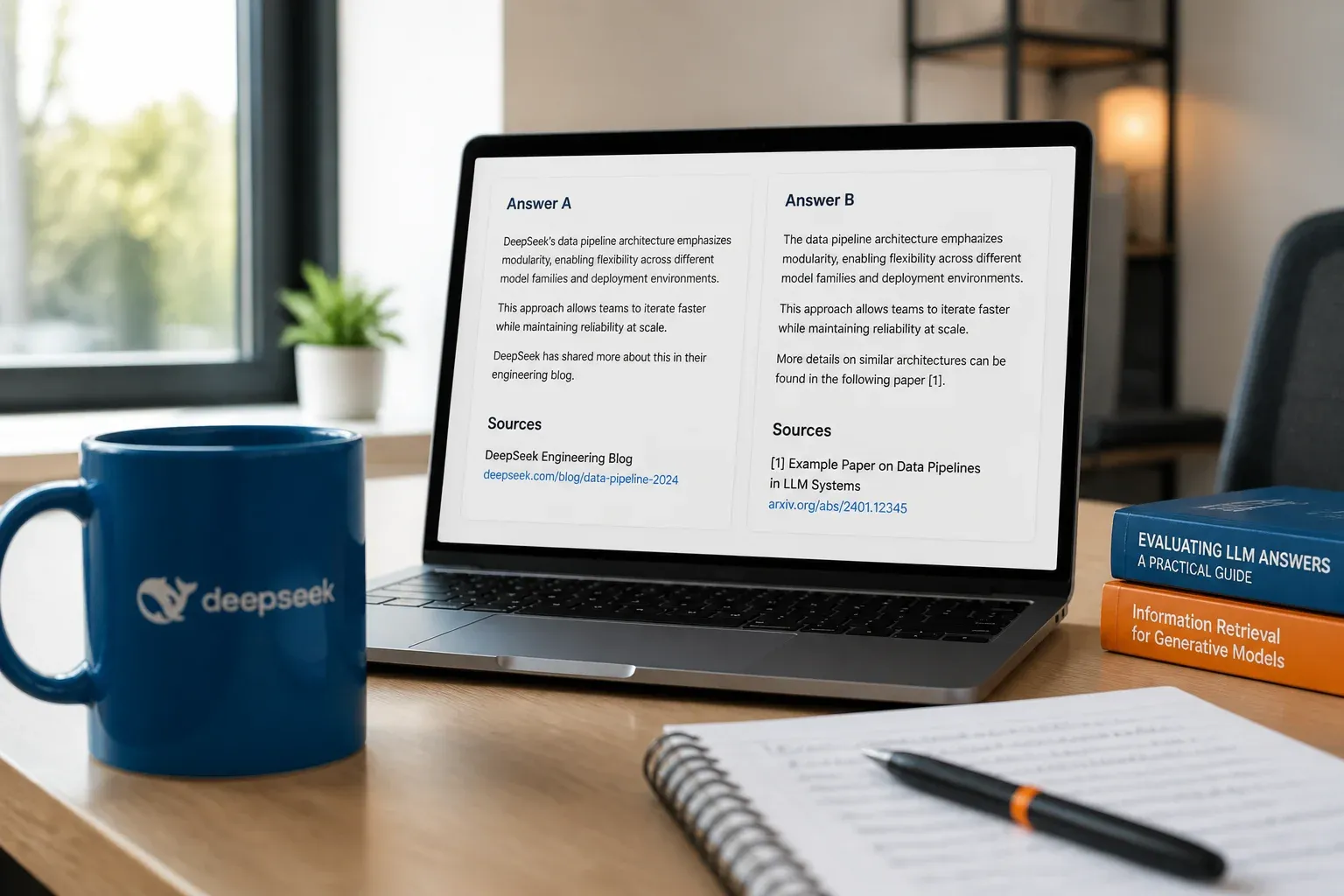
This guide gives you a repeatable loop: build a fixed query set, observe DeepSeek's answers repeatedly, log the sources it shows, look for patterns, make targeted changes, then retest against the same baseline.
Why You Cannot See the Machinery Behind DeepSeek Citations
You can measure what DeepSeek shows you. You cannot see the machinery behind it. Hold that distinction, because every conclusion in this guide depends on it.
DeepSeek's public materials do not document a source-ranking formula or a citation-selection algorithm. Its privacy policy describes network data collection like IP addresses, device identifiers, and cookies, but contains no mechanical description of how pages get crawled, indexed, or credited. The GEO Wiki entry reaches the same conclusion: no published index, no ranking formula, no rules for which retrieved page receives visible credit. Verify this yourself during research, since product behavior changes.
Keep model and API behavior separate from the consumer search product. Tool use and web access in the DeepSeek API appear in specific integration contexts like Claude Code rather than as a generic browse-the-web call. In the Anthropic compatibility layer, the citations field is labeled "Ignored". None of that describes what a person sees in the DeepSeek app with search enabled. Do not treat one as evidence for the other.
To keep claims honest, this guide tags every piece of evidence with one of four labels.
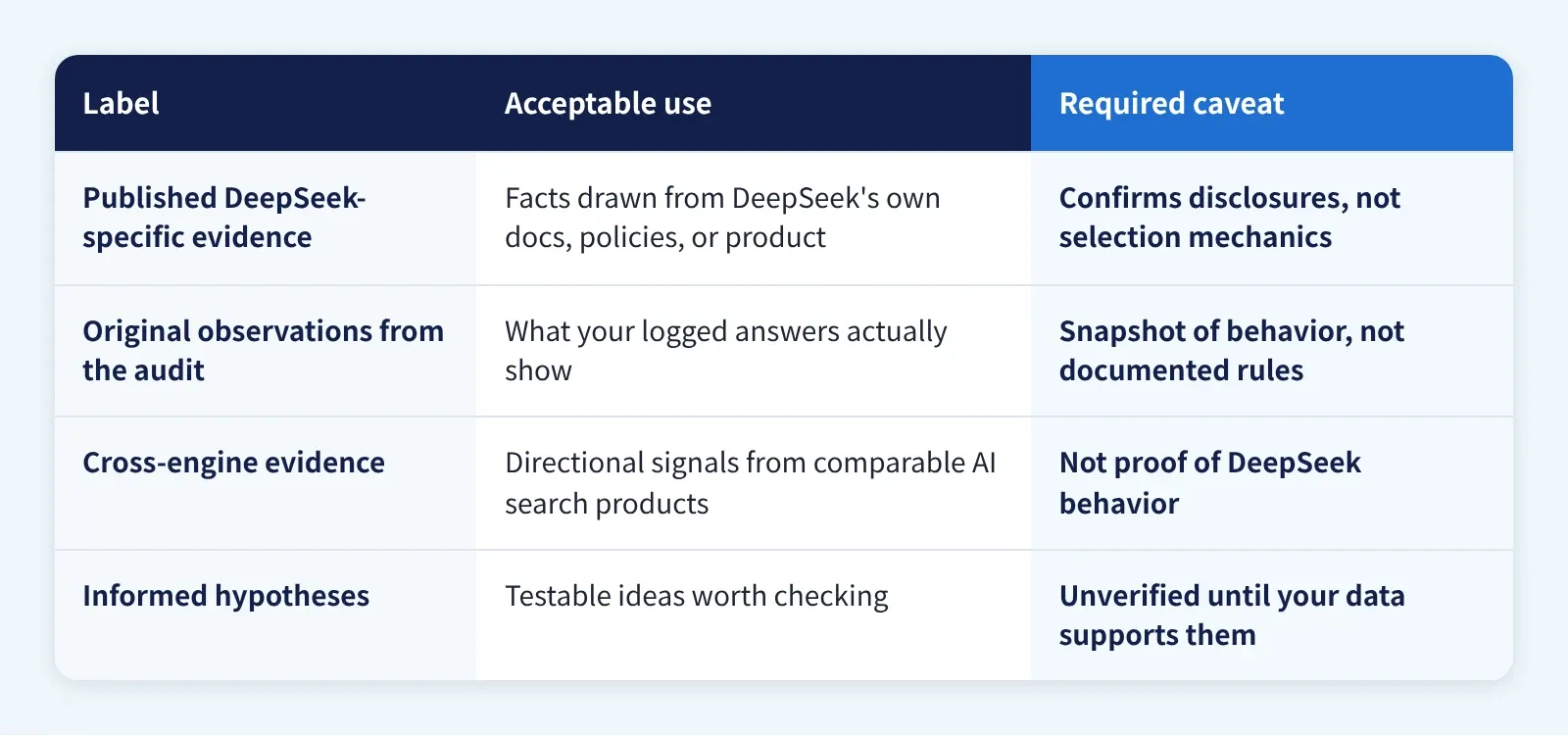
Third-party posts that assign specific weighting schemes to DeepSeek can generate hypotheses. They cannot stand as established facts. A measured citation rate is real data. Any story about why DeepSeek picked that source is a hypothesis until you test it. Correlation in your audit will not reveal the retrieval, reranking, or citation logic underneath, and treating it as proof is where most DeepSeek GEO advice goes wrong.
How to Build a DeepSeek Citation Audit That Actually Holds Up
One answer tells you almost nothing. Identical prompts can return materially different cited-source sets across runs, and one cross-engine study measured same-prompt source overlap between 23.9% and 88.7% depending on the product. Treat your audit as a repeated-observation panel from the start.
The only public DeepSeek-specific effort, a citation-accuracy audit, ran 48 English questions across 30 fresh chats with Search enabled, Instant mode on, and DeepThink off. It benchmarks accuracy, not commercial source selection, so borrow its controls (frozen prompts, claim-level scoring, URL validation) and supply your own query categories.
Run these seven steps.
- Define the decision the audit informs: brand visibility, category authority, product consideration, factual support, or competitor comparison. One decision per audit.
- Build a fixed query set covering informational, definitional, problem-aware, solution-aware, comparison, recommendation, branded, and verification prompts. Freeze exact wording in a version-controlled sheet.
- Record test conditions for every run: date and time, interface, search mode, language, geography, login state, device, and fresh-session status. Log them as context; don't assume they move citations until your data shows an association.
- Choose repetitions and disclose them. Run each query several times or across scheduled windows, then state your actual count. There's no published DeepSeek rule for this number, so don't invent one.
- Capture the full answer: response text, visible source labels, cited URLs, citation placement, and screenshots where permitted. Follow redirects and normalize URL variants while keeping the original.
- Log every source in one row per citation.
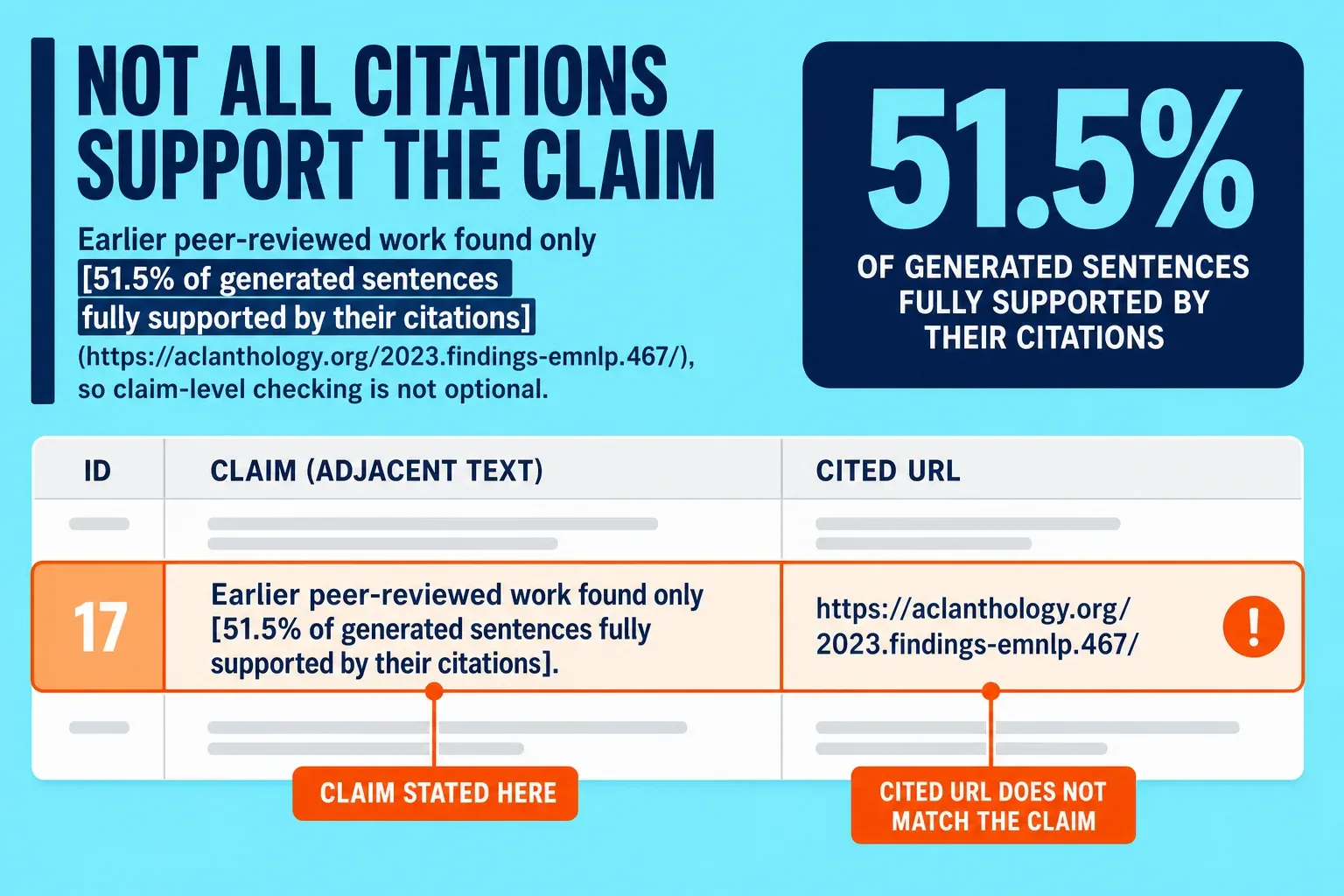
- Quality-check your coding. Write coding rules before analysis, then manually review ambiguous mentions, duplicate URLs, home-page citations, and citations that don't support the adjacent claim. Earlier peer-reviewed work found only 51.5% of generated sentences fully supported by their citations, so claim-level checking is not optional.
Five metrics turn the log into evidence:
→ Citation rate: eligible runs where your domain gets at least one visible citation ÷ total eligible runs.
→ Mention rate: runs naming your entity ÷ total eligible runs.
→ Source share: citations to a domain or source class ÷ all logged citations.
→ Query coverage: distinct queries where you appear ÷ all tracked queries.
→ Citation context: a coded field for the claim, framing, answer section, and whether the citation supports the nearby statement.
A minimal log looks like this:
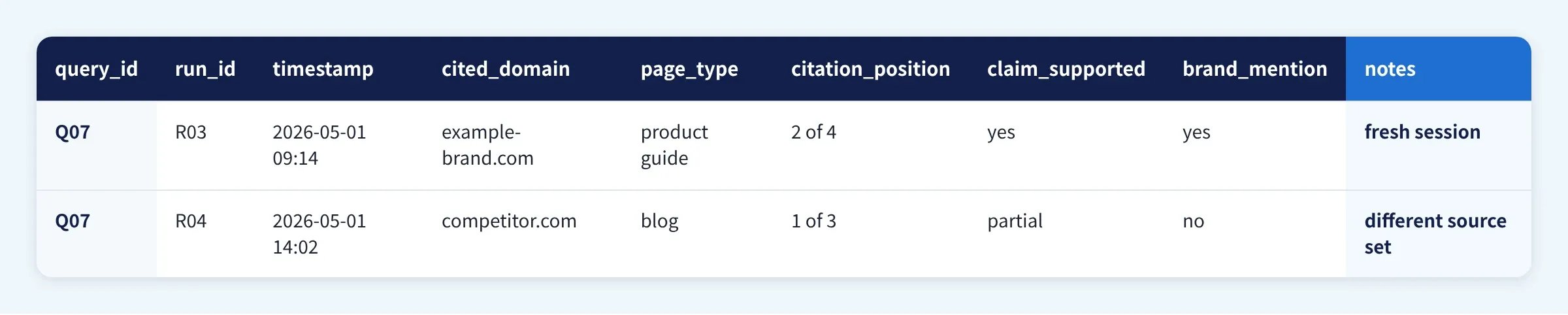
Those values are placeholders, not findings. Source availability, personalization, product updates, language, geography, and nondeterministic outputs all limit reproducibility, so report ranges across runs rather than a single number.
How to Read Patterns in Your Audit Without Overstating Them
Your log now holds patterns. The mistake is naming a cause. A DeepSeek citation audit is observational: you can't randomize page features or queries as treatments, and you can't see the internal features the system used, so treat every pattern as an association, not a rule. From one observed distribution, multiple different mechanisms can produce the same pattern.
Segment at three levels before interpreting anything.
→ Domain level: source category, topical relevance, first-party versus third-party ownership, and how concentrated source share is across a few domains.
→ Page level: answer format, factual density, headings, tables, definitions, named authors, references, dates, and entity clarity.
→ Query level: intent, specificity, freshness need, risk level, language, and whether the prompt asks for a comparison or a recommendation.
Then run each pattern through a fixed loop: observed pattern, plausible explanations, follow-up test.
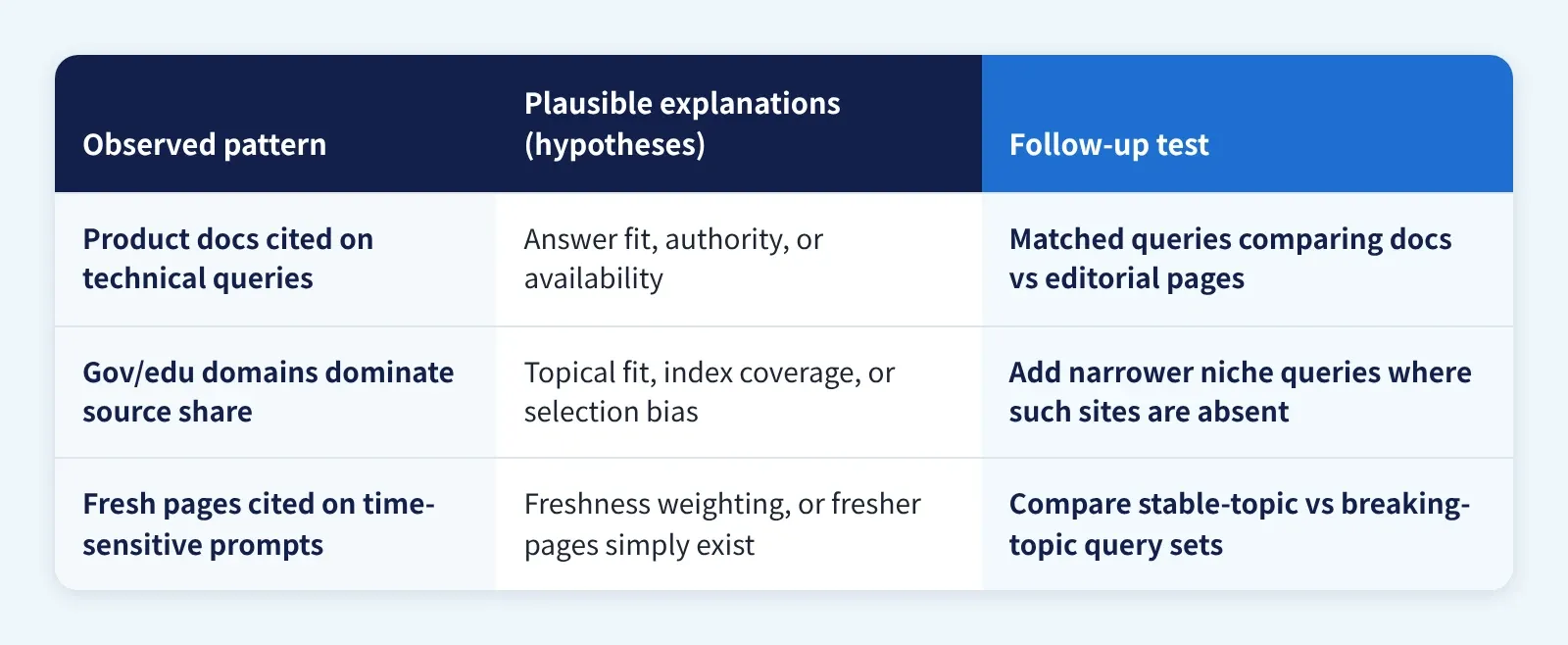
Label results honestly. Use "In this DeepSeek audit..." for your own observations, "DeepSeek documentation states..." for first-party facts, "A cross-engine study found..." for directional comparisons, and "Our hypothesis is..." for proposed explanations. DeepSeek's public terms and privacy policy don't document retrieval or citation-selection mechanics, so no first-party rule justifies a causal claim.
Two traps to name out loud. Selection bias: your sample only contains pages that entered the index, qualified for queries, and passed internal filters, so it's not a neutral snapshot. Confounding: authoritative sites may co-occur with citations for reasons unrelated to authority itself. Frequent citation, backlinks, structure, freshness, or domain authority alone don't reveal a hidden ranking factor. Keep the language associational until a controlled test earns something stronger.
Six Content Fixes That Close DeepSeek Citation Gaps
Every change below should trace to a signal in your log and end with the same fixed queries rerun against a stable baseline. If you can't name the query gap a change addresses, don't ship it yet.
Six workstreams, ordered by what your audit usually surfaces first.
→ Improve answer extraction. When a tracked query shows mentions but no citations, or citations flow to a competitor page with a cleaner structure, add a direct definition, a two-sentence summary near the top, descriptive headings, a comparison table, or an ordered procedure. Write self-contained passages that answer the query without requiring the rest of the page. Retest the same query set.
→ Increase factual specificity. Where citations skew to sources with named units, dates, and methods, replace vague copy with named products, measured values, test conditions, and stated limitations. Cite primary sources for consequential claims. Never manufacture a statistic to fill a table.
→ Clarify entities. If the same brand or product appears under inconsistent names across your pages, standardize them, explain how the entities relate, and align your About, author, product, and contact facts across owned profiles. Structured data is a machine-readable clarification aid, not a proven citation lever.
→ Strengthen verification signals. Show qualified authorship, editorial ownership, references, methodology, and revision history where you have them. Treat these as demonstrated quality signals, not as confirmed DeepSeek selection factors.
→ Protect crawlability and freshness. Confirm target pages return successful responses, expose substantive HTML rather than script-rendered content, and use stable canonical URLs. Google advises against using JavaScript to swap the canonical URL away from the original HTML value. Verify access with normal tools, but note that DeepSeek publishes no crawler user agent or IP ranges, so conventional crawler access does not prove DeepSeek retrieval.
→ Build third-party corroboration. Find queries where DeepSeek cites independent publishers, standards bodies, trade groups, or databases you're absent from, then pursue legitimate coverage, accurate directory listings, or research citations. Link acquisition alone is not a confirmed DeepSeek GEO factor.
Prioritize with four columns: impact, evidence strength, effort, and measurement feasibility. Order the queue this way: fix access failures first, close high-value answer gaps, correct entity ambiguity and unsupported claims, improve verification signals, then chase corroboration.
Illustration only, not measured data: an industrial product page earns mentions but no citations across several specification queries, while cited competitors carry sourced spec tables. The team adds a spec table with units, tolerances, and a datasheet reference, then reruns the identical fixed queries the following cycle. Treat any movement as a hypothesis to confirm across repetitions, not proof the table caused it.
How to Run DeepSeek Citation Measurement as an Ongoing Cycle
Treat DeepSeek visibility as repeated sampling rather than stable rank tracking, because answers and cited domains vary across runs. One screenshot proves nothing. Build a loop instead: record a baseline, ship one change, wait for discoverability, retest with the identical fixed query set, then review.
Keep two panels. A stable control set that never changes wording, language, geography, interface, or repetition procedure, so results stay comparable across cycles. And a separate exploratory set for emerging customer questions. When you reword or add queries, start a new series rather than folding them into the old trend, per the freeze-the-panel principle.
Compare like with like. Same prompts, same product experience, same coding definitions. Log the model version and operating mode, including thinking versus non-thinking where it applies, and treat web and mobile as separate cohorts. Segment your trend line around major model or agent releases, which can shift search behavior and citation selection. Mark those release dates directly on the chart so a regime change is never misread as your win or loss.
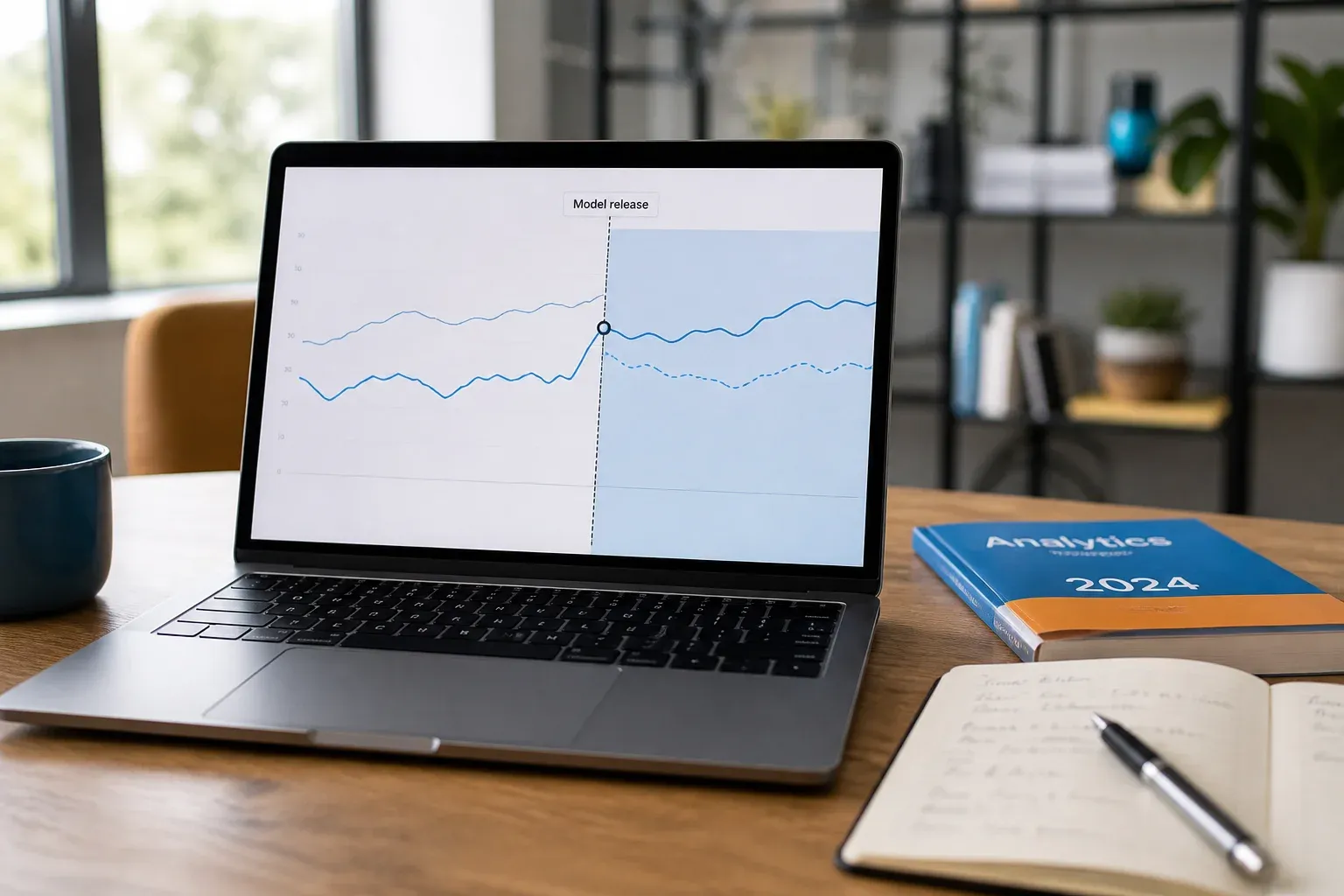
Report by query category and by page, not just as a blended average. A higher mention rate with flat citation rate suggests better entity visibility without source attribution. A higher citation rate paired with weak citation context can still miss the business goal. Track competitor and source-class shifts too, so a gain is not just the overall source mix moving under you.
Match your confidence to your design. Write "observed after the change," not "caused by the change," unless a stronger experimental setup earns the stronger word. Then prioritize next cycle's work where business value, a real citation gap, evidence strength, and implementation feasibility overlap.
What Your DeepSeek Audit Cannot Prove
Keep the interpretation honest. Your query set is finite, so it samples DeepSeek behavior rather than mapping it. Product behavior is time-sensitive: UI behavior observed through mid-2026 can change with a model release. Output varies run to run. Location and account state may shift results. Retrieval and weighting stay opaque, since DeepSeek does not publicly document how it weights authority, freshness, or consensus. No correlation from your logs can tell you the algorithm. Note too that live sources generally appear only when Search the web is enabled.
Before publishing findings or recommendations, confirm each item:
→ Fixed, versioned query set
→ Repeated observations with timestamps
→ Consumer DeepSeek Search tested, not API behavior substituted
→ Mentions and citations coded separately
→ URLs, source types, and citation context logged
→ Core metrics calculated consistently
→ Evidence labels applied to every conclusion
→ Optimization actions tied to measured gaps
→ Identical queries retained for retesting
→ Cross-engine findings marked directional
→ No causal or algorithm claims based only on correlation

Which high-value query category will your team audit first?
Work With dminorstudio
Auditing DeepSeek citations takes a fixed query set, repeated observations, and disciplined logging, and most teams run out of time before the second cycle. Dminorstudio builds and runs DeepSeek citation audits for B2B companies, then turns the gaps into content, entity, and technical fixes you can retest against the same baseline. If you want your brand named and cited in AI answers across the US and China markets, book a call with dminorstudio and we'll map your first high-value query set together.
Sources
- DeepSeek Privacy Policy — DeepSeek
- DeepSeek · GEO Wiki — GEO Wiki
- Integrate with Claude Code | DeepSeek API Docs — DeepSeek
- Using the Anthropic API | DeepSeek API Docs — DeepSeek
- Quantifying Uncertainty in AI Visibility: A Statistical Framework for Generative Search Measurement — arXiv
- DeepSeek Citation Accuracy Audit 2026 — Seek-Chat / GitHub
- Evaluating Verifiability in Generative Search Engines — ACL Anthology
- Observational Studies and Causal Inference — PubMed Central
- Causal statistical inference in high dimensions — ETH Zürich
- DeepSeek Terms of Use — DeepSeek
- Chapter 16 Causal biases | Causal Inference — University of Oxford
- Understand the JavaScript SEO basics — Google Search Central
- DeepSeek Crawlers Explained: User Agents, robots.txt and Access Control | Menra — Menra
- AI Citation Measurement Standard — AI Citation Institute
- DeepSeek-V3.1 release announcement — DeepSeek
- DeepSeek News: December 2025 — DeepSeek
- How DeepSeek Cites Sources: Memory vs Search | SearchScore — SearchScore
- Can DeepSeek Search the Web? How Search Works — FixAEO
About The Author

Stephen Tseng
Co-founder of dminorstudio. regularly writes about the intersection of AI, SEO, and B2B growth strategy.
Frequently Asked Questions About DeepSeek GEO
What is the difference between DeepSeek SEO and DeepSeek GEO?
DeepSeek SEO focuses on making your pages discoverable through DeepSeek-mediated search, meaning your content can be found and retrieved at all. DeepSeek GEO (generative engine optimization) goes a step further: it focuses on making your content likely to be retrieved, understood accurately, and cited inside a generated answer. You need both, because a page can be technically accessible but still never appear in an AI-written response.
Does DeepSeek cite sources the same way across all devices?
No. How sources display varies between the DeepSeek website and the mobile app. In Smart Search mode, DeepSeek inserts inline reference markers like [Reference 1] into responses, but the visual presentation of those citations can differ by interface. For audit purposes, treat web and mobile as separate cohorts and log which interface you used for every test run.
Can I trust a single DeepSeek answer as a reliable data point?
No. Identical prompts can return materially different cited-source sets across runs. One cross-engine study measured same-prompt source overlap between 23.9% and 88.7% depending on the product. A single answer is not a reliable data point. Run each query multiple times, log all outputs, and report ranges rather than a single result.
Does having strong Baidu SEO help with DeepSeek citations?
There is no publicly documented evidence that Baidu SEO signals directly influence DeepSeek citation selection, as they are separate systems. That said, foundational practices like crawlable HTML, stable canonical URLs, clear entity naming, structured formatting, and primary-source references make pages easier to retrieve and extract answers from when you test your DeepSeek query set. Treat any overlap as correlation to test across runs, not a proven cause.
How often should I run a DeepSeek citation audit?
There is no single right answer, but a cycle-based approach works best. Run a baseline audit, make one targeted change, then retest with the identical query set before making the next change. Schedule recurring audit windows rather than running one-off tests, and segment your trend line whenever DeepSeek releases a major model or product update. Product behavior can shift meaningfully with new releases, so a frozen query panel with regular repetitions gives you the most reliable picture over time.
What types of content tend to appear in DeepSeek cited sources?
DeepSeek does not publish a citation-selection formula, and the only public DeepSeek-specific audit benchmarks citation accuracy rather than commercial source selection. In your own citation audit, segment logged pages by answer format, factual density, headings, tables, definitions, named authors, references, dates, and entity clarity to see what correlates with citations across your query set. Treat those patterns as content improvement targets to retest, not as confirmed ranking factors or guaranteed citation triggers.
What should I do if my brand is mentioned but never cited?
A mention without a citation means DeepSeek referenced your entity in its answer but did not attribute a source to support it. The most common fix is improving answer extraction: add a direct definition near the top of your page, write self-contained passages that answer specific queries without requiring the full article, and use descriptive headings. Retest the same queries after each change to see if citation rate improves. Never assume one change caused a shift until you confirm it across multiple runs.