
What Is China GEO?
China GEO is the work of making your company's Chinese-language expertise easy for Chinese AI answer tools to find, understand, represent and reference. It extends your SEO and content strategy rather than replacing it: SEO earns a ranked link, GEO aims to get your content pulled into the generated answer.
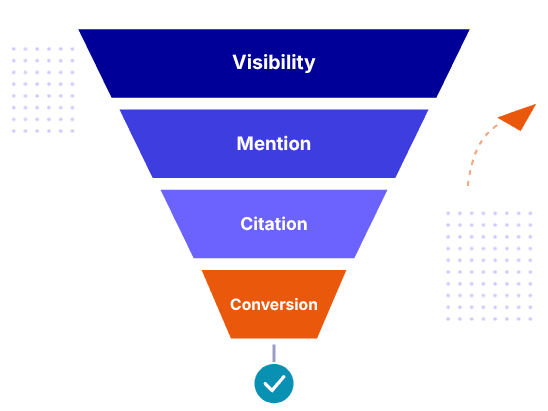
We track four outcomes separately, because they are not the same thing:
- Visibility: you appear in or around an answer.
- Mention: the AI names your brand.
- Citation: your source is referenced or linked.
- Conversion: a buyer takes a commercially meaningful action.
Visibility is a leading signal, not proof of pipeline. New to the topic? Read China GEO for Western B2B: A Beginner's Guide.
Why China Needs a Separate AI Strategy
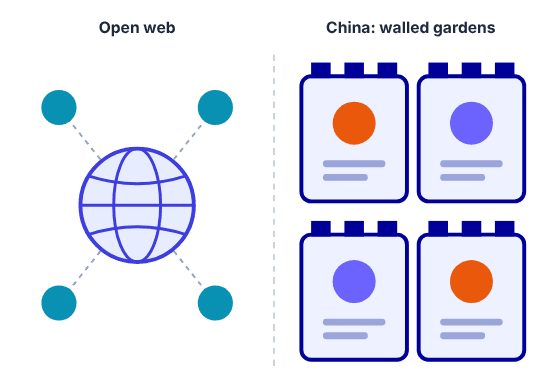
Western GEO assumes an open web where your own site can earn the citation. China runs on walled gardens, where each engine pulls mostly from its owner's ecosystem. Research on Chinese-language generative search found third-party content dominates citations, while direct corporate-site citation is uncommon. Everything published also sits inside a regulatory system that shapes what engines surface at all.
The audience is already there. China had 602 million generative-AI users by December 2025, 42.8% of internet users, up 141.7% year over year (CNNIC, March 2026). By June 2026, AI-native apps reached about 499 million monthly active users, up 85.4% year over year (TechNode, July 14, 2026, reporting QuestMobile data).
A translated version of your Google or ChatGPT playbook will not reach them. Already running Google SEO and PPC with us? China GEO is the Chinese counterpart, built on different engines and different sources.
Six Chinese AI Engines and Why Each Matters
Every major Chinese AI engine is owned by a company that already runs part of the Chinese internet, and that ownership shapes what it cites. In June 2026, Doubao had about 382 million active users, Qwen 167 million and DeepSeek 129 to 130 million (QuestMobile, 2026 first-half report).

Built by the team behind quant fund High-Flyer, with open-weight models enterprises can self-host. It matters as a positioning target: technical buyers use it for due diligence and vendor comparison.

Baidu's assistant, with Baidu naming Search as one of the services receiving ERNIE's capabilities. It sits closest to SEO, so it is usually the first stop for B2B GEO work alongside our Baidu SEO and PPC service.

ByteDance's assistant, tied to Douyin's user base. It matters if your buyer research shows up on video-first platforms.

Alibaba Cloud's model line, which Alibaba says is used by more than 90,000 corporate clients in China (SCMP). Relevant for procurement and supply-chain-adjacent queries.

Moonshot AI's assistant, known for long-context handling. Useful to professionals working through long technical documents or contracts.

Tencent's assistant, connected to WeChat and able to pull from WeChat Official Account content. Your WeChat marketing feeds it directly.
How These Engines Decide What to Cite
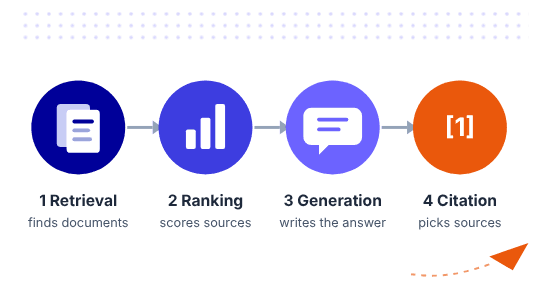
Each engine runs the same four-stage pipeline:
- Retrieval: pulls current documents at query time.
- Ranking: scores them on relevance, authority, timeliness and task fit.
- Generation: writes the answer.
- Citation: decides which sources to reference.
Being in a model's training data does not get you cited. Citation happens at retrieval, from sources the engine can find and trust right now, and Zhihu and Baidu Baike appear again and again. The engine-by-engine tactics are in our China GEO Playbook.
Our China GEO Services
We make your company eligible to be cited by Chinese AI engines. No agency, including us, can guarantee that a model will cite or mention you: the platforms themselves disclaim control over their generated answers. What we control is the quality, consistency and reach of the evidence those engines draw from.
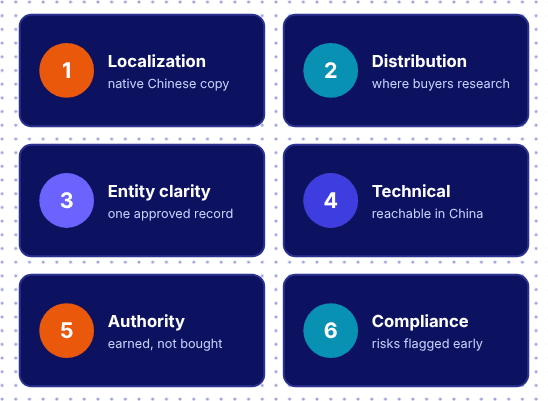
① Native Chinese Localization
We research the words Chinese buyers actually type, not a literal rendering of your English terms, using Baidu Index, keyword tools and your sales conversations. Native editors with subject-matter knowledge write and review every piece, backed by a bilingual glossary.
② Platform Distribution
Your website is one source among many. We map where your buyers research, then build presence on the surfaces engines retrieve from, such as Baidu Baike, Zhihu, WeChat and WeChat-based trade media, each in the format that platform rewards.
③ Entity and Content Clarity
AI systems pull facts, so the facts have to match everywhere. We keep one approved record of company names, product terms, specifications and credentials, then fix contradictions across your pages and third-party listings.
④ Technical Foundations
If a page cannot be crawled, rendered or reached quickly from inside China, none of the content work counts. We audit hosting and access from mainland locations, structure, metadata and Baidu crawlability, then verify after launch.
⑤ Authority and Corroboration
Credible third-party references help engines trust what you say. We earn them through real coverage, expert content and genuine citations. We do not sell manufactured mentions or paid placement dressed up as organic.
⑥ Compliance Awareness
Hosting, content rules, AI content labeling and personal-information handling affect what you can publish and how. We flag risk and escalate early, and we bring in qualified Chinese counsel for legal questions rather than giving legal advice ourselves.
How a 180-Day China GEO Plan Works
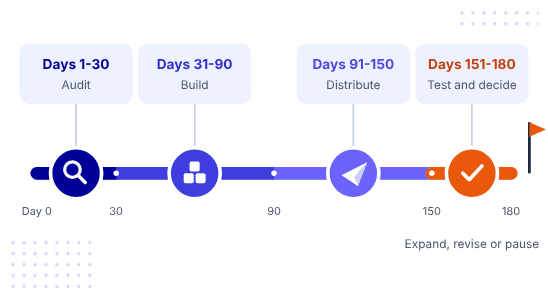
We run a bounded 180-day plan instead of an open-ended retainer. Six months is about how long a working presence in China usually takes to establish, and each phase ends with defined outputs.
Days 1 to 30: Audit and Research
We confirm your China market fit, review your existing Chinese assets and check that they can be reached from mainland China. Then we record how AI tools answer your buyers' key questions today.
Days 31 to 90: Build the Foundation
We fix the main technical and consistency issues, then create the Chinese-language sources that AI engines draw on. Everything is reviewed and approved before it goes live.
Days 91 to 150: Distribute and Expand
We publish across the Chinese platforms your buyers use and track what earns engagement. We only expand where that engagement shows up.
Days 151 to 180: Test and Decide
We repeat the baseline questions and compare the results against where you started, reported as ranges. Then you decide whether to expand, revise or pause.
Who China GEO Is For, and Who Should Wait
China GEO fits international B2B companies with real China demand and someone to own the program. Without those, fix the foundations first.

A Good Fit
✅ International B2B companies in industrial manufacturing, technology or SaaS.
✅ Teams that want a China-specific approach, not a Western playbook translated word for word.
✅ Companies that want one team covering Chinese content, technical foundations and platform visibility on Baidu, WeChat and the web.
✅ Leaders who want results measured against baselines and tied to pipeline, not promised as guaranteed citations.

Not Yet
➖ No validated China demand.
➖ No Chinese sales path to convert interest.
➖ Translation-only content presented as localization.
➖ Pages your prospects in China cannot reliably reach.
➖ No internal owner willing to carry the program.
Not sure where you stand? The six readiness questions in our beginner's guide will tell you, and our guide on how to choose a China GEO agency shows how to evaluate any partner, us included.
China GEO FAQ
What is a China GEO agency?
A China GEO agency makes your brand visible inside China's AI-assisted search and answer tools, alongside conventional search. The work covers Chinese content, platform monitoring, technical foundations, authority building, measurement and local compliance.
How is China GEO different from Baidu SEO?
Baidu SEO targets ranked links on one search engine, while China GEO targets how multiple AI systems summarize, cite and answer. The two overlap: crawlability, metadata, page structure and indexation matter for both.
Does GEO replace SEO?
No. GEO complements SEO, because the same technical foundations, clean information architecture and quality content feed both ranked results and AI answers.
Which Chinese AI platforms should a B2B company prioritize?
It depends on where your buyers research, and that changes fast. For most B2B entrants, WeChat and Baidu come first, with LinkedIn, Xiaohongshu and Douyin added later only if your buyers are there. We validate platform priority against current evidence at the start and reassess as engines change.
How long does China GEO take?
It depends on your starting point, platform scope, content volume, technical work, localization depth and compliance needs. A functional digital presence typically takes 3 to 6 months to establish, and organic lead generation usually becomes meaningful at 6 to 12 months. Our 180-day pilot shows early indicators before you commit further.
How much does a China GEO engagement cost?
Pricing follows the same variables as timelines, so no credible agency can quote a flat figure without seeing your site, market and goals. Be wary of fixed prices attached to guaranteed outcomes.
Can an agency guarantee citations or mentions?
No. The platforms disclaim control over their own generated outputs, so no vendor can promise inclusion. Treat any guarantee as a warning sign.
How should AI visibility be measured?
Probabilistically. AI answers and citations vary across repeated queries, platforms and time, so expect baselines, repeated sampling, ranges rather than single numbers, and a link to pipeline and conversion, not one-off screenshots.