
What Being Cited in a Chinese AI Answer Actually Gets You
Understanding how chinese ai search cites sources starts with a simple idea: citation visibility means your content is named, quoted, or linked inside an AI-generated answer, where the user reads it before, or instead of, scrolling to standard blue links.
That position matters because AI modules increasingly sit on top. At the 2025 Baidu World Conference, Robin Li said 70% of first-position results are now rich-media answers rather than text links, and 18% of Baidu results were AI-generated as of September 2024. Attention lands on the answer card first.
A visible citation can help discovery, build trust, and open a referral path. It does not guarantee a click or signal endorsement. A randomized experiment found reference links raised trust even when the links were wrong, so treat presence as influence, not proof.
Throughout this guide, evidence carries one of three labels. Documented fact comes from official product sources. Observed behavior comes from current hands-on or third-party testing. Reasonable inference is my read of the evidence.
One caveat applies everywhere: interfaces and citation behavior shift by product version, mode, account status, device, and query. Test before you rely on any pattern.
Four Chinese AI Search Products, Four Different Setups
These four are not one category. Treat them separately before comparing how any of them cites.
Baidu runs AI answers inside a search engine. Its consumer "AI搜" entry and "AI智能回答" feature are built on the Wenxin model, and Baidu's cloud side (千帆) groups retrieval and generation under one product family. By the end of June 2025, over half of mobile search result pages carried AI-generated content.
Kimi is a web-connected assistant from Moonshot AI. Its help center states that all search-based answers include reference links users can click to verify. That is documented, so I treat Kimi's traceability as a stated feature, not a guess.
DeepSeek is the thin case. It documents native Web Search for Claude Code via its Anthropic-compatible endpoint, but search and citation mechanics for the consumer assistant and OpenAI-style API are not detailed publicly. Read DeepSeek here as observational only.
Doubao, from ByteDance, has web search, but I found no first-party product page spelling out how it selects or displays sources. What exists is third-party analysis, so Doubao's citation mechanics stay an evidence gap.
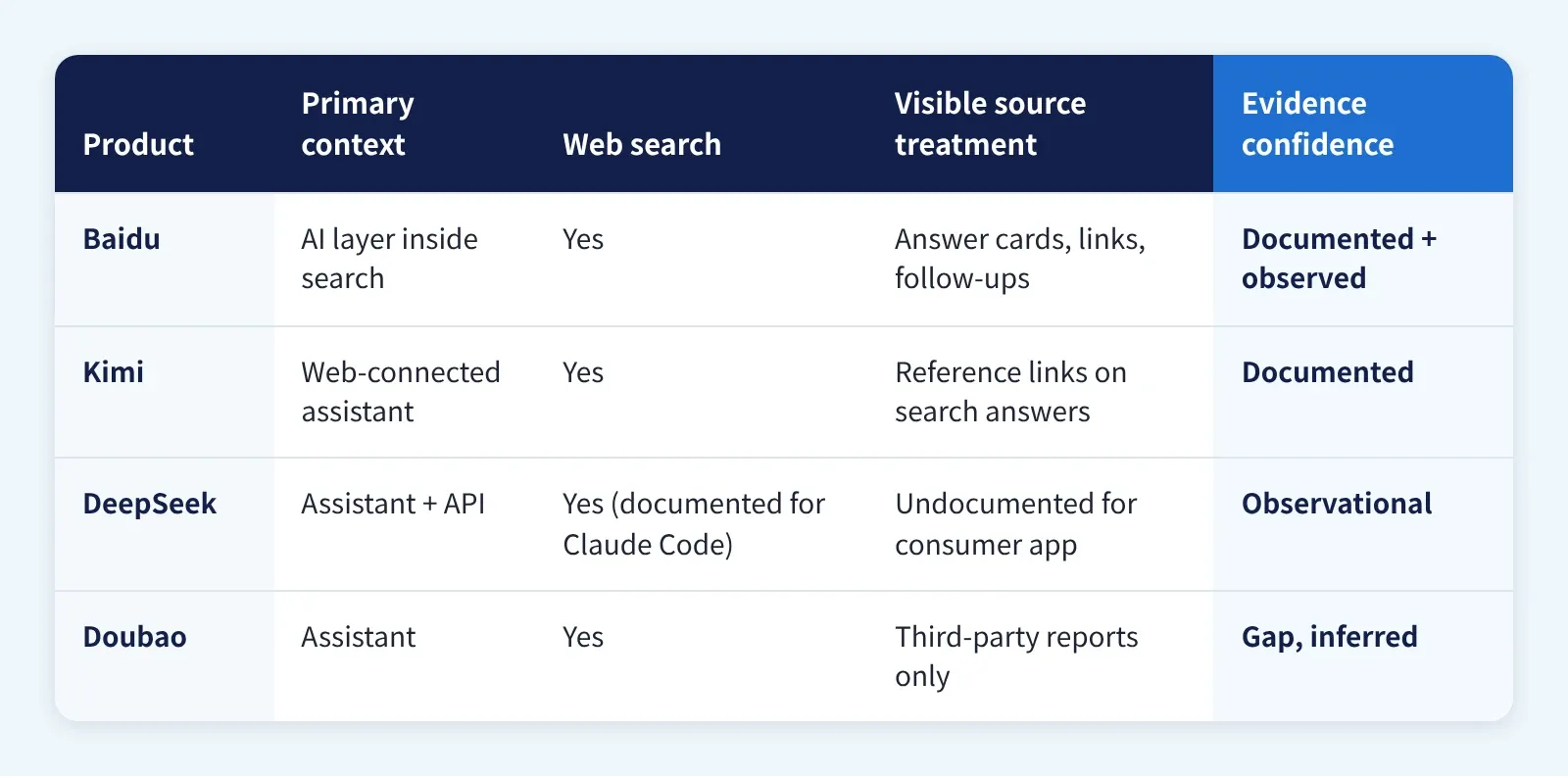
Hold these differences as you read the pipeline that follows.
How Chinese AI Search Engines Read Your Query and Gather Candidates
Before any answer appears, the system has to figure out what you asked and pull material that might answer it. These are two separate jobs.
Step 1 is query interpretation. The engine parses intent, entities, language, location, freshness needs, and any follow-up context from earlier turns. Baidu's enterprise search side describes this openly: it applies natural-language processing to understand queries and data semantically, converting a query into a semantic vector and comparing it against documents by meaning rather than exact words. That is documented behavior for Baidu's cloud products. Whether the consumer AI answer layer runs the identical process is a reasonable inference, not a stated fact.
Say a procurement engineer types a Chinese query asking which industrial air cooler model fits a given flow rate, with current specs. The engine has to catch the intent (a product comparison), the entities (specific model families, a capacity figure), the language (Simplified Chinese), and the freshness signal (current). Miss any one and the retrieval that follows drifts off target.
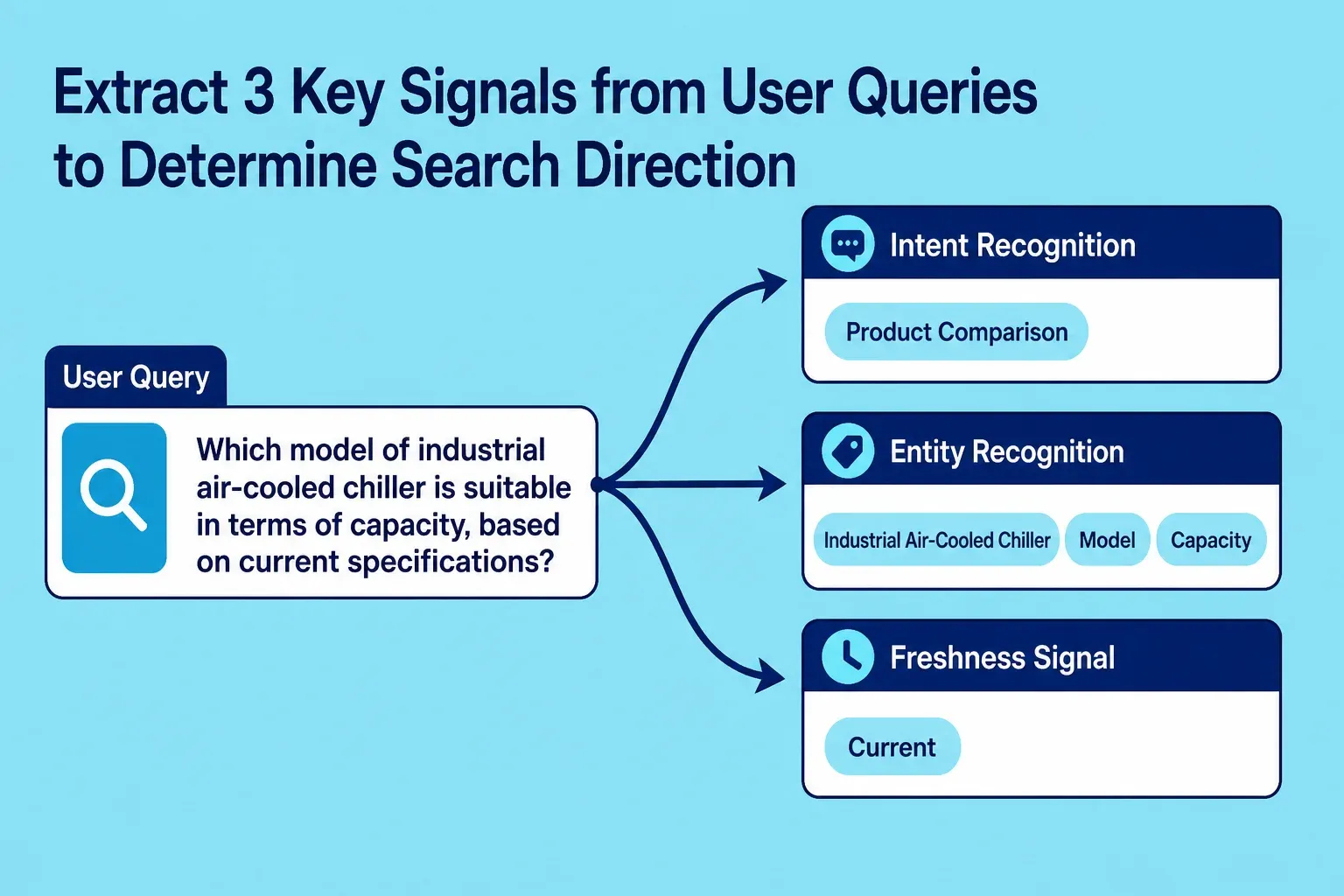
Step 2 is retrieval. The engine finds candidate pages or passages from whatever source pool it has: a web index, live search, connected documents, or a knowledge base. Baidu's architecture is described as a multi-index, multi-stage recall and re-rank process that combines keyword indexes with semantic vectors. DeepSeek documents that its web search, once enabled, retrieves public internet information based on your input and, for complex questions, extracts multiple keywords and runs parallel searches. Kimi and Doubao both retrieve from the live web, though their internal recall steps are not spelled out in first-party docs.
One point to hold onto: retrieval is not citation. An engine can pull your page into its candidate set and still leave it out of the final answer. Getting retrieved is the entry ticket, nothing more.
What you can do at this stage:
- Publish indexable Chinese-language pages, not PDFs or image-only content.
- Match titles and headings to the real questions buyers type.
- Name entities precisely: exact model numbers, standards, and brand spellings.
- Put key facts in readable HTML text, not locked inside graphics.
- Keep dates and specifications current so freshness checks pass.
How AI Engines Rank Candidates and Synthesize an Answer
Once the engine has a pool of candidate passages, it has to decide which ones carry weight. Ranking here means prioritizing evidence for an answer, which is not necessarily the same job as sorting a page of blue links.
Baidu is the most explicit of the four. Its AI-search documentation describes a data priority mechanism built on authority, timeliness, and relevance, with official data getting priority in financial scenarios. On the classic search side, Baidu defines authority as the professional level of the resource's producer and treats content with clear time information as more time-sensitive. Doubao's materials from ByteDance point to multi-source verification and source authority without publishing a citation-ranking formula. Kimi offers little first-party detail on how it weighs candidates. DeepSeek's public docs cover API modes and limits, not a search-ranking algorithm, so any claim about how it prioritizes evidence is inference, not documented behavior. Treat likely usefulness signals like authority, freshness, and topical match as reasonable inference unless a platform states them outright.
Step 3 is synthesis. The engine folds the top-ranked passages into a direct answer, a short summary, a comparison table, or a bulleted list. That compression is where things break. Common failure points:
- Outdated evidence gets pulled in because a newer page ranked lower.
- Two sources disagree and the answer picks one without flagging the conflict.
- Context gets stripped, so a qualified claim reads as absolute.
- The model compresses beyond what the source supports and invents a specific.
- Two similar entities get conflated, so your Model A specs get attached to Model B.
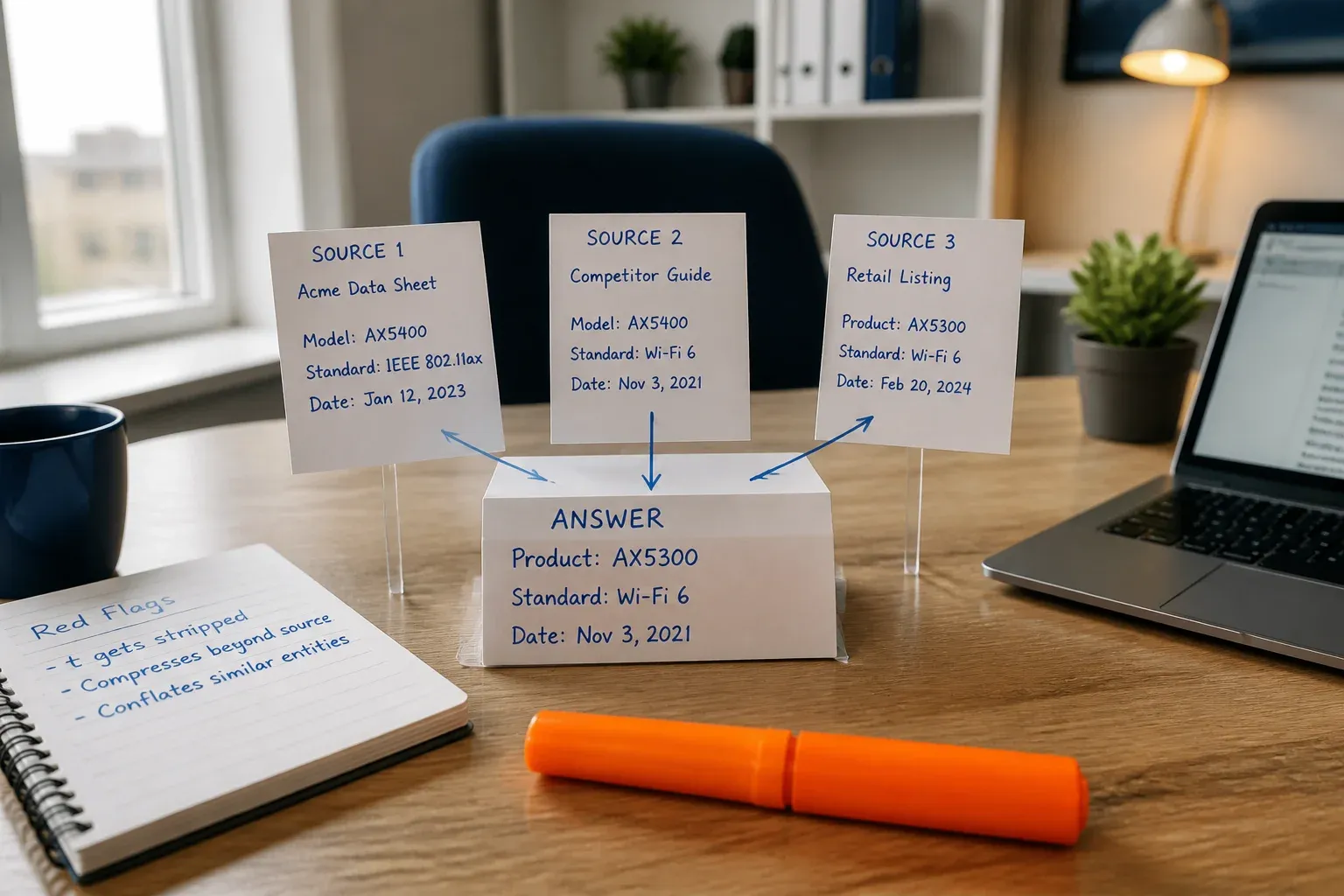
You can reduce those risks with how you write. Lead with the answer, then support it with evidence in the same block. Name the entity, then disambiguate it with exact model numbers and standards. State the date on the page, and update specs so freshness checks pass. Make claims specific, and make verification easy by putting the supporting figure right next to the claim.
None of this guarantees you get cited. It lowers the odds that a synthesis step misreads, ages out, or mixes up your content with a competitor's.
How Each Chinese AI Engine Links a Claim to a Source
Source attribution is the link between a claim in the answer and the page it came from. Two things worth separating: a system can pull information from a page without ever showing a citation, and a source it does show may support only part of a sentence. Showing a source is not the same as using one.
A June 2026 hands-on test of 200 industry queries found the author could only count sources the answer explicitly displayed, with no way to reverse-engineer what was retrieved but hidden. That gap holds across products. Assume some contribution stays invisible.
Baidu gives the clearest display pattern (observed, from third-party reviews). Its AI summary module sits at the top of the results page, above standard results, with clickable source links or cards beneath the answer, often labeled 引用来源 or 信息来源. A notice reading 本条结果由 AI 生成 marks the block as machine-written. Deep Search mode returns longer answers with more displayed sources.
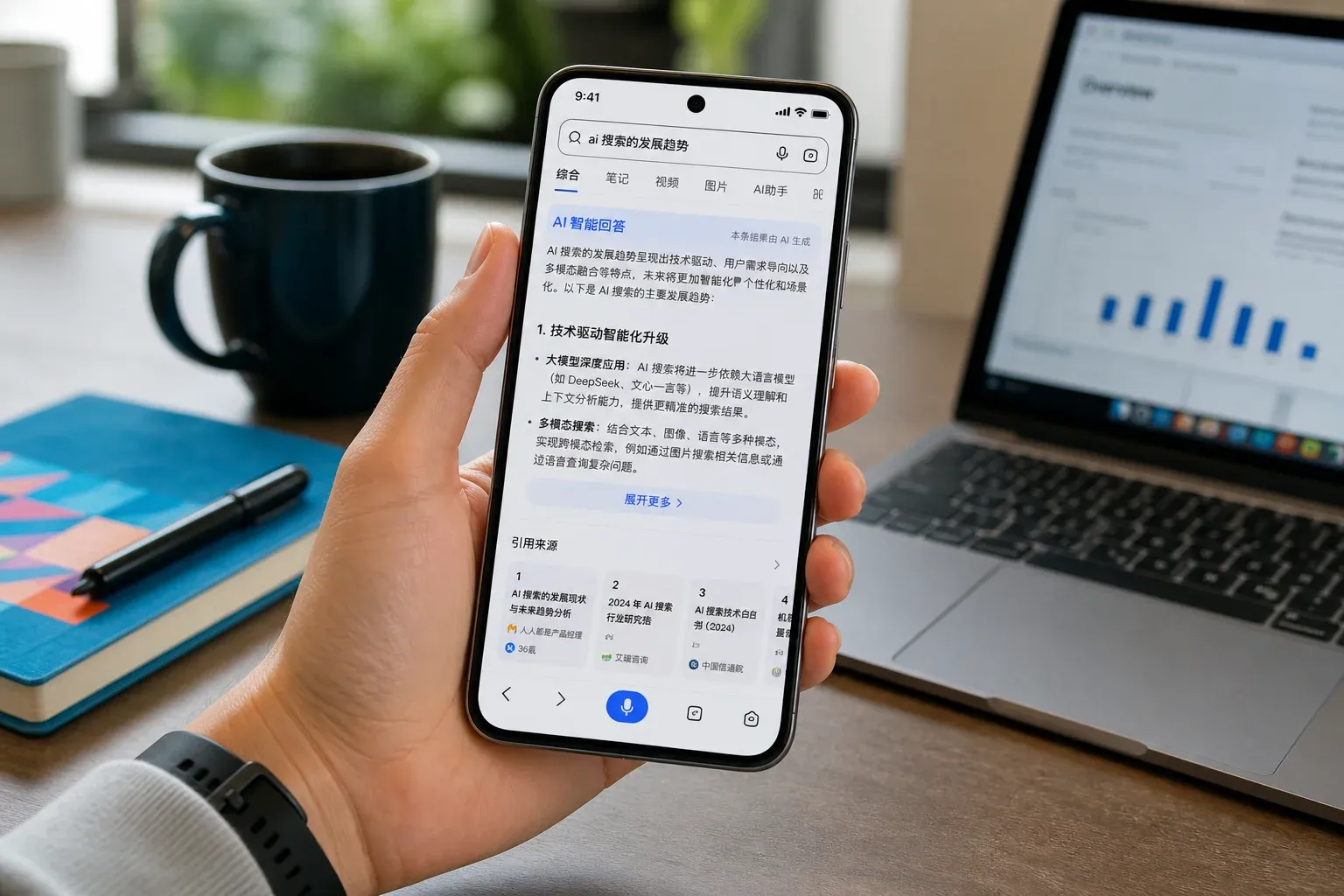
Kimi's official help docs (documented) say search answers carry clickable links to original sources for verification and mention reference links plus authoritative badges. The exact UI format, whether numbered footnotes, cards, or a side panel, is not confirmed in the materials I could verify. Treat the display shape as unknown.
Doubao behavior here comes from a dated test, not documentation. A June 2026 walkthrough on Alibaba Cloud's developer community describes clicking to expand a source list rather than persistent inline markers. UX benchmarks put Doubao's marker or card interaction at 76% and downstream click-through at 34%, so many users open the sources without leaving for the underlying page.
DeepSeek is the weakest on display (observed, early 2026 tests). It outputs cited pages with links near the answer, but the client cannot pull the full result list, and there is no structured claim-to-source pairing; URLs surface only when the model runs an open_page action.
One caution before you read into any of this: the order sources appear in does not prove how much each one shaped the answer. A source listed first may support one clause. A heavily used page may not appear at all.
Comparing All Four Products: Where Sources Land and How Well They Hold Up
Compare these four on what a user can actually see, not on guessed internals. Five dimensions do the work: when sources appear, where they sit, how granular the attribution is, whether links resolve, and whether the destination supports the claim. Read every profile with a confidence label attached.
Baidu (moderate confidence, third-party observed). Its AI summary sits above standard results with clickable source cards beneath. Observed citation preferences lean toward Baidu-owned properties like Baijiahao, Baidu Baike, and Zhidao. Documented product pages describe deep search and source tracing, but no public material spells out the ranking algorithm.
Kimi (moderate to high confidence, partly documented). Official help docs state search answers carry clickable links to originals for verification, which is the strongest documented traceability of the four. Third-party observers describe a broader research and document mix rather than one house ecosystem. The exact display shape stays unconfirmed.
DeepSeek (low confidence, observational only). Retrieval is documented in its terms, but citation display and source ranking are not. Early 2026 tests describe a technically mixed source set drawing on Zhihu and technical forums, with no structured claim-to-source pairing. A May 2026 panel put its output at 72.3% Mainland-CN sources. Record the operating mode every time, since chat and intelligent search differ.
Doubao (moderate confidence, verified interface plus a documentation gap). Its terms confirm it searches public web sources and shows them above the response. Observed citations are the most concentrated of the four and visibly tied to ByteDance properties like Toutiao and Douyin, with the same May 2026 panel reporting 88.6% Mainland-CN sources. How it selects and ranks those sources is undocumented.
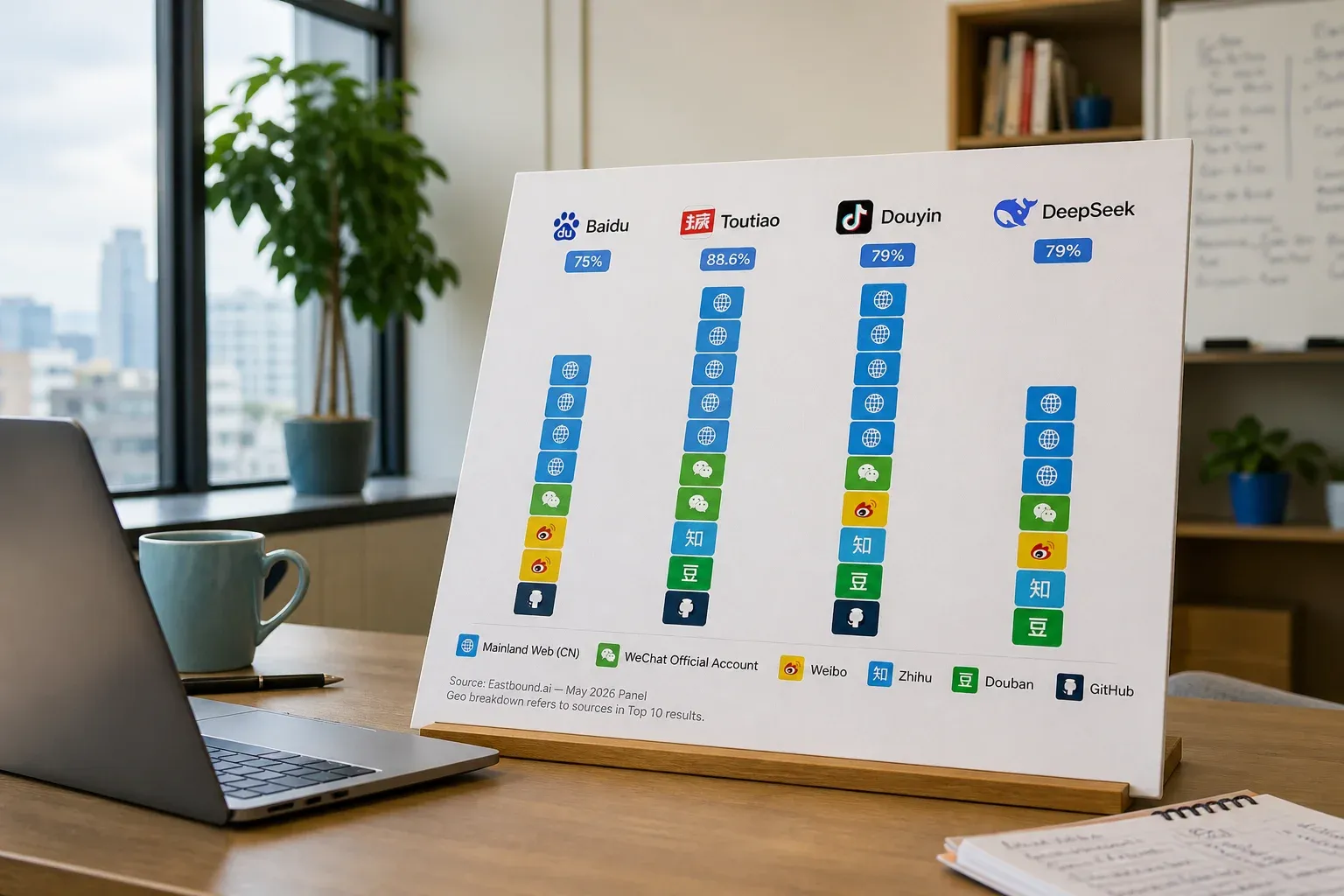
None of this establishes a universal winner, and one query proves nothing. The next section turns these differences into a test you run yourself.
Two Checklists to Get Your Content Found and Cited by Chinese AI Search
Optimization improves your odds. It never guarantees inclusion. Work these two lists in order.
To make a page easy to discover and cite:
- Publish a crawlable Chinese-language version and use the terms Chinese buyers actually type, not translated marketing phrases.
- Answer one clear question per section, and place a short factual summary right under each descriptive heading.
- Name companies, products, people, and locations the same way everywhere.
- Include authorship, publication and update dates, primary evidence, references, specifications, and a canonical URL on the page.
- Keep key content and links in the HTML itself instead of hiding them behind script-only rendering or login walls.
- Submit URLs through API push, Sitemap, or manual submission, and clean up 404s and stale URLs so retrieval does not trip on dead links.
- Keep claims consistent across your site and trusted external profiles, and earn relevant third-party mentions without manufacturing citations.
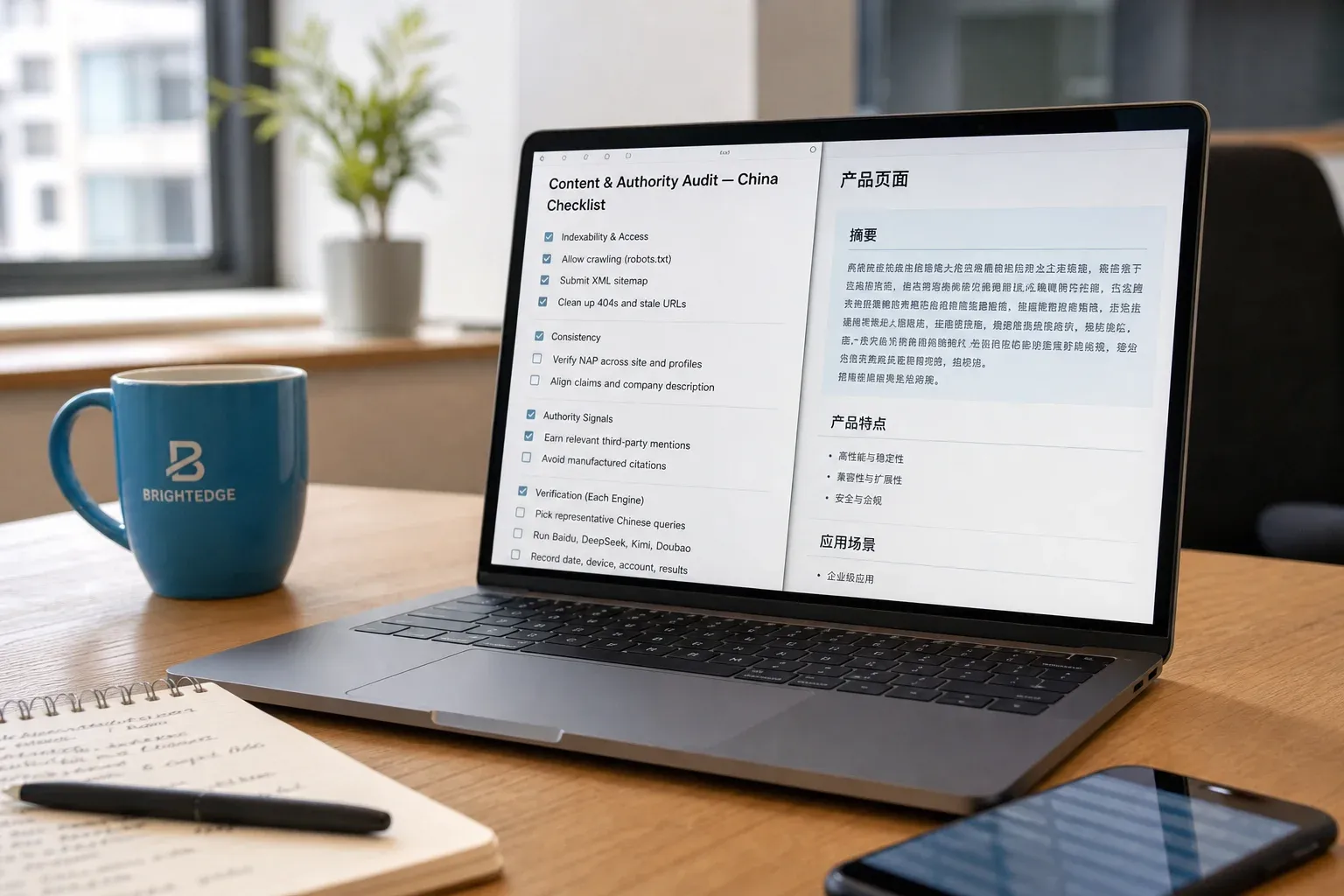
To verify what each engine does with that content:
- Pick a handful of representative Chinese queries a real buyer would use.
- Run the same query on Baidu, DeepSeek, Kimi, and Doubao. Record the date, device, account, mode, and exact prompt every time. DeepSeek's chat and search modes behave differently, so log which one you used.
- Capture the full answer and the source panel. Open every cited URL.
- Map each claim to the passage that supports it. Flag anything missing, broken, mismatched, or circular.
- Rerun after a week or two to catch citation drift, and compare branded prompts against non-branded ones.
- Log results as observations. A five-query sample is not a ranking. If an answer is wrong, use the feedback path, like Kimi's thumbs-down report.
Look at your own site through this lens. Which pages could an AI engine verify in one click, and which ones would leave it guessing?
Ready to Show Up in Chinese AI Search Answers?
If your pages are getting skipped by Baidu, DeepSeek, Kimi, and Doubao, that gap costs you visibility every day. We help B2B brands make their content discoverable, citable, and verifiable across Chinese AI search. Book a call and we will audit where your content stands and map the fixes that move you into the answer card. Which pages on your site are easiest to cite today, and which ones need the work?
Sources
- 2025百度世界大会召开多项AI成果集中发布-新华网 — 新华网
- “跑通智能体生态闭环,人人可开发获益”-南方都市报·奥一网 — 南方都市报
- Human Trust in AI Search: A Large-Scale Experiment — MIT
- Form 6-K for Baidu INC filed 08/20/2025 — Baidu, Inc.
- Kimi Search Guide - Kimi Help Center — Moonshot AI
- DeepSeek Claude Code Web Search Setup - DeepSeek V4 Pro — DeepSeek V4 Pro
- 智能企业搜索-百度智能云 — Baidu
- 语义搜索与RAG:构建下一代智能检索系统 — Baidu
- 百度AI搜索技术架构解析与开发实践指南 — Baidu
- DeepSeek V2 系列收官,联网搜索上线官网| DeepSeek API Docs — DeepSeek
- AI 搜索新能力:自适应思考 + 金融级合规安全开关 - 百度智能云千帆社区 — Baidu
- 搜索用户体验是什么?搜索引擎是如何判断好的用户体验?_百度推广 — Baidu
- 详解7大因素,是什么影响百度搜索结果排序_百度推广 — Baidu
- 百度AI搜索 评测 - 百度智能搜索升级,大模型赋能中文搜索新体验 | 星枢 AI — 星枢 AI
- 百度AI搜索 - AI搜索分析测评 | MagicNetWorld — MagicNetWorld
- 指南与答案的Agentic Search - Kimi 帮助中心 — Moonshot AI
- 中文AI检索通道与豆包机制:三层结构与GEO实操判断-阿里云开发者社区 — 阿里云开发者社区
- AI答案引用展示形式九平台横评:谁给点击,谁只给心智 - MaxAEO — MaxAEO
- 【特别篇:DeepSeek V4 正式版原生联网搜索实测——搜索质量很好几乎免费,但结果是个黑盒】 — 稀土掘金
- Generative Engine Optimization for China — GEO & AI SEO China | Eastbound — Eastbound Research
- 百度搜索资源平台课程页面 — 百度搜索资源平台
- 百度搜索资源平台链接提交工具 — 百度搜索资源平台
- Contact & feedback - Kimi Help Center — Moonshot AI
About The Author

Stephen Tseng
Co-founder of dminorstudio. regularly writes about the intersection of AI, SEO, and B2B growth strategy.
Frequently Asked Questions About Chinese AI Search and Source Citations
Does being cited in a Chinese AI answer drive real traffic to my website?
A citation in a Chinese AI answer puts your brand name or content directly inside the answer card, which users see before anything else on the page. That builds recognition and trust. However, it does not always mean a direct click. A 2026 UX benchmark found that Doubao's source interaction rate was 76%, but click-through to the actual page was only 34%. Visibility and traffic are related but not the same thing. Treat citation presence as a trust signal and a discovery tool, not a guaranteed traffic source.
Why does Baidu seem to prefer its own properties like Baijiahao and Baidu Baike in AI answers?
Baidu's AI answer layer draws from its own indexed web, and its owned platforms like Baijiahao, Baidu Baike, and Zhidao are heavily indexed and meet its authority and freshness signals by default. Third-party observations consistently show these properties appearing more often in Baidu AI summaries. For B2B brands targeting Chinese buyers, publishing on Baijiahao or contributing to Baidu Baike where relevant can increase the chance of being included in Baidu's answer cards alongside your own website content.
What is the difference between being retrieved and being cited by a Chinese AI engine?
Retrieval means the engine pulled your page into its candidate pool as a potential source. Citation means it actually named, quoted, or linked your page in the final answer. These are two separate steps. An engine can retrieve your content and still leave it out of the answer entirely if another source ranks higher in the synthesis stage. Getting retrieved is the first step, but it is not the finish line. To move from retrieved to cited, your content needs to be authoritative, fresh, clearly structured, and easy for the model to verify.
Does DeepSeek cite sources the same way Baidu and Kimi do?
No. DeepSeek is the least transparent of the four on citation display. Early 2026 tests found that it outputs links near the answer but does not provide a structured pairing between each claim and its source. URLs only surface when the model runs an open_page action. Baidu and Kimi both show source cards more consistently, with Kimi's official help docs stating that all search-based answers include clickable links to original sources. DeepSeek's citation behavior should be treated as observational only until it documents its process publicly.
How often should I test whether my content is being cited by Chinese AI search engines?
Run a full test at least once a month, and always after you publish new content or update existing pages. Citation behavior can shift by product version, query phrasing, device, and account type, so a page that appeared in citations last week may not appear this week. Log the date, device, account, and mode every time you test. Rerun the same queries after one to two weeks to check for citation drift, and compare how branded and non-branded queries perform differently across Baidu, DeepSeek, Kimi, and Doubao.