
Why Your Google SEO Program Stalls on Baidu
Your Google SEO program can be excellent and still deliver almost nothing on Baidu.
I see it constantly. A Western B2B team ranks well in the US. They launch a Chinese site. Six months later, Baidu sends a trickle of visits. Same content. Same playbook. Close to zero results.
Baidu search engine optimization runs on a different set of signals. Some overlap with Google. Many don't. In 2026, three differences do the most damage to Western sites:
- AI answers built on ERNIE now sit above organic results for many informational queries.
- Baiduspider has tighter limits on what it crawls and renders.
- Baidu penalizes tactics that some Western teams and their Chinese vendors still treat as normal.
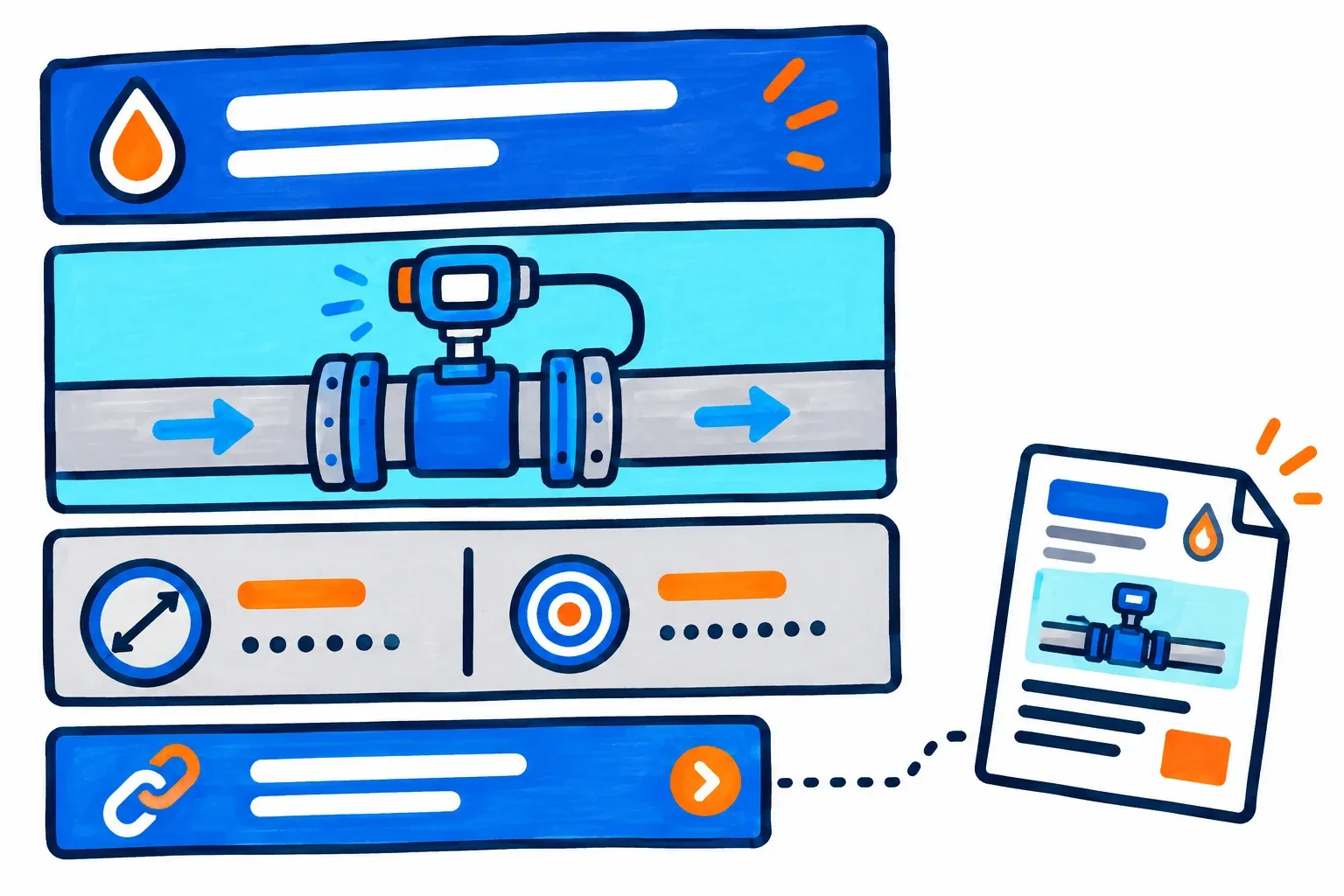
To make this concrete, this guide follows one illustrative company. It is a fictional US maker of industrial flow sensors, not a client case. Its website runs on React, sits on AWS servers in Virginia, and reaches China through a Shanghai distributor. On Google, it ranks for "electromagnetic flow meter" and dozens of spec queries. On Baidu, it barely shows up.
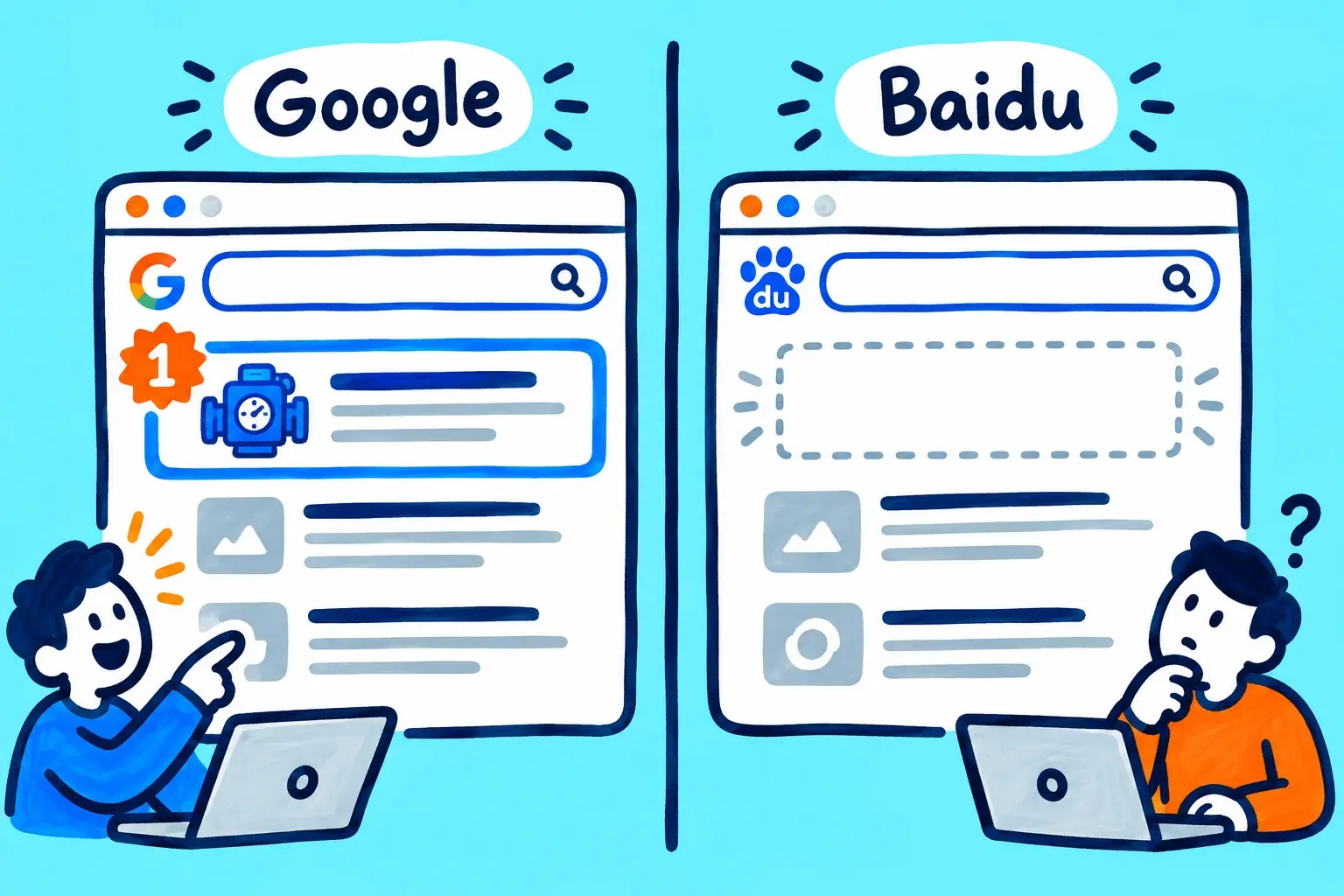
By the end, you will know which ranking factors matter most in 2026 and which ones Baidu confirms in its own documentation. You will also know which ones come from practitioner observation, including mine, and what to fix first if you're that flow-sensor team.
Where would your own site land on Baidu today?
The Five Baidu SEO Basics Every B2B Site Needs First
Baidu still holds the largest share of search in China, so it is the engine Chinese engineers and procurement teams use to vet suppliers. None of the advanced work later in this guide pays off until these basics are in place. The flow-sensor company misses every one. Each line shows the problem first, then the fix after the arrow.
- English-first site with a Chinese folder bolted on → Publish a full Simplified Chinese site as the primary experience for China.
- Spec sheets machine-translated with literal phrasing ("flow feeling device") → Have native technical writers rework terms, units, and examples the way Chinese buyers search.
- Server in Virginia → Host in mainland China or a nearby region. Expect slower loads offshore.
- No ICP filing → File one. Every mainland-hosted site needs an ICP filing (ICP备案), and foreign firms usually need a local entity or partner to file. An ICP license (ICP许可证) is a separate requirement that applies only to commercial services such as online transactions or paid memberships.
- Debating .com vs .cn → Treat .cn as a trust signal for Chinese visitors. Baidu has not confirmed any ranking boost for .cn.
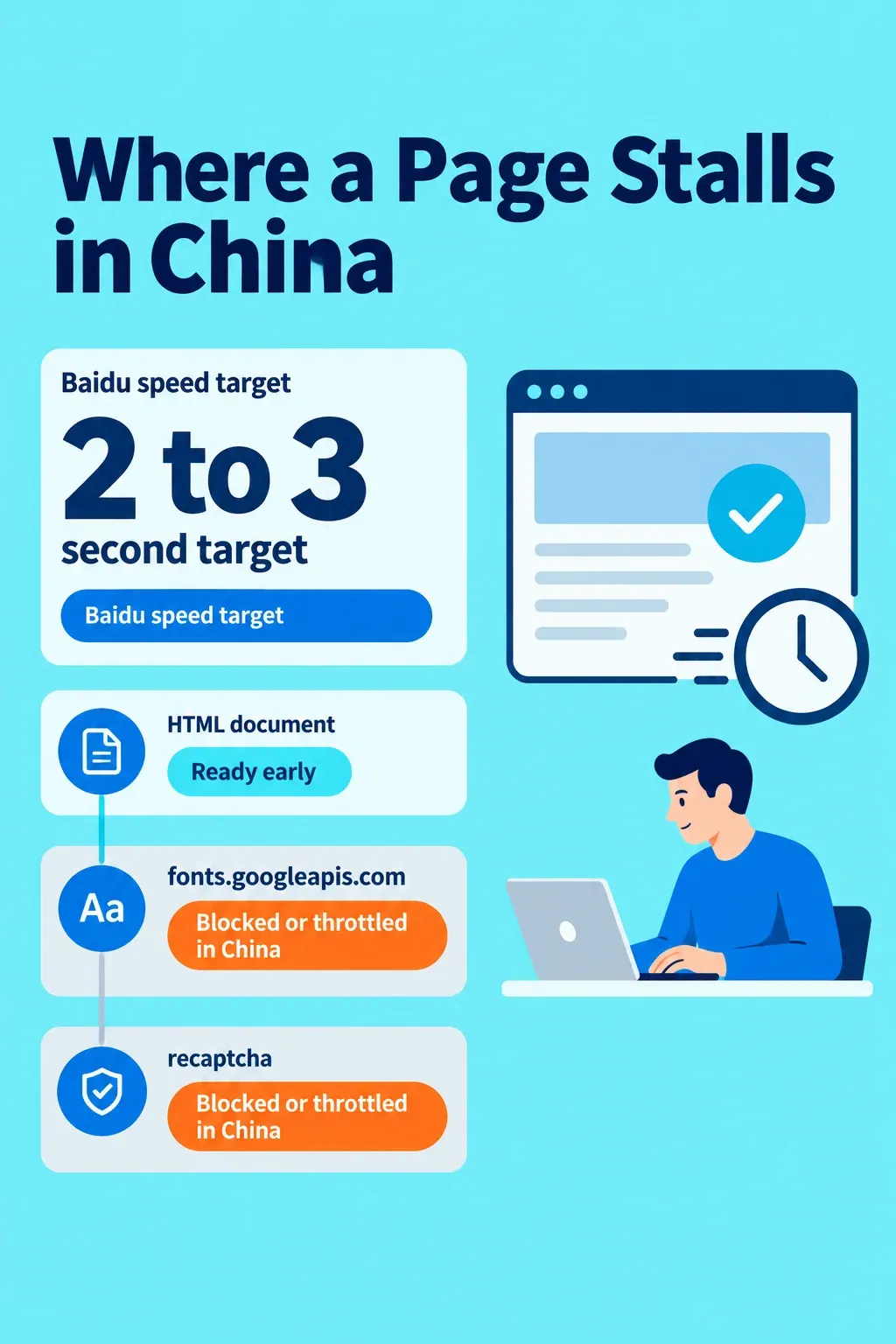
- Google Fonts and reCAPTCHA calls that stall page loads in China → Self-host fonts and switch to a China-accessible CAPTCHA. Baidu's speed guidance centers on a 2 to 3 second load window.
- Unreviewed product claims and user content → Run a China-specific legal review before launch. The prohibited categories are broad and include anything barred by other laws.
For how these basics differ from Google, see our Baidu vs Google SEO comparison.
What Baiduspider Can and Cannot Read on Your Site
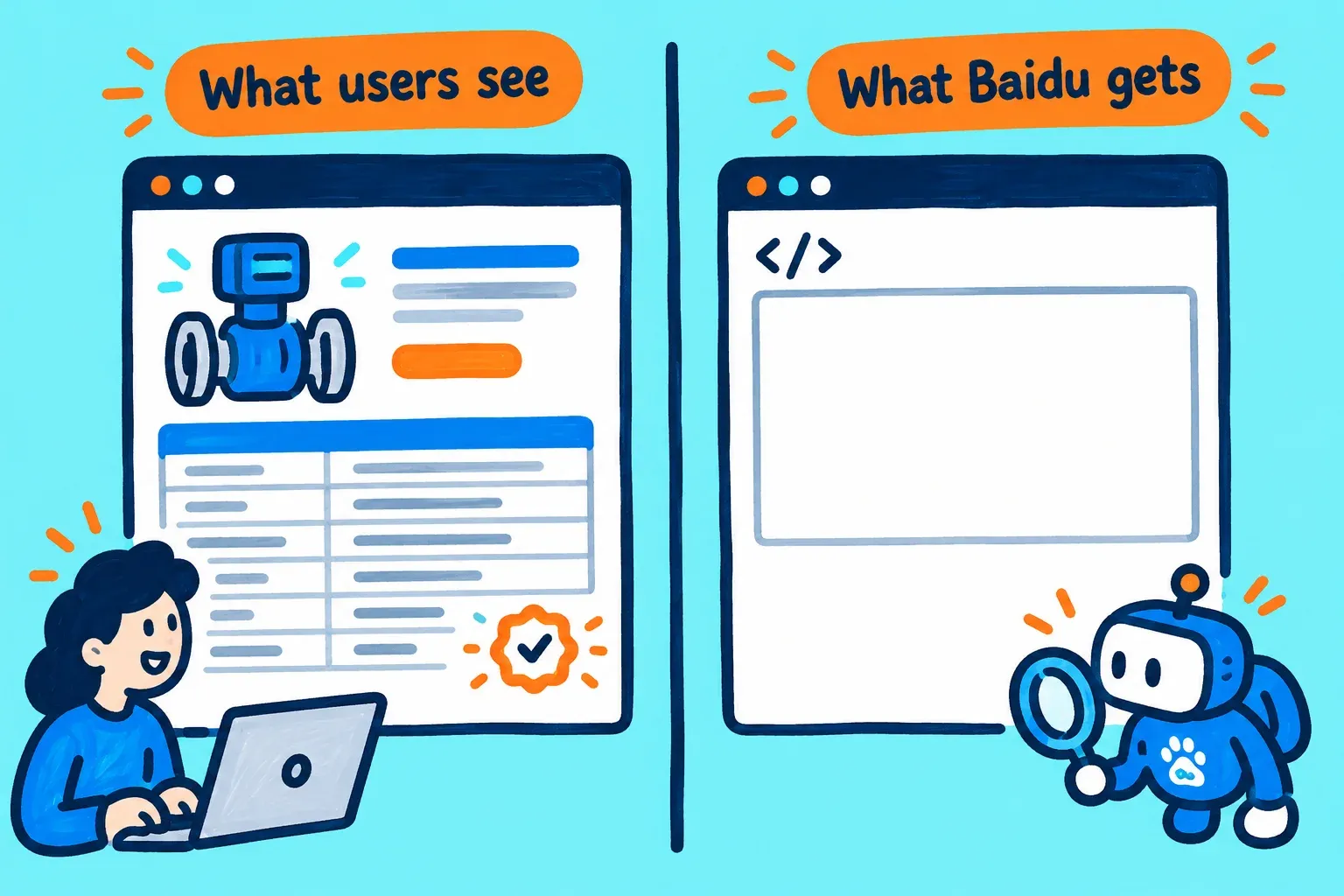
The flow-sensor site is a React single-page app. Buyers in a browser see a polished product catalog. Baiduspider may see empty pages.
JavaScript rendering. Baidu-documented: Baidu runs a separate rendering crawler, Baiduspider-render/2.0, alongside the standard Baiduspider/2.0. Baidu does not publish how much JavaScript it renders, and its docs do not promise that SPA content gets indexed. Practitioner-observed: content that loads through client-side API calls after hydration often gets indexed as an empty shell. Server-render or prerender every product and spec page so model names, specs, and certifications are in the initial HTML. Then compare "view source" with what the browser shows. If the specs are missing from the source, Baidu may never see them.
robots.txt. Practitioner-observed: developers often block asset or API folders by habit. That stops Baiduspider from fetching the CSS and JS it needs to render the page. Add an explicit Baiduspider group and leave assets open. Before you block "Baidu" traffic at the firewall, run a reverse DNS check. Baidu-documented: real crawlers resolve to *.baidu.com or *.baidu.jp.
HTTPS. Baidu-documented: Baidu announced full HTTPS crawling and indexing in May 2015. In June 2017 it upgraded its HTTPS certification tool to prioritize crawling and display of verified sites. Migrate once, redirect every HTTP URL, and verify the move in the Search Resource Platform (formerly Baidu Webmaster Tools).
Mobile adaptation. If you run separate m. URLs, submit mapping rules in the Search Resource Platform. Practitioner-reported: the tool requires equivalent primary content on PC and mobile pages, and it only maps pages for display. It does not fix rankings. Responsive design removes the mapping step entirely.
Run representative pages through Baidu's crawl diagnosis, then confirm indexing gains in Baidu Tongji.
How Baidu's AI Answers Change Who Gets the Click in 2026
Ranking on page one no longer guarantees a visit. Baidu reported that more than 50% of mobile search-result pages carried AI-generated content by the end of June 2025, up from 35% in April, and 64% by July. That figure counts result pages, not queries. In the same report, Baidu said link-based results are being progressively replaced by structured, multimodal AI answers. A later report put the share at roughly 70% by October 2025.
There was no single launch day. Baidu folded AI content into mobile results through 2025. Its developer docs record an April 17, 2025 update adding DeepSeek and ERNIE 4.5, and they describe AI Search as using search content as real-time knowledge that models filter and summarize. Coverage describes the answer cards as sitting near the top of results with clickable citations that point to Baidu properties, Zhihu, and company websites.
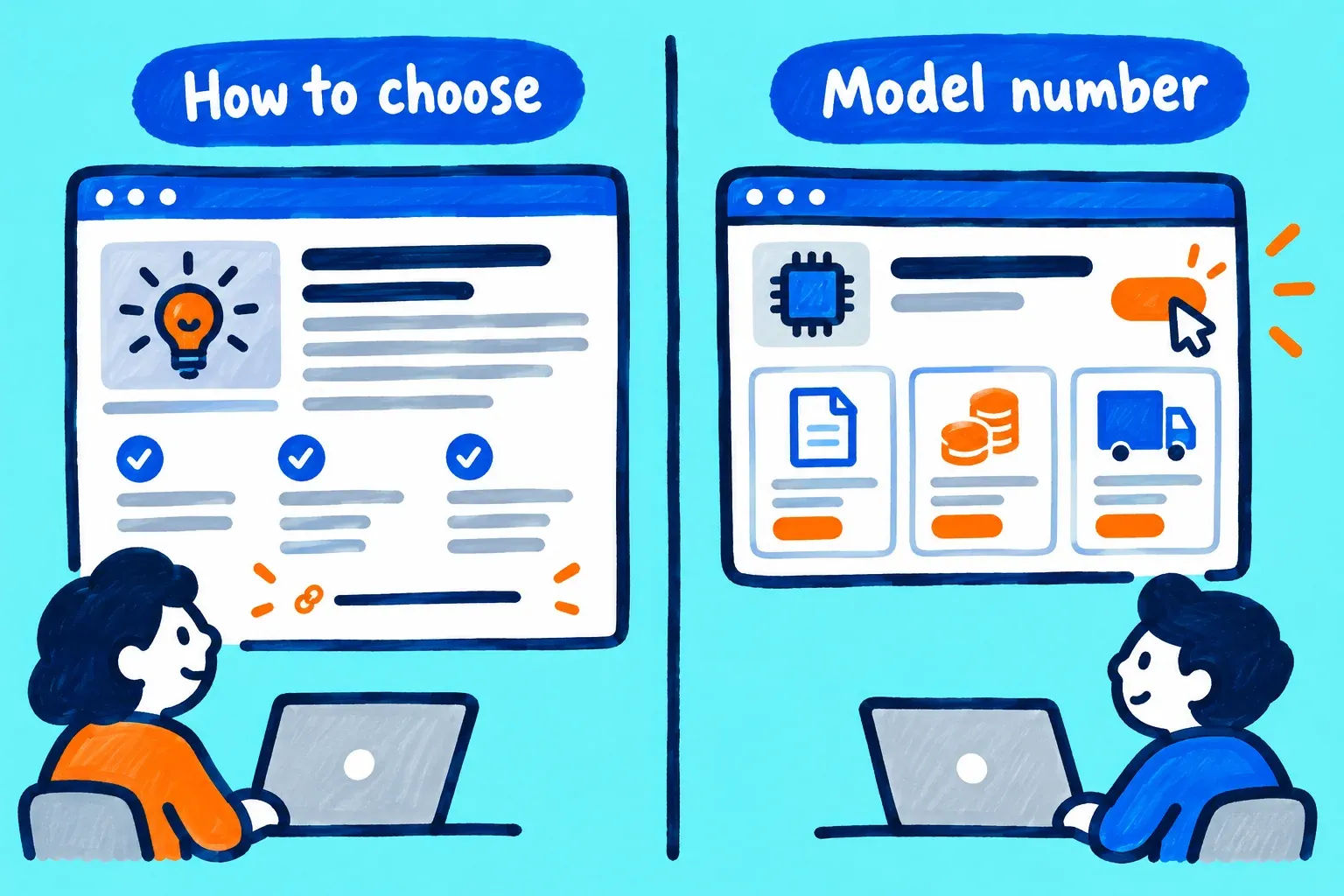
Take a Chinese engineer searching "how to choose a flow sensor for wastewater." The AI summary can define the problem, compare technologies, and judge suitability without sending the engineer anywhere. A search for the flow-sensor company's exact model number plays out differently. That buyer needs a datasheet, a price, or the Shanghai distributor's phone number. Our inference, which Baidu has not published, is that model and brand queries keep more click potential than informational ones.
So how does a page get cited? Baidu hasn't said. It has not published its citation weighting or answer-ranking formula. Getting indexed does not guarantee a citation, and there is no independent proof that ERNIE favors Baidu-owned sources.
Here is what we see working in client accounts. These are agency observations, not Baidu rules:
- Vague "solutions" copy gets skipped. Answer one buyer question per page in native Chinese, using clear H2s and short paragraphs.
- "High accuracy" gives the model nothing to quote. Publish specs like ±0.5% accuracy, IP68, and DN50 to DN1000 in HTML tables.
- A site with no outside footprint is hard to vouch for. Build mentions on Baidu properties and reputable Chinese trade media.
- If you only check rankings, you miss the shift. Track impressions, clicks, branded searches, and conversions separately in Baidu Tongji.
When impressions rise while clicks stay flat, the AI layer is probably answering for you.
Baike, Zhidao, Tieba, and Baijiahao: Where B2B Brands Can Show Up
Your website competes with Baidu itself. Baike, Baijiahao, Zhidao, and Tieba routinely take first-page spots for competitive queries. No reliable recent study puts a number on how much of the page they own. Treat Baidu as a set of surfaces you can publish on, beyond your own site.
- Baijiahao is the most practical channel. Publish Chinese application notes, troubleshooting guides, and explainers there.
- Baike works for branded searches and credibility. Baidu's enterprise entry guide asks for factual, evidence-backed copy. Bring citable sources and business documents. Leave the marketing language out.
- Zhidao is for answering real buyer questions with technical substance. Zhidao's rules prohibit promotional content and traffic-driving links. Fake Q&A pairs are a penalty risk.
- Tieba covers niche engineering forums. Join existing threads when you have something useful to add.
Do these surfaces feed AI answers? Chinese GEO practitioners see Baike and Baijiahao cited often, but their samples are private. Baidu has published no preference rule.
The flow-sensor company posts one Baijiahao application note per month. Each note covers wastewater metering, with installation diagrams, DN ranges, and accuracy data, and links back to its datasheet.
Baidu Penalties in 2026: What Gets B2B Sites Demoted
Baidu has been fighting spam for more than a decade. Green Radish 1.0 launched February 19, 2013. It stripped ranking value from bought and sold links, and Baidu warned of further action against the sites involved. Green Radish 2.0 followed on July 1, 2013, and extended enforcement to paid advertorials and the links inside them. Pomegranate, released May 17, 2013, hit pages where ads buried the main content.
Treat all three as history. Many "Baidu algorithm" lists online are third-party summaries rather than official documentation. Build your 2026 checklist from Baidu's current rules instead:
- Buying links from Chinese link farms → Stop. Earn citations from partners, industry associations, and trade media.
- Distributor sites copying your product pages → Your Shanghai distributor's copy of your datasheet competes directly with your own page. Baidu lists copying and splicing content as low quality. Give distributors distinct, localized content, or have them summarize and link to your original.
- Keyword-stuffed titles → Baidu warns against keyword accumulation and excessive title modifiers. Write one clear title per page. Ignore folklore character counts.
- Pop-up chat widgets on mobile → Baidu's guidance restricts intrusive ads and poor mobile landing pages. Show chat after a tap or scroll, as a small button.
- Paying for click traffic to boost rankings → Drop the vendor. Baidu's anti-spam rules cover search fairness.

To spot a penalty, watch for sudden drops in indexed pages or traffic, then check site messages in the Search Resource Platform. Fix the cause completely before you submit feedback. In our experience, link-spam recovery on Baidu can take years.
Your Baidu SEO Priority List for 2026
Fix these in order. Each step depends on the one before it.
- Hosting, ICP filing, mobile speed → confirmed by Baidu
- Server-rendered pages, robots.txt, HTTPS, mobile adaptation → confirmed by Baidu
- Native Chinese content built around buyer questions → confirmed by Baidu
- Penalty-safe links, titles, and mobile UX → confirmed by Baidu
- Baidu properties and AI-answer-ready content → practitioner-observed
The flow-sensor company spends days 1 to 30 on mainland hosting and ICP. Days 31 to 60 go to prerendering spec pages. Days 61 to 90 go to Chinese application notes on its site and Baijiahao.
Dminorstudio offers Baidu SEO and PPC support. More on the blog.
Which of these is your China site failing today?
Sources
- Search Engine Market Share China, StatCounter
- 上海电商公司需要办理ICP许可证吗, 上海市中小企业发展服务中心
- What are the fundamental differences between Baidu and Google SEO?, dminorstudio
- Baiduspider user-agent documentation, Baidu Search Resource Platform
- Baiduspider rendering documentation, Baidu Search Resource Platform
- Baiduspider, Patrick Stox
- Baidu SEO Ranking Factors 2026: Data-Driven Guide, SEO for China
- Baiduspider identity verification guidance, Baidu Search Resource Platform
- 百度站长平台:HTTPS认证工具升级公告, 沃通WoSign
- 百度资源平台移动适配使用说明, 搜外SEO教程
- Baidu Announces Second Quarter 2025 Results, Baidu, Inc.
- Introducing Support for Baidu AI Tracking, LLM Pulse
- 千帆AppBuilder产品文档, 百度AI开放平台
- 百度AI搜索:千帆AI应用开发者中心文档, 百度智能云
- Baidu (百度) GEO Guide: ERNIE, AI Search and Baiduspider, Coaley Peak
- Baidu, SearchEngines.Net
- 2026年百度AI搜索GEO怎么做?, 即推GEO学院
- China GEO Playbook: Get Cited by DeepSeek, ERNIE & Doubao, dminorstudio
- Baidu, Marketing China (GMA)
- 企业类词条编辑指南, 百度百科
- Baidu Zhidao, 百度百科
- 百度AI搜索怎么优化:信源分布与权重排序, 互橙增长实验室
- 百度绿萝算法1.0和2.0版本的公告完全解读, 赵彦刚博客
- Baidu SEO Algorithms Index, China Marketing Corp
- Baidu webmaster notice, Baidu Search Resource Platform
- Baidu title and keyword guidance, Baidu Search Resource Platform
About The Author

Stephen Tseng
Co-founder of dminorstudio. regularly writes about the intersection of AI, SEO, and B2B growth strategy.
Frequently Asked Questions About Baidu SEO for B2B
Does Baidu SEO work the same way as Google SEO?
No. While both search engines share some basics, such as page speed, mobile-friendliness, and quality content, Baidu operates on a distinct set of signals. Key differences include the need for an ICP filing to host in mainland China, Baiduspider's limited JavaScript rendering, and Baidu's own ecosystem of platforms like Baike, Baijiahao, and Zhidao. A strategy built purely around Google signals often underperforms on Baidu.
What is an ICP filing and does every B2B site need one?
An ICP filing (ICP备案) is a registration that every website hosted on a mainland China server must have. Foreign companies usually need a local entity or partner to complete the filing. An ICP license (ICP许可证) is a separate requirement that applies only to commercial services such as online transactions or paid memberships.
How does Baidu's ERNIE AI affect B2B search traffic?
Baidu reported that more than 50% of mobile search-result pages carried AI-generated content by the end of June 2025, and a later report put the share at roughly 70% by October 2025. For informational queries, the AI summary can answer the user's question directly without sending them to any website. Model and brand queries likely keep more click potential, though Baidu has not published this. B2B sites should publish structured, specific content, with clear specs and technical data in HTML tables, so AI systems have something precise to cite.
What is Baijiahao and should B2B companies use it?
Baijiahao is Baidu's content publishing platform. Baidu properties, including Baijiahao, routinely take first-page spots for competitive queries. For B2B brands, it is a practical channel for publishing application notes, technical explainers, and industry guides in Chinese. Publish real technical substance rather than marketing copy.
How long does Baidu SEO take to show results for a B2B site?
Baidu publishes no timeline. Plan the technical foundations first: mainland hosting, ICP filing, and server-rendered pages. The example plan in this guide spends 90 days on hosting and ICP, prerendering spec pages, and starting Chinese application notes. In our experience, recovery from link-spam penalties can take years.
Can a B2B company get cited in Baidu AI answers?
Getting cited in Baidu's AI answers is possible, but Baidu has not published a confirmed citation formula. Based on practitioner observation, pages that publish specific, structured answers to real buyer questions in native Chinese, backed by named specs, certifications, and factual data, appear more likely to be cited. Chinese GEO practitioners also see Baike and Baijiahao cited often, though Baidu has published no preference rule.