
Where Chinese AI Engines Actually Pull Their Answers
Chinese AI engines pull answers from a mix of official company and government sites, licensed news publishers, knowledge and Q&A platforms, social ecosystems, academic databases, and specialist technical communities. That is the short version. The longer version is that no single ranking holds across every engine, because citation formats and source preferences are governed by each engine's specific ecosystem.
Treat the 12 entries in this piece as an unranked priority list, not a scoreboard. The order does not represent measured citation frequency or cross-engine influence. It reflects where international B2B brands tend to get the most return for the effort.
The sources Chinese AI engines cite shift with several variables at once: which engine answers, whether the query triggers live retrieval or leans on the model's parametric memory, the freshness the question demands, the search mode a user selects, and what sits in that engine's accessible index. A Qwen workflow with the web search tool configured behaves differently from a DeepSeek session with no live search enabled.
So inclusion in any one platform never guarantees a citation. What it does is raise the odds that an engine finds accurate, corroborated information about you when a relevant query fires.
How Does Each Chinese AI Engine Source Its Answers Differently?
Six engines, six different retrieval setups. Treat the differences as the reason your Baidu ranking alone will not carry you across every product.
A few ground rules first. Citation behavior shifts by product version, search setting, user location, and query type. A question that asks for current information usually triggers live retrieval; a general question may lean on the model's trained memory and cite nothing external. Label what follows as documented behavior or strategic inference, and verify before you build around it.
- Baidu / ERNIE (文心一言): Documented. Baidu integrated DeepSeek and ERNIE deep-search with online search and RAG in February 2025, and its AI answers display source links beneath the generated summary with configurable reference presentation. Inference: Baidu likely favors its own vertical properties such as Health and documents, plus selected partners.
- DeepSeek: Documented. Behavior changes sharply depending on whether web search is enabled. With live search off, it answers from training data and cites little.
- Doubao (ByteDance): Documented ownership. It sits inside the Douyin and TikTok short-form ecosystem. Inference only: no first-party rule states it prefers Douyin or Toutiao content in citations.
- Kimi: Documented. Search answers can embed inline citations, and its Deep Research mode is built for multi-source synthesis.
- Qwen (Alibaba Cloud): Documented. Citation depends on whether the web search tool is configured in a given workflow.
- Tencent Yuanbao: Sparse public documentation. First-party materials do not detail its retrieval integrations the way Doubao's or Qwen's do, so treat any claim about its preferred sources as inference.
Baidu covers a large share of queries with AI answers, cited near 45%. That reach still leaves five other engines pulling from indexes Baidu does not control.
The Facts Layer: Sources That Confirm Who You Are in Chinese AI Search
Before you publish anywhere, the engines need a consistent set of facts about your company, products, and claims. These four source types build that foundation.
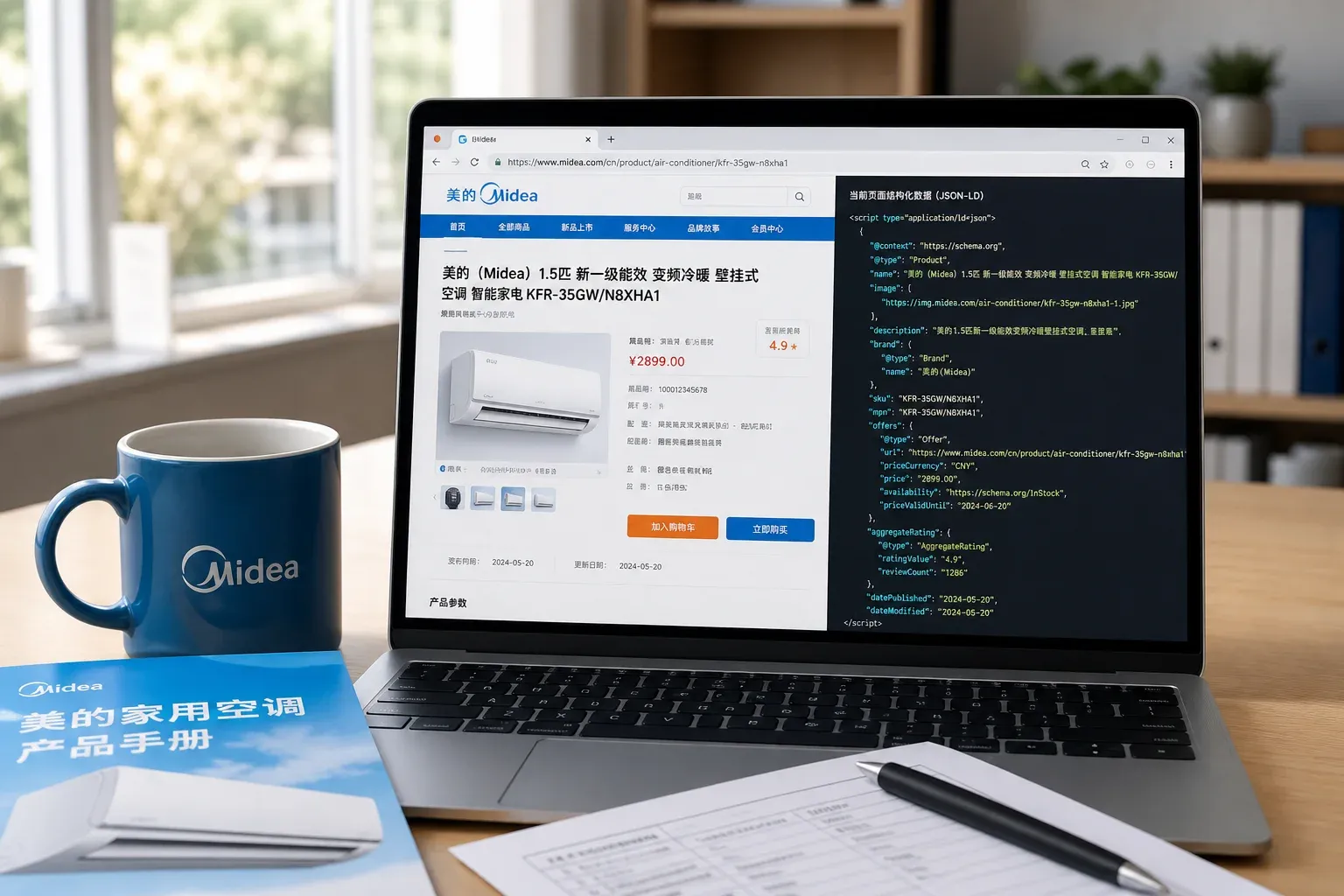
1. Your Chinese-language website and newsroom. Owned pages remain the primary record for company facts, product specs, executive bios, case studies, and announcements. If a crawler cannot read them, none of that reaches an index. This affects nearly every engine that runs live retrieval, and Baidu/ERNIE most directly given its integrated search. Build substantive Chinese pages, not thin machine translations or JavaScript-only experiences. Use stable URLs, visible publication dates, a clear organization identity, consistent Chinese product and brand terminology, and structured data. Confirm your pages are crawlable and indexable rather than assuming they are.
2. Government, regulatory, and public-institution sites. Ministry pages, regulator notices, standards bodies, procurement records, and corporate-registration systems carry verification weight that owned content cannot supply on its own. In China, government sites must use .gov.cn for English domains and .政务 for Chinese, and cannot use other suffixes, under State Council General Office notice 国办函〔2018〕55号. That predictable structure makes these sources easy for engines to trust for regulated-industry, compliance, and market-entry questions. Align your brand claims with your official registered name, license records, applicable standards, and public filings so the facts match across sources.
3. Established news organizations and major portals. National, financial, technology, and regional publishers, plus the large portals that redistribute reported content, can corroborate claims your own site cannot establish alone. Engines running live retrieval may surface this coverage for news-style or "latest" queries. Pursue newsworthy, attributable reporting rather than mass press-release syndication. Note that major outlets like 人民网 run submission processes with review, and theory-type contributions there are judged on originality, a clear argument, and identified author and organization. Thin, duplicated releases rarely earn that kind of independent standing.
4. Industry media, trade associations, and vertical portals. For technical B2B queries in manufacturing, automotive, electronics, healthcare, energy, or software, niche authority often outweighs broad popularity. A specialist portal that covers your exact category can shape how an engine describes your product against competitors. Contribute expert articles, standards commentary, and detailed Chinese case studies, and participate in sector events that generate coverage. These signals matter most when a user asks a comparison or specification question rather than a general one.
Get these four right and later platform publishing has something accurate to reference. Skip them, and every downstream mention inherits the gaps.
The Knowledge Layer: Where Chinese AI Engines Repeat or Distort Brand Facts
Once the facts exist, the platforms that summarize and discuss them shape how engines describe you. These four differ sharply in editorial rigor.
5. The Baidu knowledge ecosystem: Baike, Zhidao, and Wenku. Baike is an encyclopedia, Zhidao a community Q&A service, and Wenku a document-sharing library. Baike carries the most weight for durable entity facts because it applies reference-quality tiers, treating central government sites, central media, and recognized academic journals as A-class sources while requiring independent documentation for commercial claims. Contributor guidance is blunt: choose big sites, direct publication, with an editor, no disclaimer. Forums, blogs, and self-media are restricted as references. Zhidao and Wenku face lighter source verification, so their content is less reliable for entity facts. These pages may surface in Baidu/ERNIE and in other engines when publicly discoverable. Supply accurate, well-sourced entity information and genuinely useful documents. Skip promotional encyclopedia copy and unsupported edits; they get reverted.
6. Baijiahao and Baidu's publisher network. Baijiahao is Baidu's self-media publishing platform, judged on content quality, legal compliance, and moderation. Its proximity to Baidu distribution does not buy automatic preference or citation. Publish original, expert-led Chinese content that answers real industry questions, and link claims to primary evidence rather than restating marketing lines. Thin or duplicated posts rarely earn independent standing.
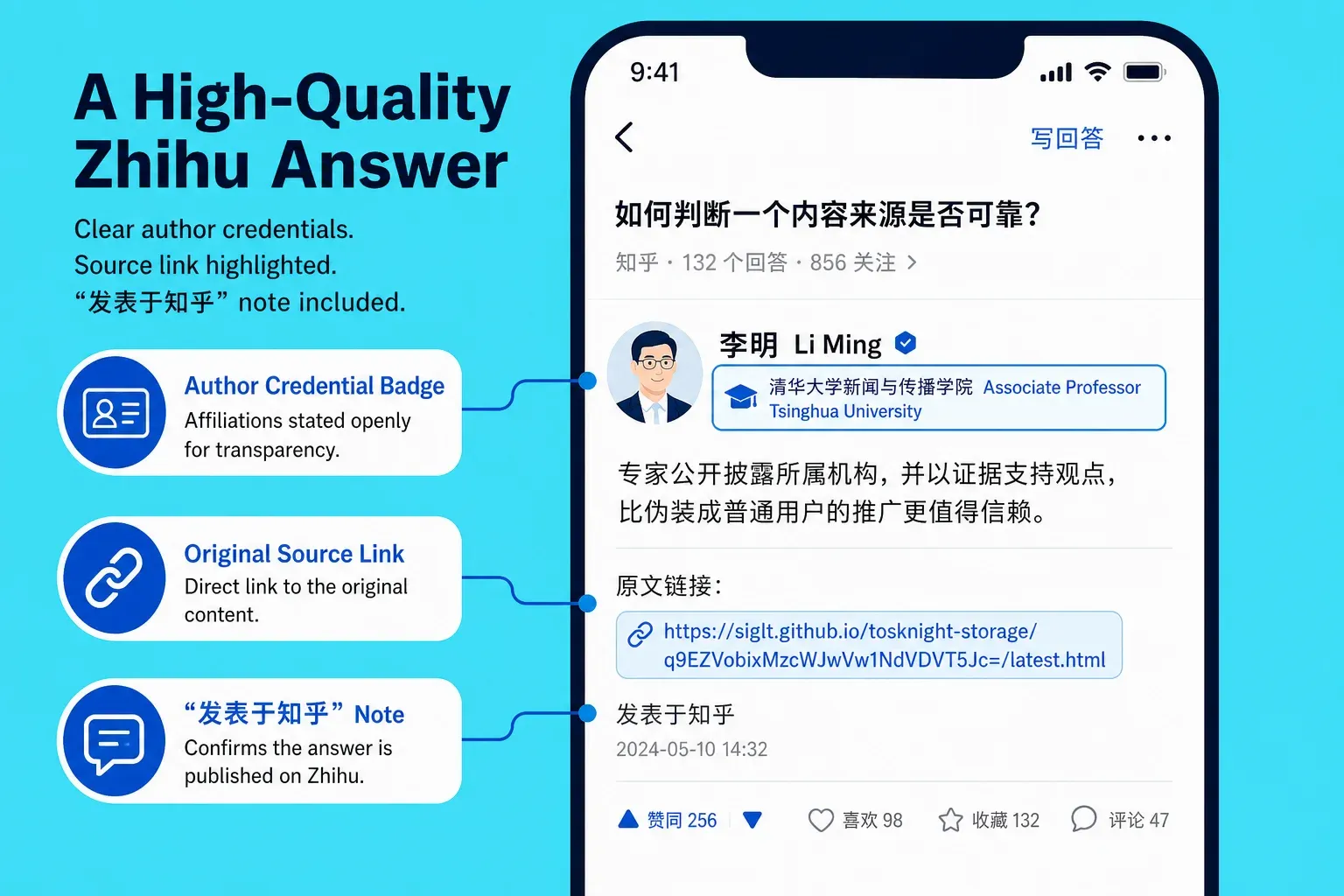
7. Zhihu. Zhihu is a major Chinese Q&A and expert-discussion platform, useful for comparison, evaluation, technical explanation, and problem-led queries. Credible, detailed answers from named subject-matter experts do better than disguised promotion. If you reprint others' answers, the rules require clear author attribution, the original link, the "发表于知乎" note, and no modification. State affiliations openly and back claims with evidence.
8. WeChat Official Accounts. These accounts carry much of Chinese corporate publishing, industry commentary, and customer education. They may hold relevance for Tencent Yuanbao within Tencent products, but visibility outside that environment is limited: content is largely restricted to the app, with account index pages requiring a verification key, which blocks broad crawling. WeChat's own 搜一搜 search rewards compliant metadata, consistent content categories, and a clean violation history. Under the 2025 rules, articles quoting more than 30% of their length cannot be marked original. Use searchable titles, consistent entity naming, and original analysis, and keep a permanent version of strategically important pieces on your own website where every engine can reach them.
Which Source Types Win Specialized B2B Queries in Chinese AI Search?
When a query shifts from "who is this company" to "prove it works," the useful sources change. These four ecosystems earn attention for research, implementation, sentiment, and product decisions.
9. Academic databases and institutional repositories. CNKI, launched in 1999 under Tsinghua University supervision, and Wanfang Data are national-scale hubs covering journals, dissertations, conferences, patents, and standards. Both are subscription-oriented, so full text is often licensed and hard for external engines to quote, while metadata and abstracts are broadly searchable. University repositories like Peking University's are more openly accessible but decentralized. For scientific, engineering, medical, and policy questions, publish citable research with Chinese abstracts, white papers with a clear methodology, and stable author profiles that engines can match to your organization.
10. Developer communities and code repositories. CSDN, Gitee, GitHub, and official developer portals shape software, API, troubleshooting, and cybersecurity answers. Public Gitee files are discoverable through web search, and CSDN content is routinely filtered with the site:csdn.net operator on Baidu. CSDN now reviews author quality every 90 days and can revoke expert status for low-quality or unoptimized AI content, so thin posting backfires. Publish complete documentation, working examples, version dates, changelogs, and consistent product attribution.
11. The ByteDance content ecosystem: Toutiao and Douyin. Toutiao is a news and content-recommendation platform; Douyin is China's major short-video app. Both may feed real-time consumer and industry signals, and there is a reasonable strategic case that Doubao draws on adjacent ByteDance content, though I have not seen first-party confirmation of retrieval behavior. Treat that as inference, not fact. Douyin's creator rules prohibit traffic fraud and false marketing. Publish expert-led explainers with transcripts, descriptive captions, explicit brand attribution, and links to durable supporting pages, since not every engine can retrieve app-locked video.
12. Product and commercial-information platforms. 1688, Tmall, JD.com, distributor catalogs, and reputable B2B directories answer questions about availability, specifications, seller identity, and pricing context. Access carries qualification requirements: 1688 tightened its 严选 store entry levels in April 2023, and 实力商家 status requires compliance with 1688's admission and brand standards. Keep accurate Chinese product names, model numbers, certifications, specifications, and authorized-channel information consistent across every listing so comparisons resolve to you, not a gray-market reseller.
How to Turn the 12 Source Ecosystems Into a Prioritized B2B Action Plan
Twelve source categories are more than any single team can maintain well. Work in sequence and pick based on your buyers' questions, where your sector holds authority, and what your team can keep accurate over time.
Start by auditing the six named engines. Run the same controlled prompt set through Baidu/ERNIE, DeepSeek, Doubao, Kimi, Qwen, and Tencent Yuanbao: brand prompts, category prompts, comparison prompts, and problem-based prompts. Record what each cites, which URLs appear, and where the facts are wrong. That baseline tells you which sources already carry you and which engines ignore you.
Next, fix the evidence foundation on your Chinese website. Make key pages crawlable in initial HTML rather than client-side JavaScript, keep entity names consistent, and publish dates, authorship, specifications, and primary documents an engine can quote. Use correctly configured robots.txt, submitted sitemaps, and consistent canonical URLs. Conventional Baidu SEO still helps here, but ranking well on Baidu does not guarantee you appear in DeepSeek, Kimi, or Doubao answers. Treat crawlability and rankings as prerequisites, not as the finish line.
Then select three to five external ecosystems from the twelve, chosen by sector fit and engine exposure rather than publishing everywhere. A scientific instrument brand leans toward CNKI, Wanfang, and Zhihu; a software vendor toward CSDN, Gitee, and developer portals.
Build independent corroboration. Credible media, industry associations, named experts, customers, published research, and technical communities give engines the third-party confirmation they favor when deciding what to trust.
Finally, monitor monthly. Track mentions, cited URLs, factual accuracy, how answers shift across prompt variations, and whether your source content stays fresh.
Measure citation presence and accuracy as their own metrics, separate from rankings and traffic. No plan guarantees inclusion, but accurate, corroborated, crawlable sources raise your odds across more engines than Baidu rankings alone ever will.
Where to Get Help Building Your Chinese AI Search Footprint
Auditing six engines, prioritizing ecosystems, and maintaining accurate Chinese-language sources is real ongoing work, not a one-time project. If your team lacks the in-market capacity to run it, that is where outside help pays off.
dminorstudio works with industrial and professional-services B2B companies on China market entry, combining China-ready website development, Baidu SEO, and WeChat operations into one program. One externally reported case study credits the agency with a Full-Stack Baidu B2B SEO strategy for Micromeritics that produced 300% organic growth and an 80% lift in Baidu site indexation. Treat that as a single vendor-reported example in the industrial sector, not a promised outcome for every brand or every engine.
No agency can guarantee an AI engine will cite you. What a good partner can do is fix crawlability, keep your entity data consistent, and build the corroboration engines look for.
Want a review of how your brand currently shows up across Chinese AI engines and where to focus first? Book a call with dminorstudio.
Sources
- Optimizing for Yuanbao (Tencent): A Strategic Playbook, ChinaRankAI
- Why AI-Generated Content Gets Ignored by AI Search, CMSWire
- Web search with large models - Alibaba Cloud Model Studio, Alibaba Cloud
- 百度将整合文心Deepseek AI搜索全面升级 - 新闻频道 - 中华网, 中华网
- Baidu AI search ecosystem coverage, 电商报
- Baidu AI search reference configuration, CNExpIntel
- Doubao user agents - xSeek Docs, xSeek
- Kimi Deep Research overview, Kimi
- 百度AI搜索2025年战略:国内GEO的风向标 - 即推GEO学院, 即推GEO学院
- 国务院办公厅关于加强政府网站域名管理的通知(国办函〔2018〕55号), 国务院办公厅
- 您添加的参考资料无法佐证内容百科参考资料使用条件详细说明-百科优化网, 百科优化网
- 如何创建百度百科词条,参考资料是硬通货,这三类才管用-百科优化网, 百科优化网
- 知乎协议- 知乎, 知乎
- Tracking Censorship on WeChat's Public Accounts Platform, The Citizen Lab
- 微信公众号和小程序怎么做微信服务搜索?搜一搜服务搜索排名规则解析, A5站长网
- 2025年微信公众号怎么加原创?最新原创标识使用指南你用对了吗?, 壹伴新媒体
- China National Knowledge Infrastructure (CNKI) as a Resource for Nineteenth-Century Music Studies, Cambridge University Press
- global_block.txt · hbkuang/bypass - Gitee.com, Gitee
- 关于开展博客专家及优质作者身份专项清理的公告-CSDN博客, CSDN
- 短视频创作者管理规范 - 小程序 - 抖音开放平台, Douyin
- 1688:严选旗舰店及严选店将在4月10日升级准入门槛 - 电商派, 1688
- 实力商家服务条件, 1688
- Baidu SEO Guide for Western Brands, SEO Mandarin
- New Website SEO: Submit to Baidu and Google | AIOOS, AIOOS
- Baidu SEO Agency | China Market Presence for Business Growth, dminorstudio
- China SEO Case Studies: Proven Results from Leading Brands ..., SEOforChina
- B2B China and US Digital Marketing Agency | dminorstudio, dminorstudio
About The Author

Stephen Tseng
Co-founder of dminorstudio. regularly writes about the intersection of AI, SEO, and B2B growth strategy.
Frequently Asked Questions About Chinese AI Search Sources
What is the difference between how Baidu AI and DeepSeek source their answers?
Baidu's AI answers, built on ERNIE, combine live search with retrieval-augmented generation, so they pull from indexed web pages and display source links beneath the generated summary. DeepSeek behaves very differently depending on whether web search is enabled. With live search off, it answers from training data and cites little. This means a brand that is visible in Baidu's AI answers may still be missing from a DeepSeek answer when the user has not enabled live search.
Do Chinese AI engines cite WeChat content in their answers?
WeChat content is largely restricted inside the app, with account index pages requiring a verification key that blocks broad crawling by external engines. This means most Chinese AI engines outside of Tencent's own products cannot reliably index or cite WeChat articles. For content you want cited widely, publish a permanent version on your own website where every engine's crawler can access it. WeChat is valuable for audience reach and Tencent Yuanbao relevance, but it should not be your only publishing channel if broad AI citation is the goal.
How important is Zhihu for B2B brands targeting Chinese AI search?
Zhihu is one of the more useful platforms for B2B brands because it is built for comparison, evaluation, technical explanation, and problem-led questions, which are exactly the questions B2B buyers ask. The key requirement is authenticity: answer as named subject-matter experts, state affiliations openly, and back claims with evidence rather than posting promotional or anonymous replies.
Can a foreign B2B company appear in Chinese AI search answers without a Chinese-language website?
It is very unlikely. Chinese AI engines that run live retrieval need crawlable Chinese-language content to surface your brand for Chinese-language queries. Without Chinese pages, the engine has no accessible source to draw from, and thin machine translations or JavaScript-only pages have the same practical effect as no Chinese content at all. A substantive Chinese-language website with key pages crawlable in initial HTML, consistent entity names, and original content is the starting point for any Chinese AI search presence.
How often should a B2B brand monitor its Chinese AI search citation presence?
Monthly monitoring is a practical baseline. AI engine behavior shifts with product updates, index changes, and new retrieval integrations, so what an engine cited last quarter may not reflect what it cites today. Monthly checks across all six major engines, using a consistent set of brand, category, comparison, and problem-based prompts, give you enough data to spot factual errors, missing citations, and gaps in corroboration before they compound. Citation presence and accuracy should be tracked as separate metrics from traditional rankings and traffic.
What types of content are most likely to be cited by Chinese AI engines for technical B2B queries?
For technical B2B queries, Chinese AI engines tend to favor content that is specific, well-sourced, and published on authoritative platforms in the relevant category. That includes citable research with Chinese abstracts on CNKI or Wanfang, complete technical documentation on CSDN or Gitee with version dates and working examples, detailed expert articles on Zhihu or specialist vertical portals, and white papers with clear methodology published on your own Chinese-language website. Generic blog posts and marketing copy rarely earn citations for technical queries because engines can find more precise answers elsewhere.