
Start with Baidu Ads when demand is still a question
If you are unsure whether Chinese buyers want what you sell, whether your keywords match how they actually search, or whether your messaging converts, start with a controlled Baidu PPC pilot. That is the practical recommendation we give clients at dminorstudio, and the reasoning is about sequencing capital, not crowning one channel as the winner.
Paid search buys you learning fast. Baidu search promotion is keyword-driven and charges only when someone clicks, so you control budget, bids, and the exact terms you test. Within weeks you see which queries pull traffic, which pages hold attention, and whether inquiries turn into real conversations. That same activity can capture near-term leads while you learn.
Baidu SEO works on a different clock. Organic visibility depends on sustained Chinese-language content, crawlable pages, and indexing eligibility, and it compounds over months rather than days. It rewards patience and an organization ready to fund a real localization program.
SEO can reasonably come first when demand is already proven and you have the appetite for that longer commitment. Otherwise, run the pilot, then let the evidence direct your SEO spend.
One caution before the details: a China search plan is not a translated copy of your Google program. The platform, the buyer behavior, and the ranking signals differ.
What actually shapes your first China search decision
The PPC-versus-SEO tradeoff you know from Google is only part of the choice here. Several factors specific to China change what your first investment can realistically deliver.
Start with buyer behavior. A Chinese research journey rarely stays inside one search box. It crosses search engines, short video platforms, and social-content apps, so a query that converts on Baidu may have started on Douyin or Rednote. Baidu's own results have shifted too: as of early 2025, AI functions in the Baidu App reached nearly 70% of monthly users, and more than a fifth of result pages carried AI-generated content. What ranks and what gets clicked is moving.
Localization is the durable principle underneath all of this. Translated keywords and a copied Google campaign will not carry you. Chinese buyers phrase problems differently, trust different signals, and judge a landing page on cues a direct translation misses. If the page reads like an export brochure, spend on either channel leaks.
Then the operational reality. Baidu makes advertisers pass identity and site review before campaigns run, verifying business qualifications and checking that the landing page meets compliance standards. Setup clears the gate. It does not decide whether your offer resonates.
Two internal factors round out the picture. Measurement: can you track a Baidu click through to a real inquiry? And follow-up capacity: when a Chinese-language lead arrives, who answers, in what language, how fast?
Six criteria run through the comparison that follows: speed, uncertainty, economics, control, internal readiness, and long-term goals. Weigh them against your own situation rather than against how you run Google at home.
How the two channels behave under pressure
Both channels put your business in front of Baidu users. They behave differently on speed, durability, and how much they teach you.
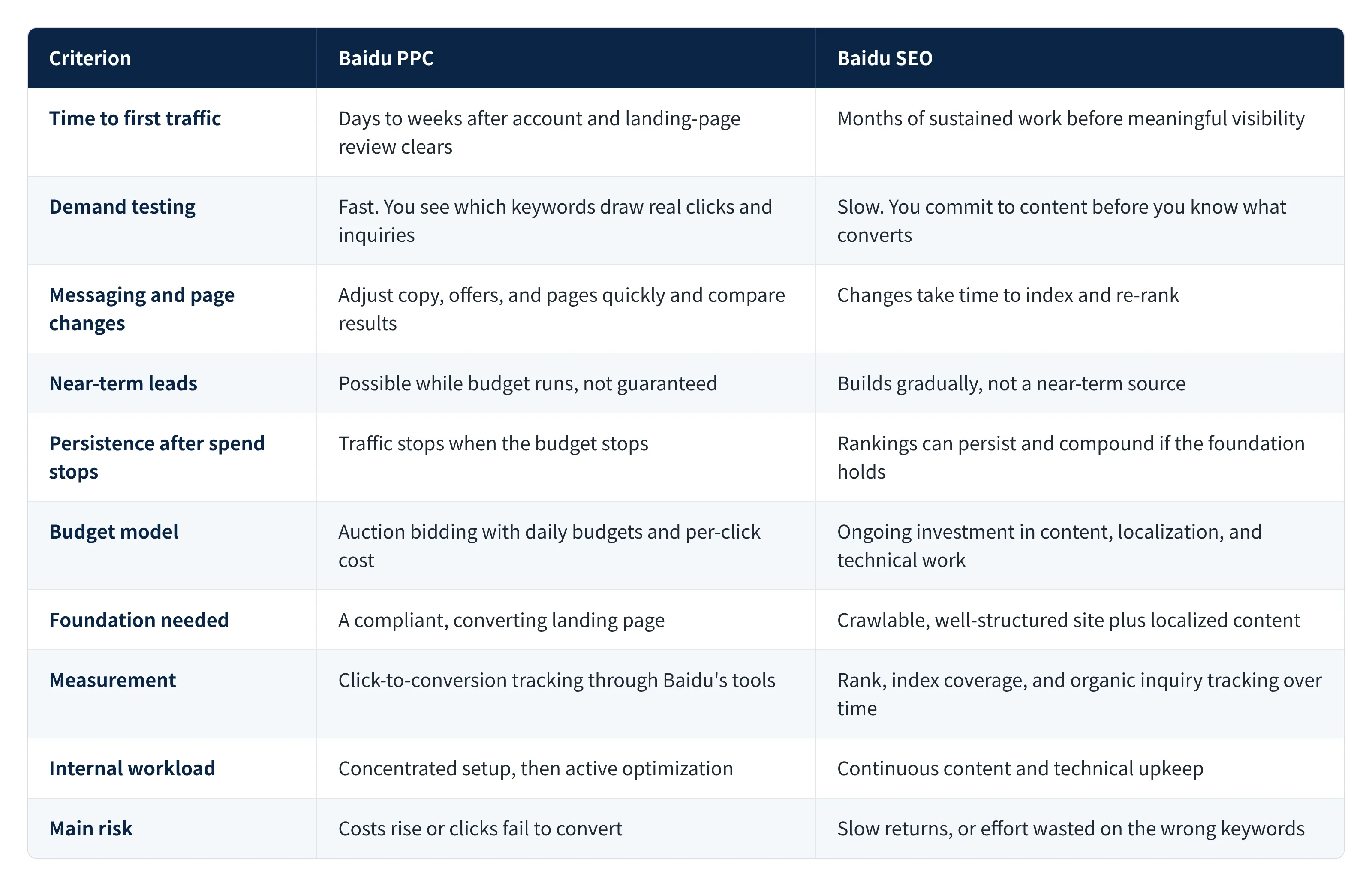
PPC buys controlled access to demand that already exists on Baidu. You choose keywords, set bids and budgets, target by region and time, and read back conversion data through Baidu's tracking across web, phone, and app goals. That control gives you fast feedback on whether Chinese buyers are searching for what you sell and whether your offer lands. It does not guarantee leads. Auction prices can climb, and a page that reads like a translated export brochure will burn clicks no matter how well the campaign is built.
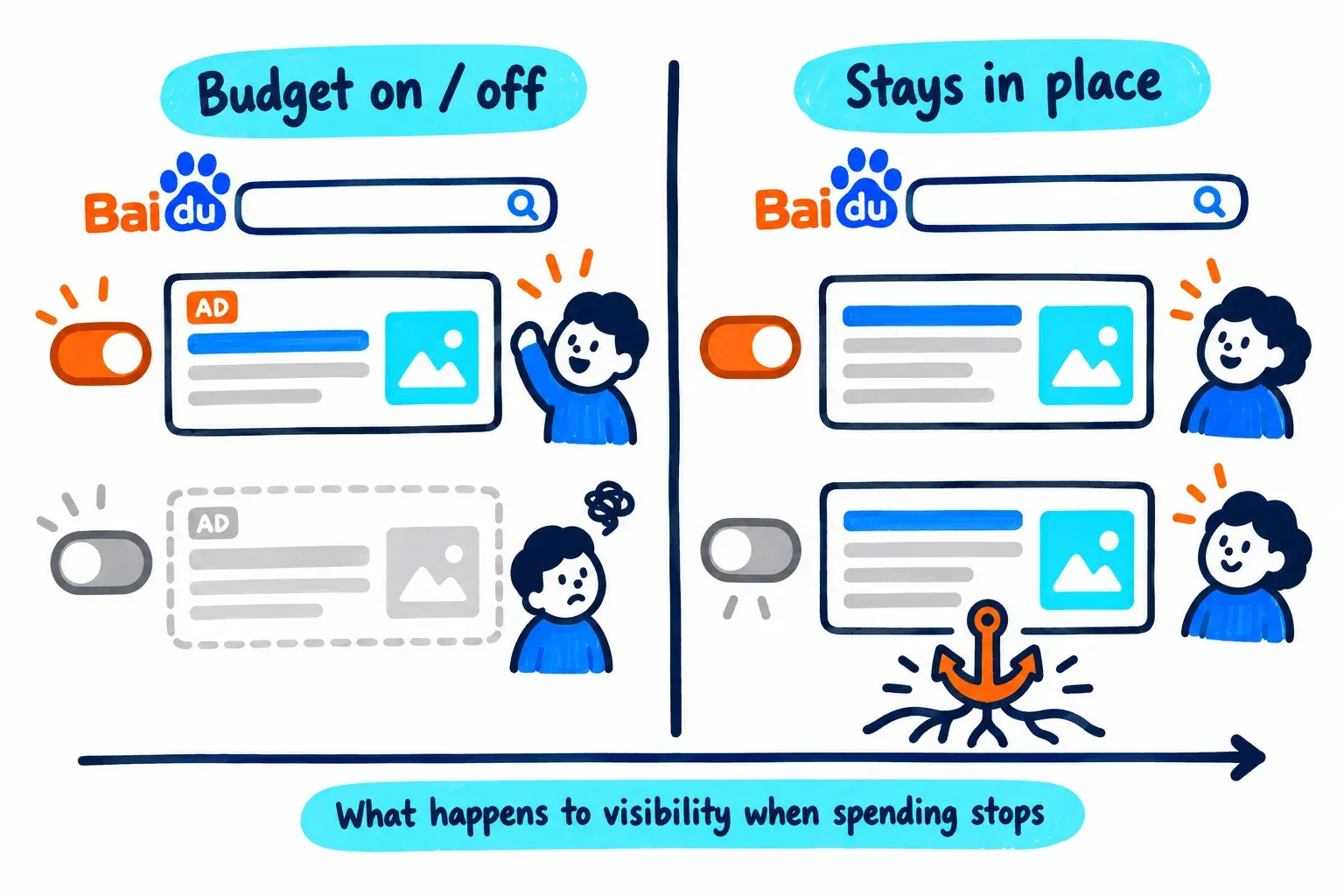
SEO is a longer-term visibility asset, not free traffic. Baidu's own description of how it handles search resources, crawl, storage, recall, ranking, and display, shows why. Crawl and indexing are the base everything else sits on, and reaching that base takes a crawlable site, localized content, and patience. When it works, visibility persists and compounds without per-click cost. When keyword choices are wrong, months of content can produce little.
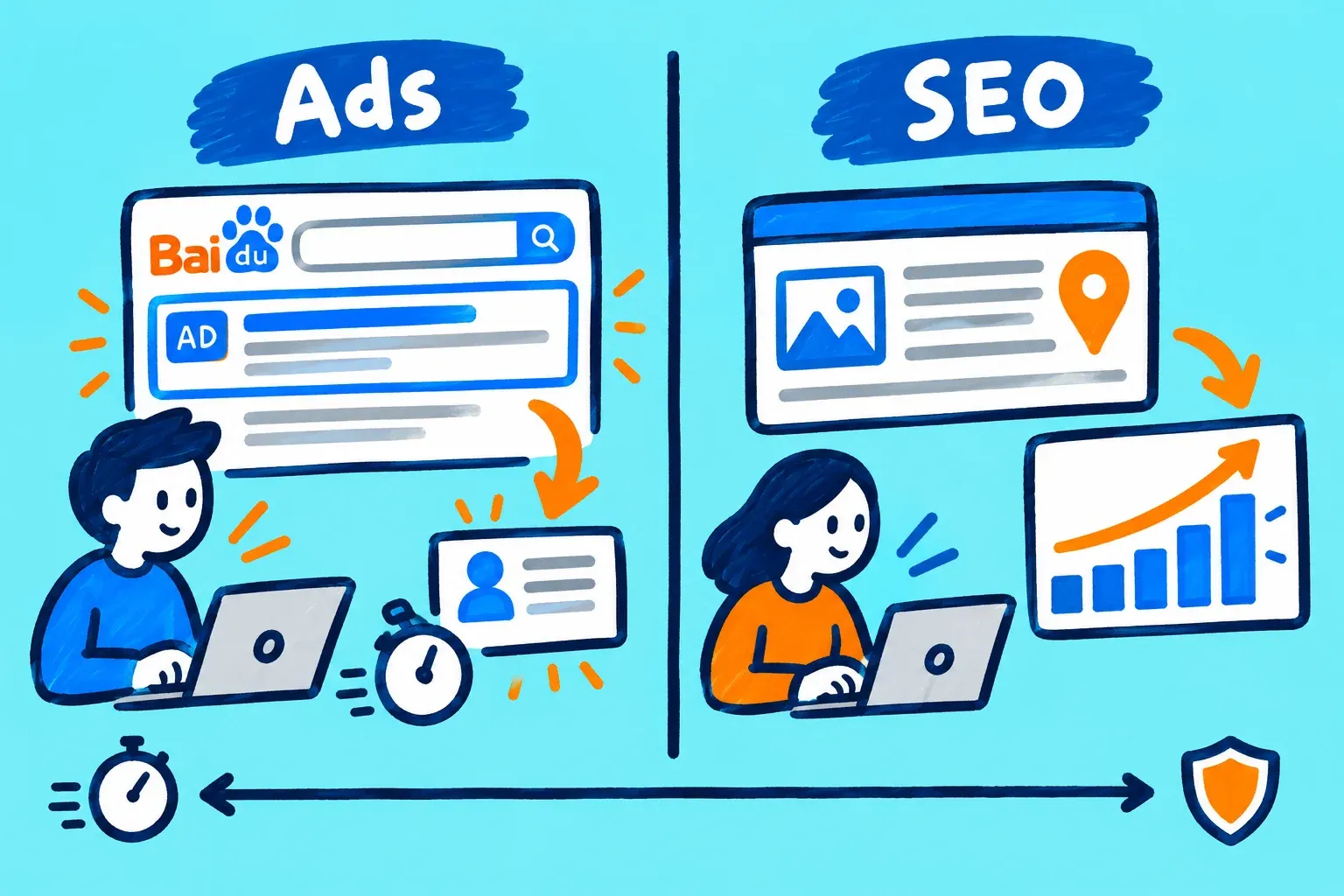
Neither wins on every criterion. PPC trades durability for speed and learning. SEO trades speed for persistence and lower long-run cost per visit. Which tradeoff fits depends on your situation, which the next section works through.
Matching the first move to your situation
The right first investment depends on what you already know and what your team can support. Three situations point in different directions.
Start with Baidu Ads
Choose paid search first when the fundamentals are still open questions. If you are unsure whether Chinese buyers search for what you sell, which terms they actually use, whether your messaging lands, or whether inquiries convert into pipeline, ads give you answers in weeks instead of quarters. Ads also fit when you need near-term leads while a longer program builds, or when leadership wants evidence before funding a broader push. A controlled paid pilot turns those unknowns into data you can act on.
Before committing, ask two things. Can your sales team follow up on Chinese-language inquiries quickly? And does your account clear Baidu's requirements? Advertisers must be lawful operators, many categories are limited to qualified enterprises, and your website content must match your qualification information.
Start with Baidu SEO
SEO first makes sense when the uncertainty is already gone. If demand is proven, the terminology your buyers use is well documented, and you have a localized Chinese website with content resources behind it, you can invest in organic visibility without gambling on keyword guesses. This path needs clear technical ownership of the site and leadership that accepts a longer time horizon. Ask honestly: can you produce localized content on a steady schedule, and can the organization wait months for visibility to compound? If the answer is no on either count, SEO first will stall.
Invest in both with clear roles
Running the two together works when budget and readiness allow it. Ads capture demand and test messaging now, while SEO builds durable visibility that persists after spend stops. Give each a defined job so they do not blur into one line item. The gating question is budget continuity. Can you fund paid clicks and sustained content work at the same time without starving either? If your budget only covers one channel this quarter, sequence them rather than splitting thin.
None of these paths is better in the abstract. The fit depends on your certainty, your team, and your timeline. When demand or keyword fit is still unproven, the paid pilot is the lower-risk way to learn, which the next section walks through in detail.
A pilot blueprint that produces evidence, not just spend
Start with one narrow question. Not "does China want our products," but something like "do procurement engineers in the Yangtze River Delta search for our type of industrial sensor, and will they submit an inquiry?" A tight question keeps the test readable.
From there, build outward.
Write a keyword hypothesis in Chinese, not translated English. The terms your buyers type are often industry shorthand, not the literal rendering of your English product names. Group those terms into promotion units by intent, and keep each unit to a single clear theme with consistent word meanings, which also helps quality scoring. Separate high-intent transactional queries from broad research terms so you can read them apart. If you run broader match types, add negative keywords in advance to keep irrelevant traffic out. Negatives can sit at both campaign and unit level and apply together.
Constrain the test to one region or one product line. Localize the ad copy and, more importantly, the landing experience. A credible Chinese-language page hosted for fast access in China does more for conversion than clever ad wording. Set up conversion tracking that records form fills and calls, not just clicks, so the account and region reports tell you where inquiries actually come from.

Decide before launch who receives a lead and how fast they respond in Chinese. A pilot with no owner on the sales side measures nothing.
Set your decision criteria in writing first. Name what would justify scaling, what would trigger a revision, what would pause the test, and what would send budget elsewhere. Review four signals together: search volume and query terms, on-page engagement, conversion rate, and lead quality from sales feedback.
A pilot earns its cost even when lead volume disappoints. Weak search volume tells you demand is thin. Odd search terms tell you your terminology is off. Good clicks with no conversions point at messaging or landing-page friction. Good leads that sales cannot close reveal a process gap. Each of those findings changes what you would do next.
Those same signals, especially the query terms and the messages that converted, become the raw input for SEO planning. Structuring and reading a pilot like this is work dminorstudio does with clients, and the next section shows how the results feed organic strategy.
Turning pilot data into an SEO roadmap
The pilot hands you a set of ordered inputs for organic planning. Read them and map each one to a specific action.
High-intent Chinese terminology that drove inquiries becomes your keyword priority list. Map each winning query cluster to a focused page rather than stuffing a generic list onto one URL. The ad messages that earned clicks and conversions tell you how to position page titles and opening content, which Baidu's guidance says should match the page's main content and reflect real search intent. Raw search-term reports expose content gaps: questions and modifiers you had not planned for. Products or use cases that converted set your landing-page build order. Geographic patterns in the region reports guide localization choices, from dialect and examples to which city or industry you feature. Lead-quality feedback from sales points you toward the topics, objections, and proof points worth writing about.
One caveat holds all of this together. Paid performance does not guarantee equivalent organic performance. A term can convert on a bid-controlled ad and still be hard to rank for, or sit behind entrenched domestic competitors. Ad data should inform the SEO roadmap, not dictate it.
The sequence runs in one direction. Test assumptions with paid search, confirm which queries carry commercial weight, then build the priority organic pages and content those findings justify. Keep PPC running selectively where speed, control, or coverage still earns its cost, on new products, seasonal pushes, or terms where organic ranking is unrealistic.
Organic visibility compounds once pages earn trust, but it does not maintain itself. Content needs updating, new queries need new pages, and technical health needs monitoring. The pilot tells you where to point that ongoing effort first.
Your first move, based on what you actually know
Match the first investment to your level of certainty about the Chinese market.
If demand, keyword fit, messaging, or conversion potential is still an open question, start with a controlled Baidu PPC pilot. It puts you in front of existing search demand, produces near-term inquiries, and returns the query, region, and conversion data that de-risk everything after it. Paid search is the cheaper way to learn.
If demand is already demonstrated and you have the localization, content, and follow-up capacity to sustain a program, Baidu SEO can lead, building visibility that compounds as pages earn trust. With enough resources, run both in a coordinated sequence: paid for speed and coverage, organic for durable presence.
The rule is short. Uncertainty favors a paid pilot first. Demonstrated demand plus strong localization and content readiness can justify SEO first. Sufficient resources can support both, sequenced deliberately.
If you want help pressure-testing your demand assumptions, judging your readiness, scoping a pilot, and mapping the right Ads-to-SEO sequence, book a call with dminorstudio. Bring what you know and what you are guessing at. We will help you decide where the first budget goes.
Sources
- China GEO: How AI Search Is Changing Content Visibility | Nanjing Marketing Group, Nanjing Marketing Group
- The 55th Statistical Report on China's Internet Development, CNNIC
- 百度推广审核规则与合规投放指南:资质、内容、落地页全解析_百度开户, 百度营销
- 解析百度搜索排序原则,如果做好网站内容_超级蜘蛛池, 超级蜘蛛池
- Guide to Baidu PPC Advertising in China, Marketing to China
- 百度推广账户怎么搭建?推广单元和关键词设置_百度营销, 百度营销
- SEM丨搜索引擎营销——关键词_百度广告推广, 百度广告推广
- 百度资源:百度搜索网页标题规范_优化猩seo, 优化猩
- 百度搜索资源平台内容质量指南, 百度搜索资源平台
About The Author

Stephen Tseng
Co-founder of dminorstudio. regularly writes about the intersection of AI, SEO, and B2B growth strategy.