
Prove the Demand Before You Build the Machine
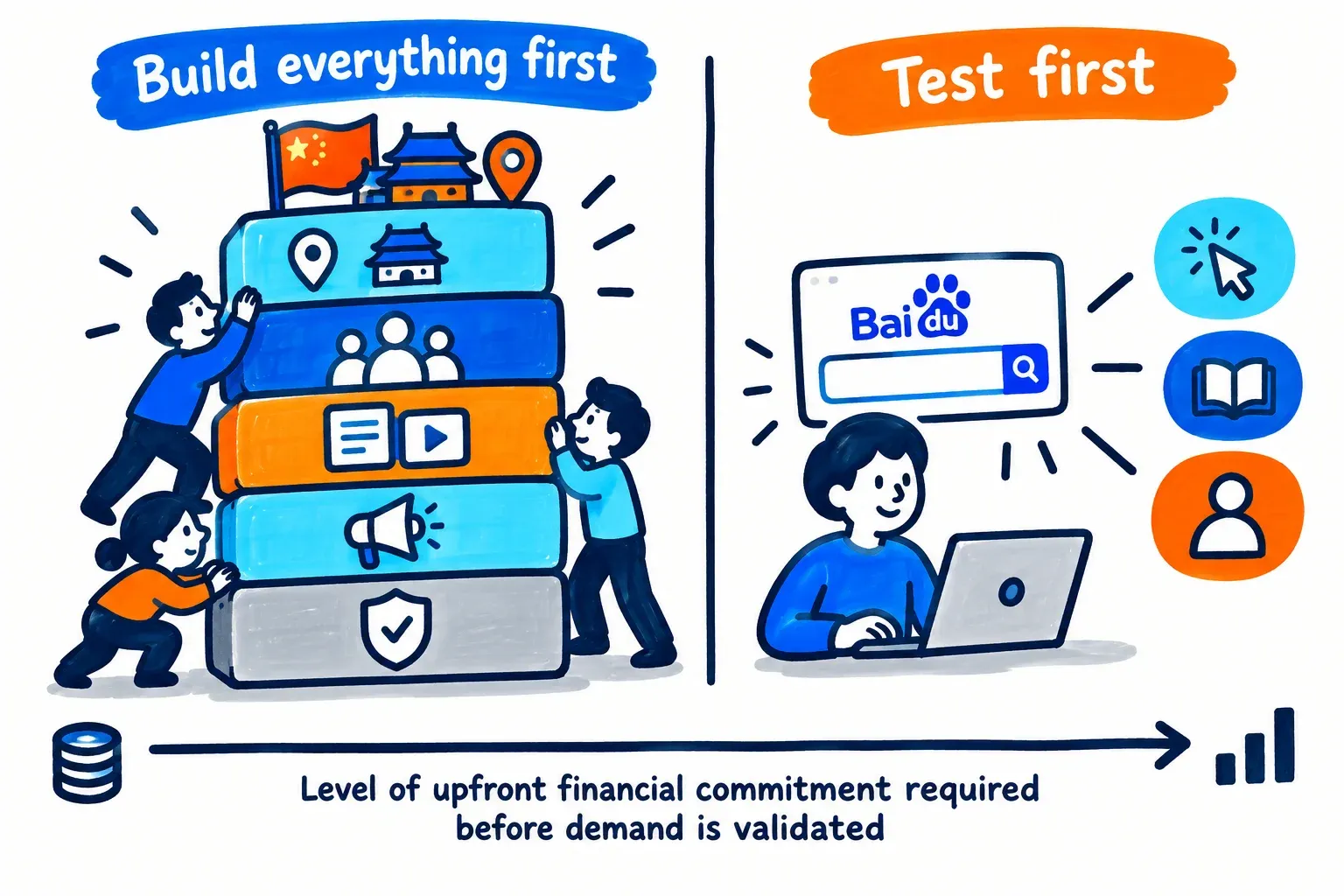
A full China marketing setup runs into serious money before a single qualified buyer ever raises a hand. A localized website, ICP filing, WeChat presence, Chinese content, and a local hire can consume six figures and several quarters. Then you wait to find out whether Chinese buyers were searching for what you sell in the first place.
Reverse the order. Instead of building the machine and hoping demand shows up, run a bounded test that measures demand first. That is the test before you localize argument, and paid search is the cleanest instrument for it.
Baidu carries roughly 59% of China's search usage across all devices, with mobile share above 70%. A controlled Baidu Ads campaign puts your offer in front of active searchers and shows you whether they click, read, and inquire. You get impression volume on real Chinese queries, click behavior, and early inquiry signals, usually readable after about four to eight weeks of live spend.
Read those signals for what they are. Search interest tells you people are looking. It does not confirm pricing acceptance, distribution readiness, regulatory feasibility, or product-market fit. A strong result earns the right to investigate further. It does not, on its own, justify hiring a team or launching a localized site.
dminorstudio packages this logic into the Baidu Ads Pilot Program, a fixed-scope way for overseas B2B companies to test Chinese search demand before funding the rest.
What Does the Baidu Ads Pilot Program Include?
The Baidu Ads Pilot Program from dminorstudio is a fixed-scope test that measures Chinese search demand before an overseas B2B company funds full localization or China infrastructure. It runs on a narrow hypothesis, usually one core offer or use case, so the results stay readable.
The build is deliberately small. Focused Chinese keyword research and intent clustering, controlled daily media spend, one or more Chinese landing-page variants matched to the tested offer, a Baidu account or access pathway, and conversion tracking. dminorstudio then runs the campaign, watches how real searchers respond, and documents what the numbers say.
The output is a decision, not a pile of dashboards. After the learning window, you get a structured read of the evidence and a recommendation: scale into deeper China investment, keep learning with adjusted targeting, or stop and put the budget elsewhere.
Scope and media budget are set after a short fit and feasibility review, not sold as a fixed package off a price sheet. The pilot fits companies that want a real signal before writing the larger check.
Is the Baidu Ads Pilot Program Right for Your B2B Company?
The Baidu Ads Pilot Program is built for a specific kind of company. Run through the fit signals before you spend a call slot.
You are a good fit if:
- You sell a defined B2B offer with identifiable buyer roles in mainland China
- Your target buyers plausibly research solutions in Chinese, not just English
- Someone on your side can respond to early Chinese-language inquiries and owns the pilot decision
- You are willing to test Chinese messaging rather than translate your English pitch word for word
- You accept that early data is directional, meant to inform a scale, continue, or stop call
The pilot is the wrong tool if:
- You expect guaranteed leads or a fixed number of deals
- You need immediate revenue proof inside a single quarter
- You have no clear core offer or value proposition to test
- No one can follow up with Chinese-language responses
- You still need trademark, entity, licensing, or regulatory approvals before you can legally advertise
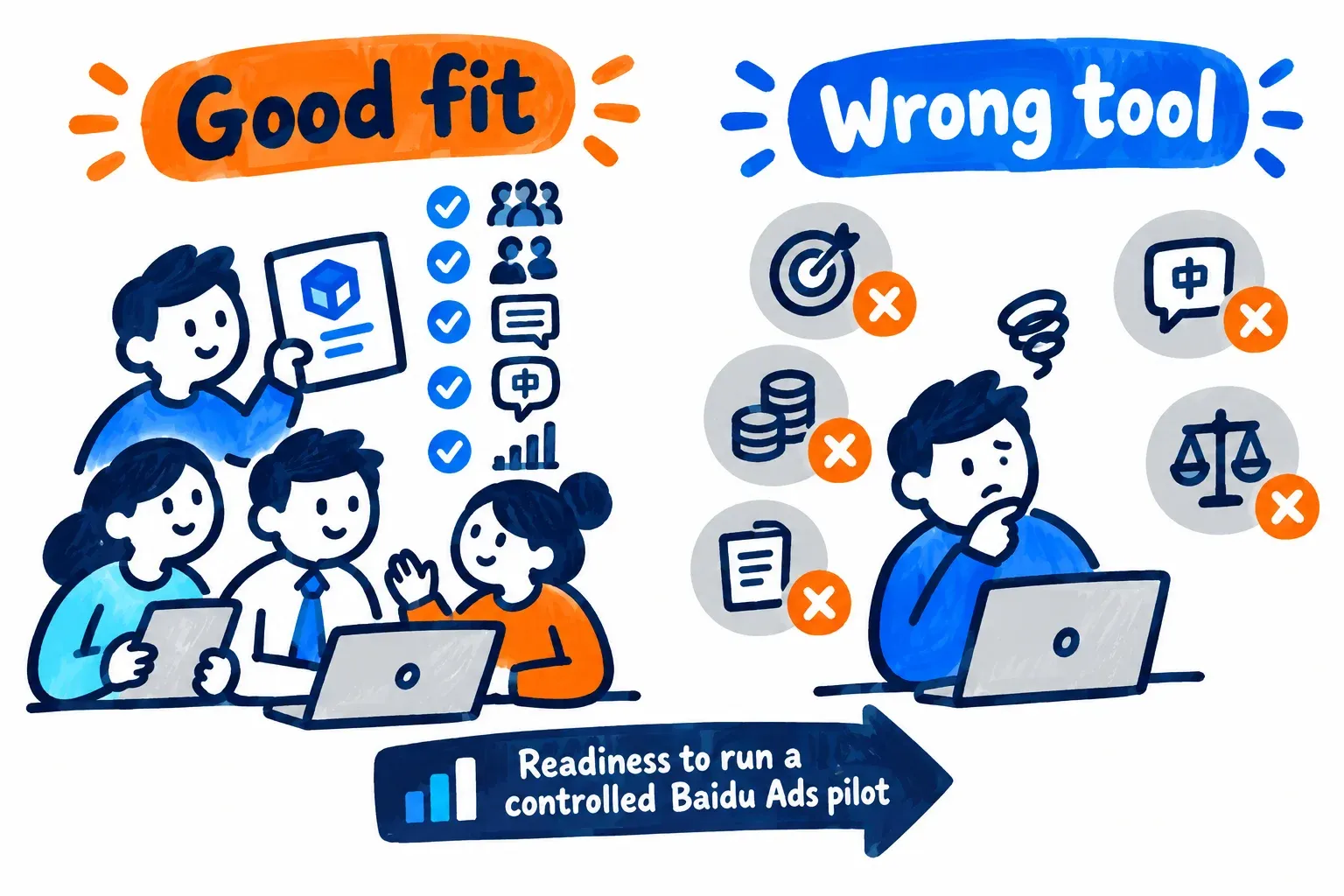
Most disappointments trace back to a mismatch on this list, not the campaign itself.
The Eight Workstreams Delivered in Every Pilot
Every dminorstudio Baidu Ads Pilot Program delivers the same set of workstreams, each with a concrete output you can point to.
1. Discovery and hypothesis. We define target industries, buyer roles, priority use cases, and the specific decision the pilot must inform. Output: a written test hypothesis and the scale, continue, or stop question it answers.
2. Account access pathway. We review feasibility case by case, since overseas advertisers face a documented qualification review covering business license validity, business-scope matching, and industry qualifications. We map whether an international account on your home registration or a domestic route fits, and list the documents each requires.
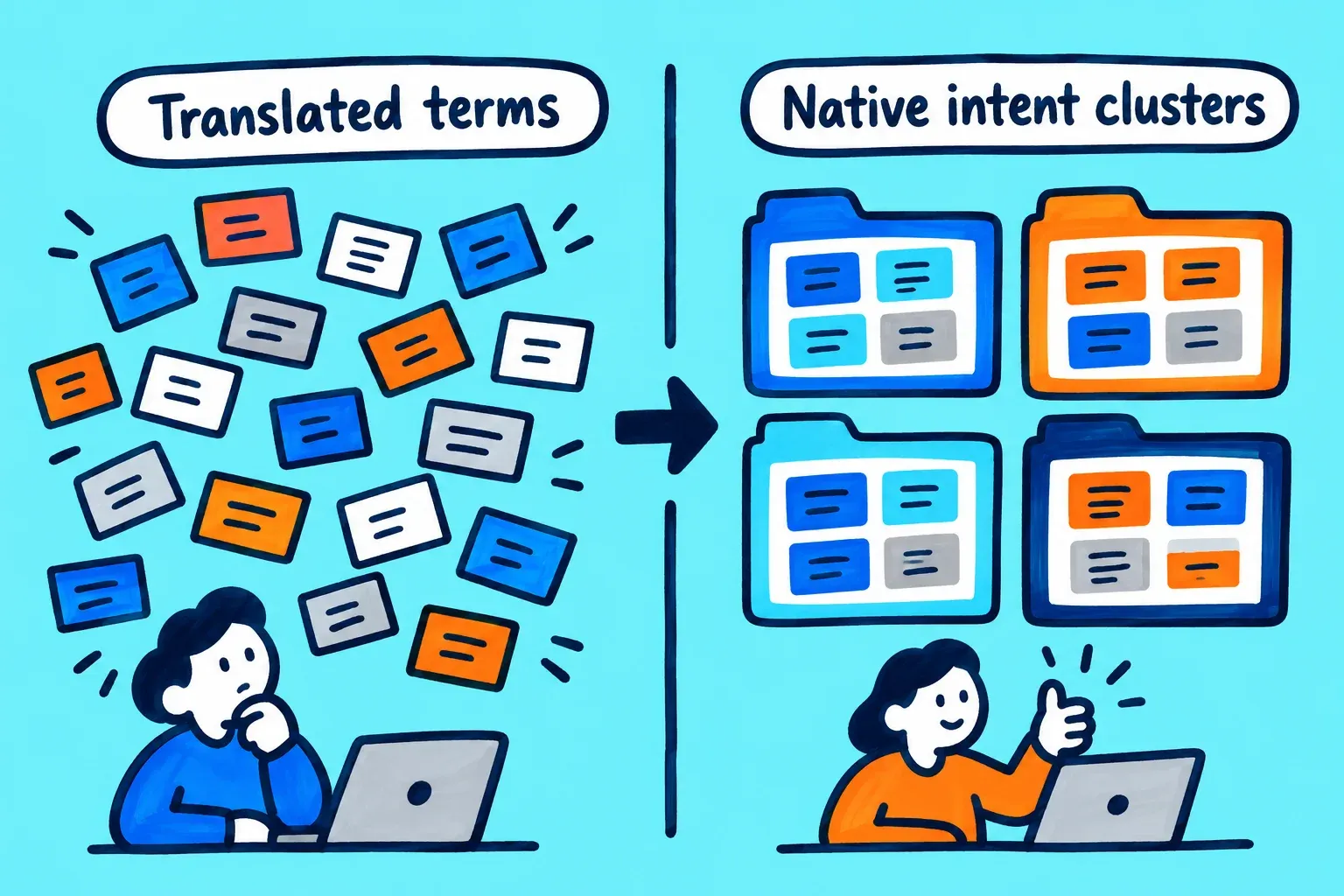
3. Native Chinese keyword research. We build the keyword set from how Chinese buyers actually search, then cluster by intent. This is original research in Chinese, not a literal translation of your English terms.
4. Controlled campaign structure. We set a limited daily spend, relevant geographic and device targeting, negative keywords, and agreed testing parameters so the budget buys clean signal rather than noise.
5. Fit-for-purpose landing pages. We produce one or more Chinese landing-page variants with localized value propositions and clear conversion paths. Baidu requires at least one Chinese-language page that matches your declared business scope and passes content compliance checks.
6. Tracking setup. Where technically applicable, we configure agreed inquiry events using Baidu's conversion tools, including form submissions, consultation clicks, and call rules that count only meaningful engagements over a set duration.
7. Active optimization. We review search-term reports, refine bids and queries, note landing-page behavior, and report on a regular cadence.
8. Decision report. A final read on the data and a recommended scale, continue-learning, or stop call.
From your side, we need product information, approved claims, account and document access, your qualification criteria for a real inquiry, and timely follow-up on Chinese-language leads. Media spend is billed separately from the service fee.
How Do the Four Pilot Phases Run, and How Long Does Each Take?
The pilot runs in four phases. Only one of them produces campaign data, so set expectations for the other three before you start.
Phase 1, qualification and setup. We confirm the offer, target audience, account route, required documentation, the measurement plan, and the baseline hypothesis the pilot will test. Setup length varies. Baidu's own guidance puts qualification review at roughly one to three business days, longer for regulated industries, and access, approvals, and technical dependencies on your side can extend it further.
Phase 2, research and build. We complete native Chinese keyword research, group terms into intent clusters, build the campaign structure, write the Chinese ad copy, produce the landing-page variants, and verify tracking before anything goes live.
Phase 3, live campaign learning. Once ads are approved and running, we run controlled tests for roughly 8 to 12 weeks of stable activity, monitoring search-term quality, traffic, inquiry behavior, and budget allocation. Basic impressions, clicks, and a few inquiries may surface around weeks 4 to 8, but reliable patterns in query quality and inquiry behavior usually need the full window.
Phase 4, analysis and decision. We review results against the criteria agreed in Phase 1 and recommend one of three moves: scale, keep learning, or stop.
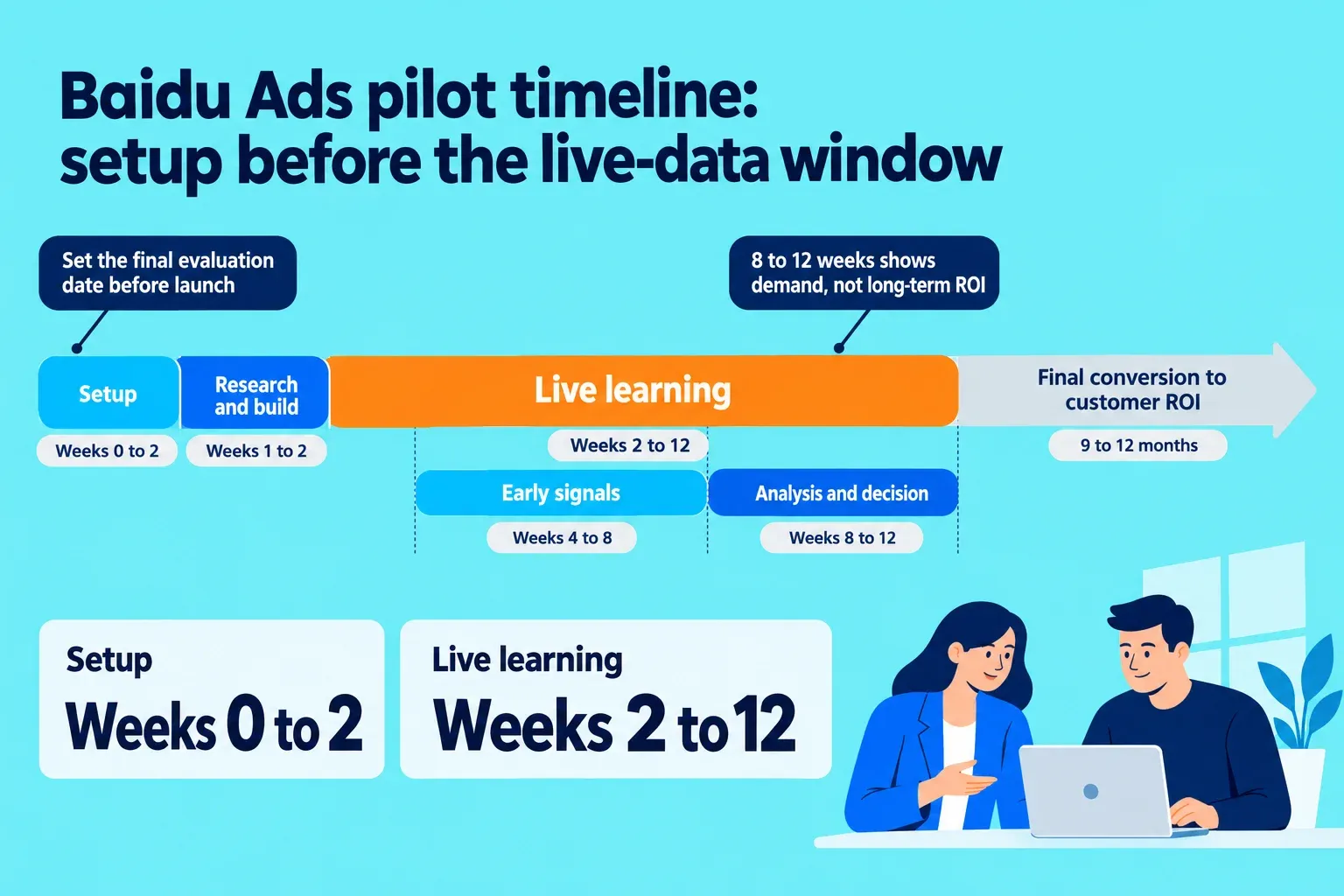
Set the final evaluation date on the calendar before launch. That keeps the decision honest instead of drifting.
Be clear about what 8 to 12 weeks can and cannot do. It can show whether Chinese buyers search for what you sell and whether they take a first conversion action. It cannot prove long-term ROI or close a typical China B2B deal. For complex B2B solutions, final conversion to customer ROI can take 9 to 12 months, well past the pilot itself.
How Is Pilot Performance Measured? The Signal Hierarchy Explained
A single lead target makes a bad scoreboard for a market test. We read the pilot as a hierarchy, moving from the broadest demand signal down to efficiency.
Demand visibility comes first. Impressions, search-term coverage, and which intent clusters actually draw activity tell you whether Chinese buyers look for what you sell at all.
Traffic quality comes next. Relevant clicks, click-through behavior, the queries we exclude as noise, geography, device patterns, and on-page engagement where it can be measured show whether the right people arrive and stay.
Inquiry signals sit above that. Form starts and submissions, contact clicks, document downloads, chat actions, and any other micro- and macro-conversions we agree on in advance are the closest early proxy for real interest.
Efficiency ties it together. Spend by intent cluster, conversion behavior, and a directional cost per inquiry tell you whether the activity looks economically plausible at larger scale.
Then there are learning outputs that no dashboard captures cleanly: which terminology resonates, which assumptions were weak, what objections surface, and how landing-page variants differ in response.
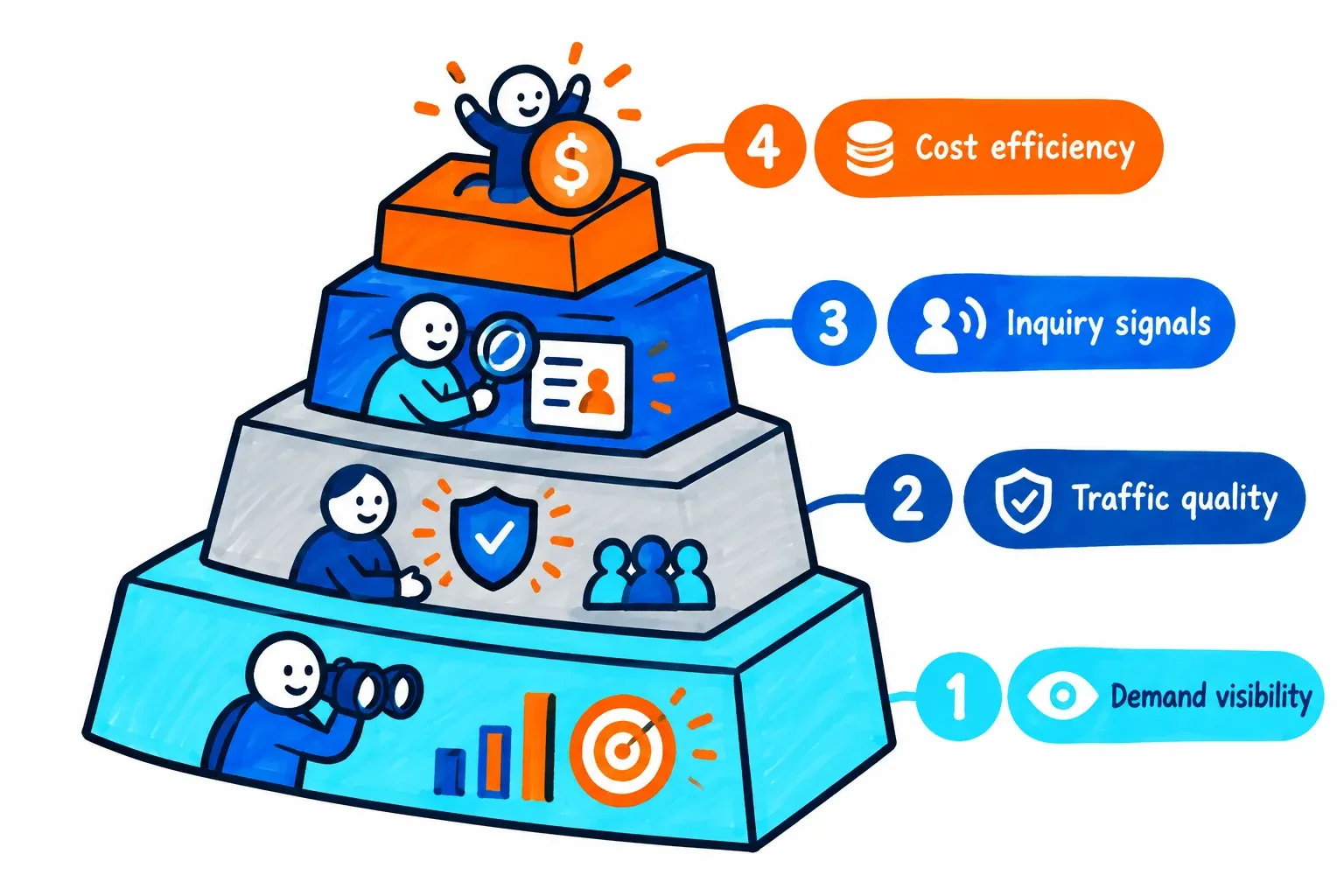
Against that hierarchy, dminorstudio reads the pilot toward one of three calls, using thresholds agreed before launch and interpreted in context.
Scale applies when there is enough relevant search activity, credible engagement or inquiry signals, and a cost path worth deeper investment.
Continue learning applies when signals exist but volume, tracking, messaging, or sample size leaves the read inconclusive.
Stop or pause applies when search demand is too thin, traffic stays irrelevant, conversion intent is absent, or operational barriers outweigh the evidence.
One caution on all of it. These are campaign outputs, not revenue. What a lead becomes depends on sales follow-up, your buying cycle, product-market fit, pricing, competition, regulation, and how far you eventually localize. There is no verified universal B2B benchmark for Baidu CTR or cost per inquiry, so thresholds are set to your case, not borrowed from a chart.
What the Baidu Ads Pilot Program Does Not Cover
Keep the boundary sharp so the pilot is not mistaken for a full China program. The Baidu Ads Pilot Program from dminorstudio is a demand test. It is not full website localization, a complete WeChat or content ecosystem, local sales representation, distributor recruitment, entity formation, ICP or trademark filing, or legal, regulatory, or tax advice. It does not clear you for sector-specific approvals.
Several of those items carry real obligations. Chinese lead forms are regulated personal-information processing under PIPL, and accessing or storing that data outside mainland China can trigger cross-border transfer requirements depending on data type, volume, and system setup. Foreign applicants without a China domicile must entrust a licensed Chinese agency to file a trademark. The pilot does not resolve any of this. It can inform that later work; it cannot authorize, replace, or complete it.
The pilot also does not guarantee impressions, leads, revenue, market success, or long-term ROI. And it does not replace your side of the work: prompt sales follow-up and Chinese-language inquiry handling stay with you.
Read every finding as directional. It is bounded by the keywords tested, the daily spend, the audience reached, the landing-page variants, the time window, tracking quality, and market conditions during the run. Change any of those and the picture shifts. What the pilot gives you is an early, honest read on Chinese buyer intent, scoped tightly enough to trust for a scale, continue, or stop decision, and nothing broader than that.
Talk Through Fit and Readiness With dminorstudio
The Baidu Ads Pilot Program from dminorstudio is a bounded way to collect decision-useful early demand data before you commit budget to broad China localization. The exploratory call decides whether that fit is real.
Come prepared. Bring your target products, priority industries, buyer profiles, current website, your China expansion assumptions, and any previous campaign data you have. The more specific your inputs, the sharper the conversation.
On the call we assess fit, account feasibility, likely testing scope, landing-page needs, measurement options, and the appropriate next step. Not every company is a match, and we will say so if the timing or setup is not right.
Use the Contact Us form with your contact information and needs. The team responds within one business day.
Book a call with dminorstudio to discuss the Baidu Ads Pilot Program for China market entry.
Sources
- Baidu Ads as China Market Entry: Test Before You Localize, dminorstudio
- Search Engine Market Share China | Statcounter Global Stats, StatCounter
- China GEO for Western B2B: Get Cited by Chinese AI Answer Tools, dminorstudio
- 百度推广开户全流程详解:从准备材料到广告上线的6步指南_百度开户, Baidu
- Advertising on Baidu: How To Open a Baidu Union Account? - Marketing China, Marketing China
- 转化跟踪没设好等于白投?_百度推广, 百度营销
- 百度推广开户流程详解:从资质准备到广告上线的五步完整指南_百度开户, 百度营销
- Baidu Ads for Western B2B: A Beginner's Pilot Guide, dminorstudio
- Why Baidu PPC Outperforms Google Ads for B2B in China, dminorstudio
- China Publishes Official Q&A on Administrative Policies for Cross-Border Data Transfers, Hunton Andrews Kurth LLP
- China National Intellectual Property Administration Trademark, China National Intellectual Property Administration
- Digital Marketing Services in New York, NY and Shanghai, dminorstudio
About The Author

Stephen Tseng
Co-founder of dminorstudio. regularly writes about the intersection of AI, SEO, and B2B growth strategy.
Frequently Asked Questions
Can overseas companies run Baidu Ads without a China entity?
Usually yes. A foreign company can generally run ads through a local agency without a mainland entity, using an international account built on overseas business documentation rather than a Chinese business license. Eligibility still depends on your industry, the documents you can provide, the account route, and Baidu's current review requirements. Regulated sectors such as medical, pharmaceutical, financial services, and education face extra qualification checks or outright limits, so dminorstudio confirms your specific case before promising anything.
How long does the full Baidu Ads pilot take from start to finish?
Setup comes first: onboarding, account access, keyword research, landing-page build, and tracking. After launch, plan on 8 to 12 weeks of stable live activity. Early impressions, clicks, and a few inquiries may show around weeks 4 to 8, but reliable patterns need the full window. That window reads demand signals. It does not close B2B deals, which run on much longer cycles.
Does the pilot require a fully localized China website?
No. The pilot uses one or more appropriate Chinese landing-page variants, and an overseas-hosted page can be feasible when it passes Baidu's content and identity review. A pilot page is not the same as complete website localization, and it does not replace that work later if you decide to scale.
What can the Baidu Ads pilot actually prove?
It produces early evidence about search demand, traffic quality, message response, and inquiry behavior. It cannot prove long-term ROI, distribution readiness, pricing acceptance, or product-market fit. Think of it as a directional read, not a final verdict.
What happens after the pilot ends?
You reach a clear decision gate with dminorstudio: scale where intent and cost signals justify more spend, keep learning with adjusted keywords or offers, or stop if demand does not support further investment. The decision report ties directly back to the hypothesis set at the start of the engagement.
How is media budget handled during the pilot?
Media spend is billed separately from the dminorstudio service fee. The scope and appropriate budget level are confirmed during the fit and feasibility review, not set from a fixed price sheet. This keeps the spend calibrated to your specific offer, industry, and testing goals.
How does Baidu Ads compare to Google Ads for reaching B2B buyers in China?
Baidu carries roughly 59% of China's search usage across all devices, per StatCounter. That makes Baidu Ads the most direct paid route to Chinese buyers actively searching for what you sell.