
Choose a China GEO agency based on what it can actually do: China-specific platform knowledge, native-language execution, content and entity strategy, sound technical foundations, authority building, honest measurement, and compliance awareness. Any agency that opens with guaranteed AI citations, guaranteed mentions, or guaranteed answer-engine rankings has told you how it sells, not how it works. No one controls whether a Chinese AI assistant cites your brand on a given day.
This guide is for international B2B marketing leaders, founders, and growth teams trying to show up in China's AI-assisted search and answer tools without being able to audit the vendor's work firsthand. You read Chinese imperfectly or not at all. You can't easily verify a case study filed under a client logo. You need a selection process that holds up even when you can't check every claim yourself.
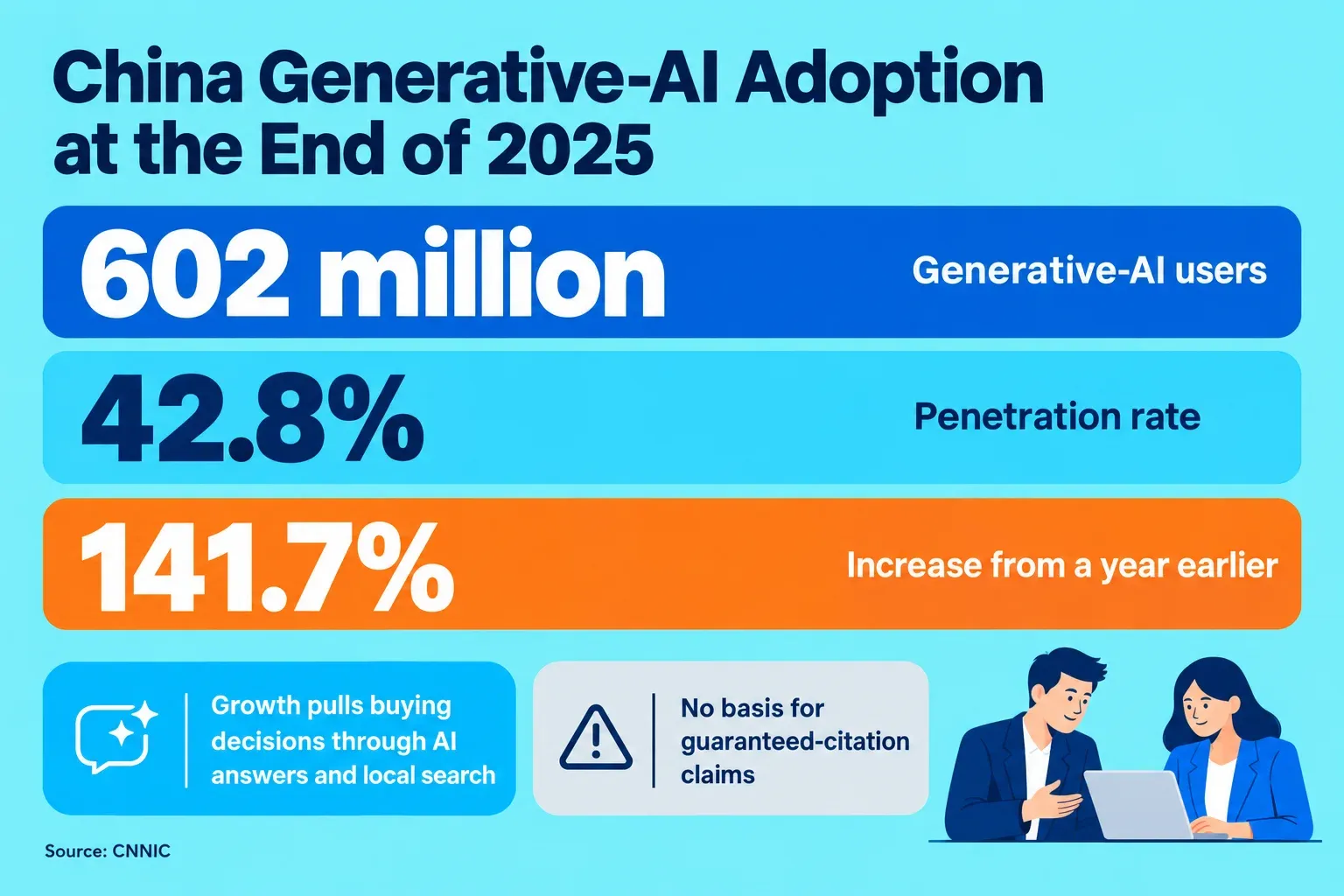
The demand is real enough to attract both serious operators and opportunists. China had 602 million generative-AI users at the end of 2025, a 42.8% penetration rate and a 141.7% jump from a year earlier. That growth pulls more buying decisions through AI answers and local search. It does not mean any agency can promise your content will be pulled into those answers. The same source that shows the user growth gives no basis for a guaranteed-citation claim.
Platform relevance also moves fast. Which assistants and search tools matter most for your category in 2026 is something to validate at the time you sign, using current first-party evidence, not a ranking someone published last year. Treat any fixed "top platform" list with suspicion and ask the agency to show how they check coverage now.
The rest of this guide walks through what a China GEO agency actually does, the capabilities credible work requires, a weighted evaluation framework, the questions to ask and the red flags to watch, a final decision checklist, and an FAQ for the narrower questions buyers search for. By the end you should be able to compare agencies on evidence and reject the ones selling certainty they can't deliver.
What Does a China GEO Agency Actually Do?
Generative engine optimization means making a company's information clear, accessible, authoritative, and retrievable for AI-assisted discovery. In practice, it is the work of helping your products, expertise, and the evidence behind them get found, understood, pulled into, and accurately represented inside Chinese search and AI answer systems.
A China GEO agency does the tasks that make your information eligible to be used by those systems. That covers Chinese technical SEO, entity and brand disambiguation, structured information, content building, placement in Chinese third-party sources, retrieval accessibility, and ongoing monitoring. Good GEO work can improve your eligibility and your visibility. It cannot force a model to cite or mention you. The model decides what to surface, and that decision shifts between queries and over time.
How Is China GEO Different from Conventional SEO?
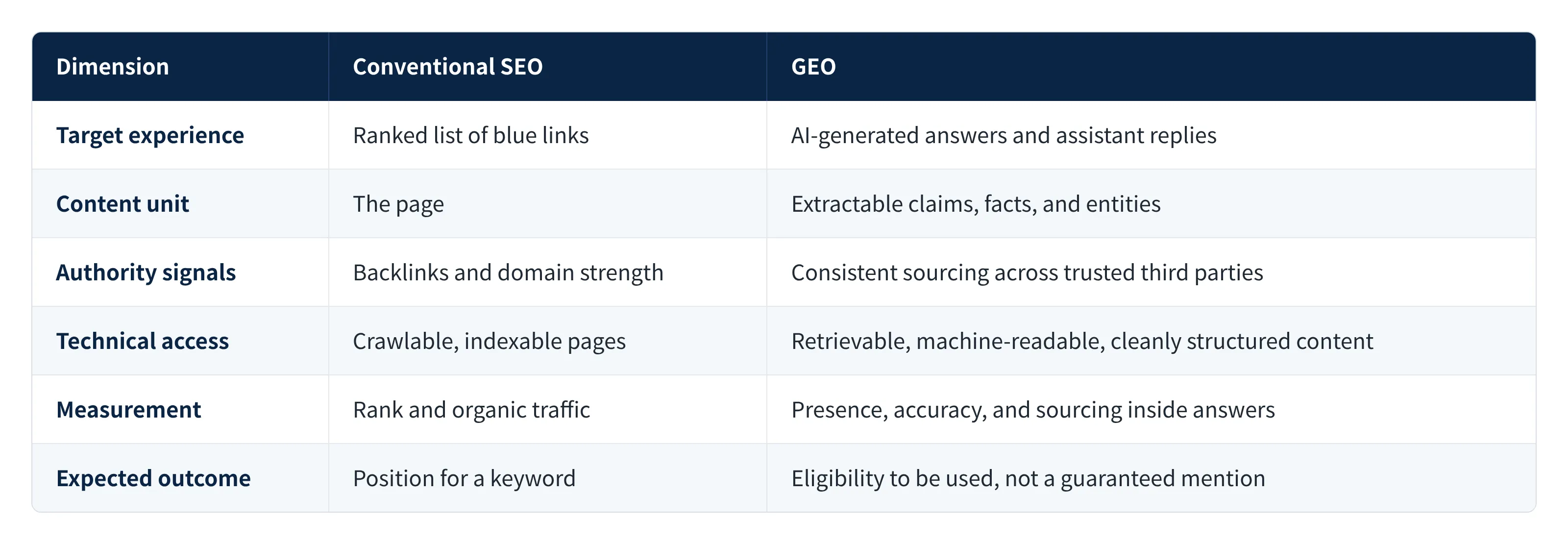
Why China GEO Needs Its Own Specialization
China does not run on a localized version of a Western playbook. Simplified Chinese search behavior and local terminology differ from direct translation. Publishing ecosystems are separate, with their own accounts, formats, and access rules. Trust signals that carry weight are Chinese third-party sources, not the ones your home market uses. Hosting and performance inside China affect whether your content is reachable at all, and content rules and compliance shape what you can publish and how.
Which Chinese AI Platforms Should B2B Companies Monitor?
Treat the list below as examples to validate, not a fixed ranking. Baidu's AI Search sits alongside Alibaba's Quark, Tencent Yuanbao, which added networked search and pulls from WeChat public accounts and video content, and ByteDance's Doubao, whose networked search shows its sources above each reply. DeepSeek and others move in and out of relevance as products change.
Ask any agency how it decides which ecosystems matter for your buyers, in your category, right now, and what current evidence that judgment rests on.
The Capabilities Behind Credible China GEO Work
Good China GEO rests on a handful of operational competencies. An agency that can explain each one, with examples of how it does the work, is worth more than one that sells outcomes.
Native-Language Research and Localization
Translation gets you readable Chinese. It does not get you the words Chinese buyers actually type. Query research starts from how your category is named locally, which often differs from a literal rendering of your English terms. Agencies can combine trend and demographic patterns from Baidu Index with keyword expansion from the Baidu keyword planner, then validate suggestions against customer interviews, Chinese search results, and your industry's own terminology. Record the region, date, device, and match settings behind each term. For technical B2B products, a native editor also has to get the subject matter right, not just the grammar.
Platform and Content Distribution
Your website is one source among many. Chinese buyers move across local publishing accounts, social platforms, industry media, and knowledge communities before they reach a sales conversation. A capable agency maps where your buyers actually go, then decides which sources deserve investment, following the buyer journey for your category rather than a generic checklist of every platform in China.
Content and Entity Clarity
AI systems pull facts, so the facts have to be consistent. Use the same company name, product names, categories, use cases, and specifications everywhere they appear. Make claims verifiable and attach them to a source. Name the author where authorship adds credibility. Contradictory specs across your own pages give a model reason to surface a competitor instead.
Technical Foundations for China Visibility
If a page cannot be crawled, rendered, or reached quickly from inside China, none of the content work counts. Pay attention to rendering, speed, hosting or delivery choices, clean metadata, internal linking, and structured information. Submission tools and sitemaps help Baidu discover canonical URLs, but submission does not guarantee a page ends up indexed. Keep your robots rules open to the Chinese pages you want found, and block low-value paths like admin areas and duplicate parameter pages.
Authority Building and Third-Party Corroboration
Credible third-party references help AI systems trust what you say. That value comes from being genuinely worth referencing, through real coverage, reviews, and citations earned over time. No agency can buy a mention or guarantee one, and any that claims to should be treated with suspicion.
How Should AI Visibility Be Measured?
Separate what you can observe from what you can only sample. Referral traffic and indexed visibility are measurable, though Baidu's index volume fluctuates and is not the same as traffic. Presence inside AI answers can only be sampled through repeated monitoring, because answers vary by query and change over time.
Compliance and Content Rules
Content rules, data handling, and advertising restrictions in China can affect what you publish and how. A marketing agency can flag risk and adjust tactics, but it should never stand in for qualified legal counsel on regulatory questions.
How to Score Each China GEO Agency
Comparing a China GEO agency on vibes and logo walls produces bad decisions. Score them. Build a 100-point scorecard, weight the categories that carry the most risk, and make every point depend on evidence you can inspect. Suggested weights: China market and platform understanding (15), Mandarin research and editorial quality (15), B2B content and entity strategy (15), measurement and reporting (15), technical implementation (10), authority and distribution (10), compliance awareness and process (10), commercial transparency and team fit (10).
For each category, write down three things before the call: what a good answer looks like, what evidence you will request, and how you will score the response from 0 to full marks.
Platform Coverage and Prioritization
Good looks like selection logic tied to your audience, product category, content access, and how platforms behave right now. Ask them to rank the platforms they would target for your category and justify each choice. Score low for a long logo list with no reasoning.
Mandarin and Subject-Matter Quality
Ask who researches, writes, edits, and validates technical terminology, by name and role. Request two Chinese samples in a technical field close to yours, plus the glossary behind them. Score on whether a native specialist, not a generalist translator, owns accuracy.
B2B Content and Entity Strategy
Good work backs claims with sources, keeps brand and product facts consistent, and includes a plan to correct contradictions across your pages. Ask for an entity audit sample and a remediation plan. Score on whether they can find and fix conflicting specs.
Technical Execution and Baidu Crawl Audits
Require a live Baidu crawl-diagnosis test on representative pages: homepage, product, Chinese editorial, and conversion. Ask who owns implementation, how they coordinate with your developers, and how they validate after launch. Score on audit depth and post-deployment verification, not slideware.

Authority Development Methods
Good methods are ethical, relevant, and earned through real coverage, reviews, and citations. Distinguish genuine third-party corroboration from manufactured mentions. Score zero for anyone selling guaranteed placements.
Measurement Methodology and Reporting Standards
Require baselines, a defined reporting window, documented prompt or query sets, repeatable sampling, traffic and conversion metrics, stated limitations, and a change log. Reporting should disclose engines, model versions, locations, timestamps, repeat counts, and raw outputs, because repeated runs produce different answers and citations. Treat index volume as separate from traffic. Score on whether their method is reproducible.
Compliance and Regulatory Escalation
Ask how they escalate content-labeling, filing, and data-export questions and when they bring in qualified counsel. Score on documented escalation, not confident reassurance.
Operating Model and Team Transparency
Evaluate who does the work, how projects are staffed, reporting cadence, and how responsibilities are documented between you and the agency. Ask for a sample remediation record covering the URL, cause, change, deploy date, recrawl, and index movement. Score on transparency.
Questions to Ask a China GEO Agency Before You Sign
Send the same written brief to every agency on your shortlist and compare the answers side by side. Standardized responses expose reasoning quality faster than any pitch deck.
Strategy and Platform Questions
Which user journeys and platforms will you prioritize, and why? How often do you reassess platform relevance as access and model behavior shift? What is your process when a platform changes crawling access or answer behavior mid-engagement?
Language and Content Questions
Who conducts the Chinese research, by name and role? Who edits the content? How do you validate technical B2B terminology and factual claims before publishing?
Technical and Compliance Questions
What access do you require from our team? Who implements the recommendations, your staff or our developers? How do you identify issues that need legal review, and who makes that call?
Measurement and Reporting Questions
What baseline will you create before work starts? Which metrics are directly observed, which are inferred, and which are sampled? How do you account for personalization, answer variability, and logged-in experiences?
Commercial and Engagement-Model Questions
What are the exact outputs at 30, 60, and 90 days? What is excluded or priced separately? Who owns the accounts, content, data, and documentation during and after the engagement? Keep admin access and the right to download reports throughout, not only at the end. Is the work a bounded pilot, a fixed project, or a retainer, and what conditions govern expansion or cancellation?
A Five-Step Selection Process for Choosing the Right Agency
Define the business use case first: the audience, the platforms that matter for your category, and what a win looks like. Shortlist two to four agencies. Issue the same written brief to each so answers stay comparable. Score the evidence against your weighted card and run a working session where they reason through a real problem from your account. Then run a bounded initial engagement, with defined outputs and reporting at least every two weeks, before committing to anything larger.
Weight reasoning over presentation. A rough answer that shows how someone thinks about your category beats a polished deck that dodges the hard questions. The next section covers how to reject the weak candidates quickly and confirm your preferred partner clears the minimum bar before you sign.
Red Flags to Watch and the Final Checklist Before You Sign
No agency controls how independent AI systems generate every answer. Baidu states plainly that it provides no guarantee for the accuracy, completeness, or functionality of AI-generated content, and DeepSeek disclaims the same. Any pitch built on certainty about those outputs is selling something the platforms themselves refuse to promise.
Walk away when you see:
- Guaranteed rankings, citations, mentions, or permanent inclusion. Provider disclaimers do not support those claims.
- Claims of secret platform access with no verifiable evidence.
- A fixed platform list presented as settled, with no plan to reassess as access and model behavior shift.
- Keyword-stuffing plans, repetitive titles, or keyword-tag padding, all flagged by Baidu search policy.
- Mass-produced Chinese content with no native editorial review. Low-quality, repetitive, or fabricated content carries enforcement risk.
- Reporting based only on screenshots, with no baseline and no link to pipeline or conversion.
- Undisclosed paid placement dressed up as organic visibility.
- Fabricated authority signals, coordinated posting, or AI account networks.
- Refusal to name the people doing the Chinese research and editing.
- Weak ownership terms over accounts, content, and data.
- Marketing advice passed off as legal clearance on labeling or data compliance.
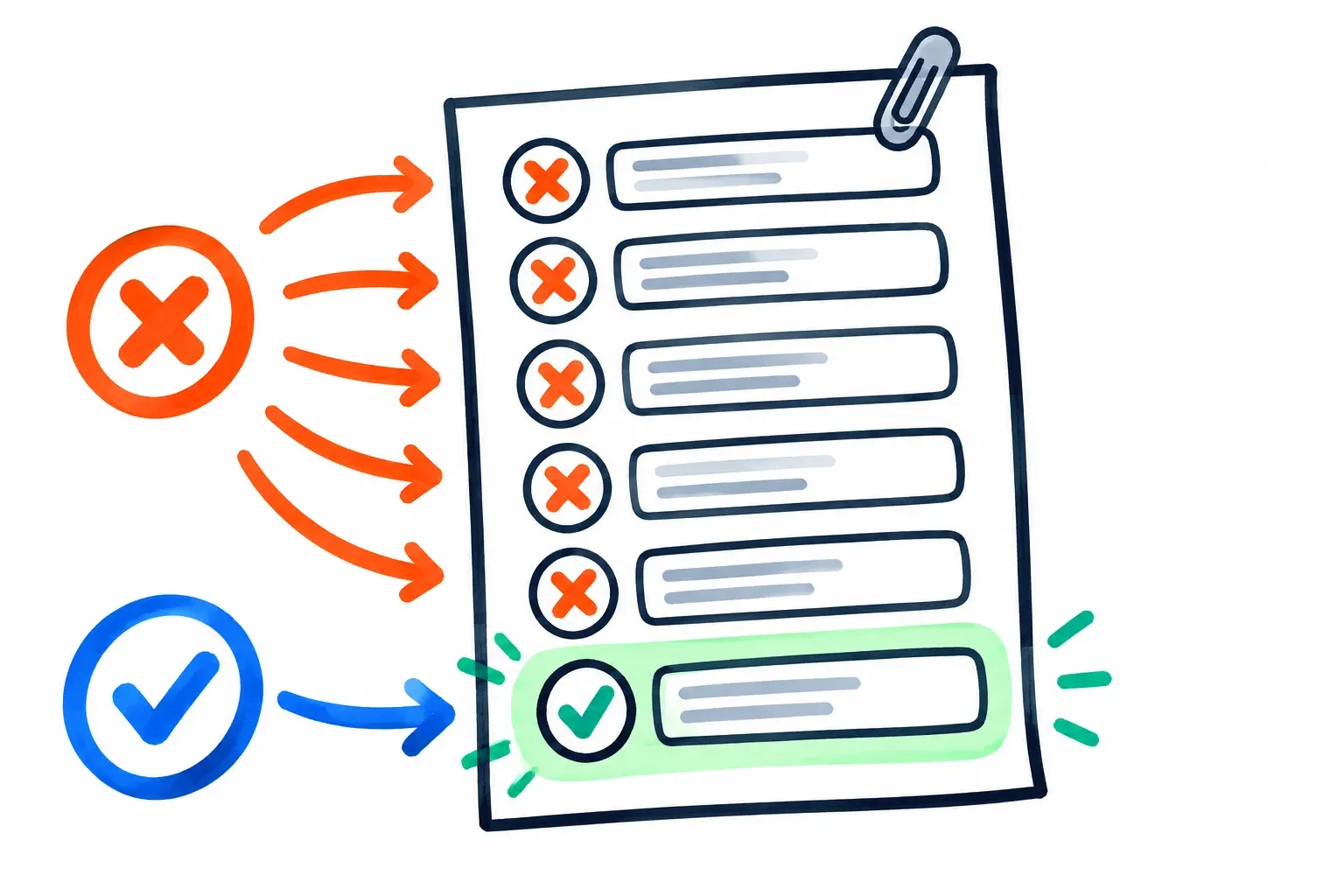
Then score your preferred partner yes or no on each of these: strategy, language, content, technical work, authority building, measurement, compliance, deliverables, ownership, pricing, engagement model, and cancellation terms. A no on ownership, compliance, or measurement is disqualifying, not a negotiation point. Fix those before money moves.
The decision rule is simple. Select the agency that can show the clearest assumptions, methods, limitations, and division of execution responsibility, not the one with the boldest forecast. The vendor willing to tell you what it cannot promise is usually the one worth hiring.
Where dminorstudio Fits in China GEO
dminorstudio is a bicultural B2B agency focused on China GEO, alongside the Baidu, WeChat, website, and lead-generation work that supports it. That focus narrows who it suits.
You are likely a reasonable fit if you are an international B2B company, often in industrial manufacturing, technology, or SaaS, that wants a China-specific approach rather than a Western playbook translated word for word. You want one team coordinating Mandarin content, technical foundations, and platform visibility instead of stitching together separate vendors. And you want realistic expectations about AI visibility, measured against baselines and tied to pipeline, not promised as guaranteed citations.
Apply the same scrutiny here that the rest of this guide asks for. The agency's published case studies describe real client work, but the performance figures are first-party claims without independent third-party audits. Ask for the methodology behind any number, and check that the reporting connects to your buyer journey before you commit.
If you are evaluating China GEO support for your B2B company, book a call with dminorstudio.
Sources
- 第57次《中国互联网络发展状况统计报告》, CNNIC
- 百度AI搜索, 百度智能云
- 腾讯元宝接入Deepseek-R1满血版,支持联网搜索并整合公众号信息源, 腾讯新闻
- 豆包用户协议, 豆包
- 百度指数使用说明, 百度指数
- 普通收录与Sitemap提交说明, 百度搜索资源平台
- Robots相关说明, 百度搜索资源平台
- 索引量工具, 百度搜索资源平台
- 抓取诊断工具, 百度搜索资源平台
- Quantifying Uncertainty in AI Visibility: A Statistical Framework for Generative Search Measurement, arXiv
- 人工智能生成合成内容标识等相关规定, 国家互联网信息办公室
- Marketing Agency Contract Terms: Essential Guide 2026, Clicks Geek
- How to Structure a Marketing Agency Pilot Project, Stackmatix
- 文心大模型免责声明, 百度AI开放平台
- 百度搜索清风算法相关说明, 百度搜索资源平台
- 百度搜索低质量内容相关说明, 百度搜索资源平台
- 网信部门严厉打击整治网络水军问题, 中央网络安全和信息化委员会办公室
- 百度搜索引擎基础知识, 百度搜索资源平台
About The Author

Stephen Tseng
Co-founder of dminorstudio. regularly writes about the intersection of AI, SEO, and B2B growth strategy.
Frequently Asked Questions About Hiring a China GEO Agency
What is a China GEO agency?
A China GEO agency is a firm that works to make your brand visible inside China's AI-assisted search and answer tools, alongside conventional search. The work covers Mandarin content, platform monitoring, technical foundations, authority building, measurement, and local compliance. It differs from a standard SEO agency because it requires deep knowledge of China's separate publishing ecosystems, local AI platforms, and content regulations.
How is China GEO different from Baidu SEO?
Baidu SEO targets ranked blue links on one search engine. China GEO targets how multiple AI systems summarize, cite, and answer questions about your brand or category. The two overlap significantly. Crawlability, metadata, page structure, and indexation still matter for both. The key difference is that GEO requires you to think about how AI assistants read and represent your content across platforms like Doubao, Yuanbao, and DeepSeek, not just how Baidu's ranking algorithm scores your pages.
Does China GEO replace Baidu SEO?
No. China GEO complements Baidu SEO. The same technical foundations, clean information architecture, and quality content feed both ranked results and AI answers. The two strategies are most effective when they share the same content, technical, and authority-building work.
Which Chinese AI platforms should a B2B company prioritize?
Reported ecosystems include DeepSeek, Doubao, Qwen, Kimi, Yuanbao, Baidu AI, ERNIE-based search, and WeChat Search. Treat any list as changeable. Ask the agency to validate which platforms reach your buyers now, and to reassess as access and model behavior shift.
How long does a China GEO engagement typically take to show results?
It depends on your starting point, platform scope, content volume, technical work required, localization depth, industry complexity, and compliance needs. A site with crawl problems and no Mandarin content takes longer than one with a clean foundation. Ask any agency for a staged plan with early indicators like index volume before committing to a long-term retainer.
How much does a China GEO engagement cost?
No credible agency can quote a flat figure without seeing your site, your market, and your goals. Pricing follows the same variables as timelines, including content volume, technical complexity, and the number of platforms in scope. Be cautious of fixed prices attached to guaranteed outcomes. Those claims are a red flag, not a value signal.
Can a China GEO agency guarantee citations or AI mentions?
No. The platforms themselves disclaim control over their own generated outputs, so no vendor can promise inclusion. Baidu and DeepSeek both state they do not guarantee the accuracy or completeness of AI-generated content. Treat any agency offering guaranteed citations as a warning sign and move on.
What credentials should I look for when hiring a China GEO agency?
Look for demonstrated native-language capability, named team members with verified China-side experience, documented technical processes for Baidu, evidence-based platform selection logic tied to your category, and measurement methods that go beyond screenshots. Ask for case studies with methodology, not just outcome claims. An agency that can show how it thinks is more valuable than one that shows only what it won.
How is AI visibility in China actually measured?
AI visibility should be measured probabilistically. AI answers and citations vary across repeated queries, platforms, and time. Expect any credible agency to establish baselines before work starts, run repeated sampling across documented prompt sets, disclose the engines, model versions, and timestamps used, and connect visibility trends to pipeline and conversion metrics rather than one-off screenshots.