
What This Audit Tests and Who Should Run It
Hard truth: You cannot improve Chinese AI visibility until you know what the tools can access, and what they say about you.
This audit is for marketing leaders, international growth teams, and China-market stakeholders at Western B2B companies selling toward mainland China. You can run every step before you hire anyone. Dminorstudio's China GEO for Western B2B guide frames China GEO as a readiness decision and sets the strategy. This piece is its diagnostic companion: you gather evidence, score gaps, and decide what to fix first.
Four outcomes, and they are not the same thing:
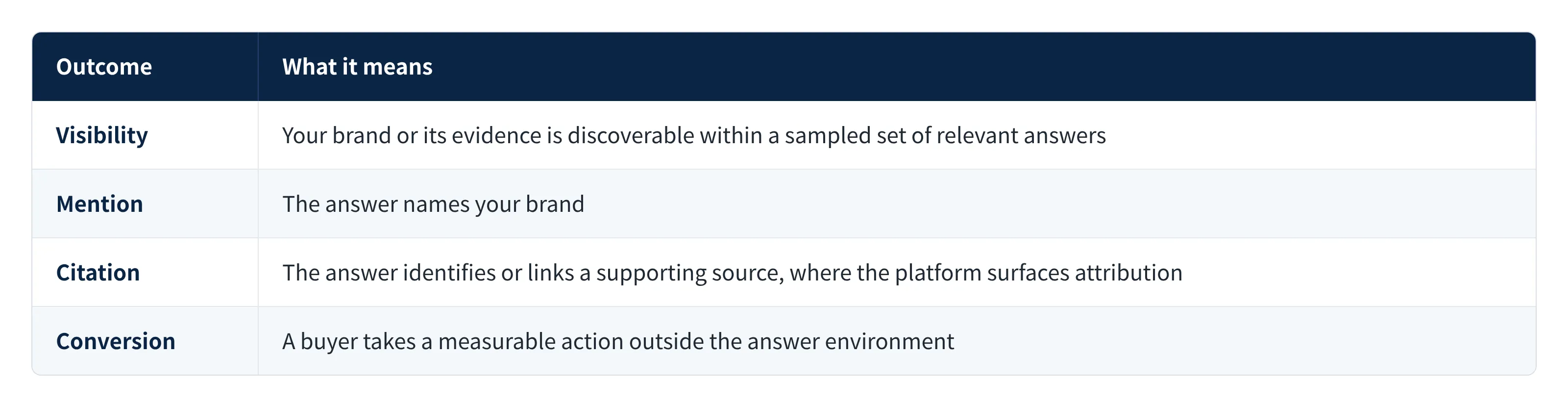
Visibility does not guarantee mentions. Mentions do not guarantee citations. And none of it guarantees leads or pipeline. Visibility and citation are leading indicators of AI search performance, while conversion is a downstream business outcome shaped by many channels.
Platform behavior shifts. What you record is a dated baseline, not a permanent verdict. Re-run it.
The audit covers six dimensions: accessibility, localization, entity consistency, local distribution, governance, and answer performance. The next section sets up how to test them repeatably.
How to Build a Repeatable Test Harness Before You Touch a Chatbot
Loose testing produces loose conclusions. Fix the conditions first, then run every platform the same way.
☐ Set one market scope. Mainland China, one or two buyer groups, and no more than three priority product lines. Wider scope means noisier results and slower reruns.
☐ Name an audit owner, then pull reviewers from China marketing, product, sales, and compliance or legal. Sales spots positioning errors; compliance flags risky claims.
☐ Create a shared evidence folder and an issue log. Every finding needs a screenshot, a date, and a place to live.
☐ Establish a dated baseline across DeepSeek, 文小言/ERNIE, Doubao, and Qwen. One platform's answer is not the ecosystem. Treat all four as separate data points.
☐ Select 8 to 12 commercially meaningful Chinese-language prompts, not just your company name. Include category questions, comparison questions, and credibility questions a real buyer would ask.
☐ Repeat your most important prompts on a second run or a different day. This is a practical testing convention for spotting variation, not a universal standard. Answers drift.
Log every run with the same fields:
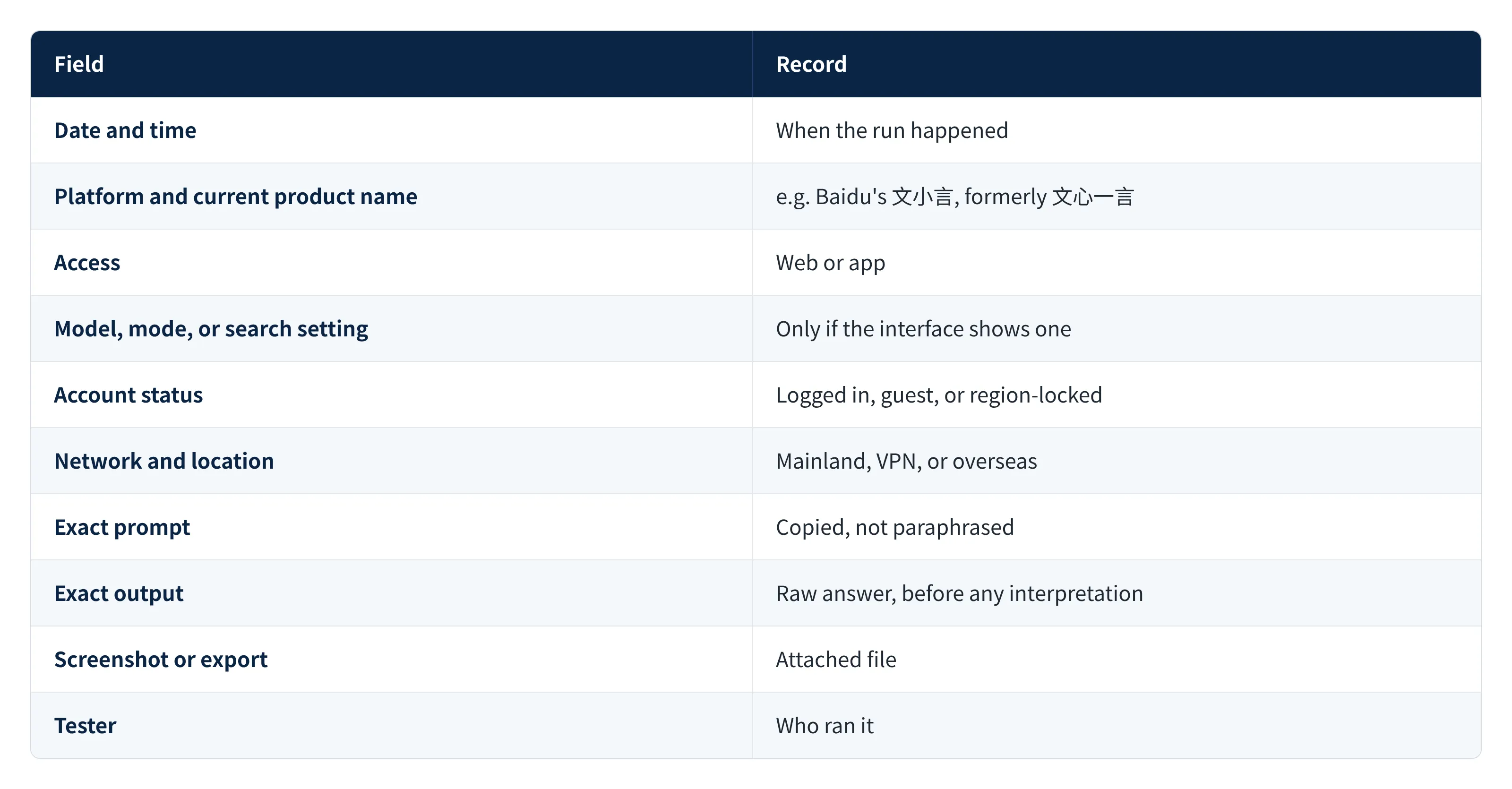
Preserve raw answers before anyone interprets them. Confirm current access routes, login requirements, and search settings against each platform's official pages when you test, since these change.
Never compare outputs captured under different accounts, networks, or dates and call it a trend. Same conditions, or no comparison.
Can Mainland Readers Actually Reach and Use Your Priority Pages?
Before testing whether any AI answers questions about you, confirm that your important pages open, render, and work from inside mainland China. A page an AI cannot fetch, and a buyer cannot load, contributes nothing.
Run this against your priority set: product, application, company, support, and contact pages, plus your key PDFs.
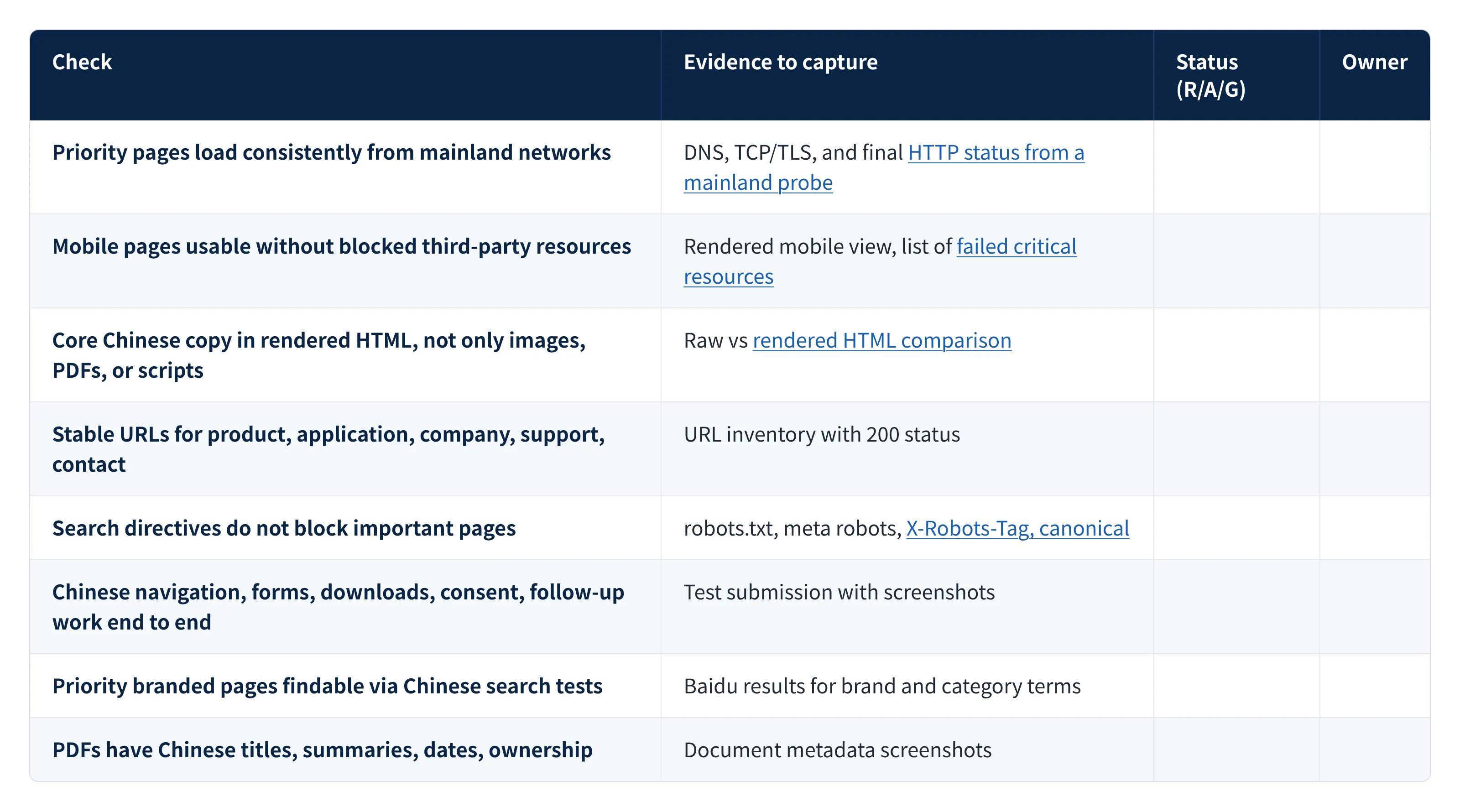
Testing resources: mainland probe for HTTP status, failed critical resources check, rendered vs raw HTML comparison, X-Robots-Tag and canonical guide.
Keep three things separate when you record findings.
Observable evidence is what you can measure: the reachability result, the rendered Chinese copy, the index directive, the search result. Log it with a date and a screenshot.
Assumption is the leap you have not proven: that an AI system can retrieve or use the page. A 200 status and a Baidu listing are encouraging signals. Neither confirms that DeepSeek, ERNIE, Doubao, or Qwen actually pulls that page. Do not treat search indexing as proof of AI retrieval.
Strategic interpretation is the decision: inaccessible or weakly structured assets get fixed before any answer optimization. There is no point tuning content an AI cannot read.
Score each row as a decision aid, not an industry benchmark.
Red means a key page fails to load, a core claim sits only in English or trapped in an image, or a form does not complete. Fix these first. Nothing downstream works until they do.
Amber means pages load but are slow, incomplete, or hard to discover. Practical diagnosis guides report 10 to 30 second load times when a site lacks China-optimized delivery and carries blocked third-party calls. Audit dependencies and delivery paths.
Green means priority content is consistently usable and technically legible across mainland tests.
Platform and network behavior shifts, so date every result and re-run before major decisions.
Does Your Chinese Story Hold Together for Mainland Buyers?
A page can load perfectly and still tell mainland buyers the wrong thing. Two problems sit underneath most of them: weak localization and inconsistent facts.
Dimension 2: Localization Quality
Work through your priority Chinese assets against these checks.
☐ Chinese content reflects mainland buyer terminology, applications, units, standards, proof expectations, and buying concerns.
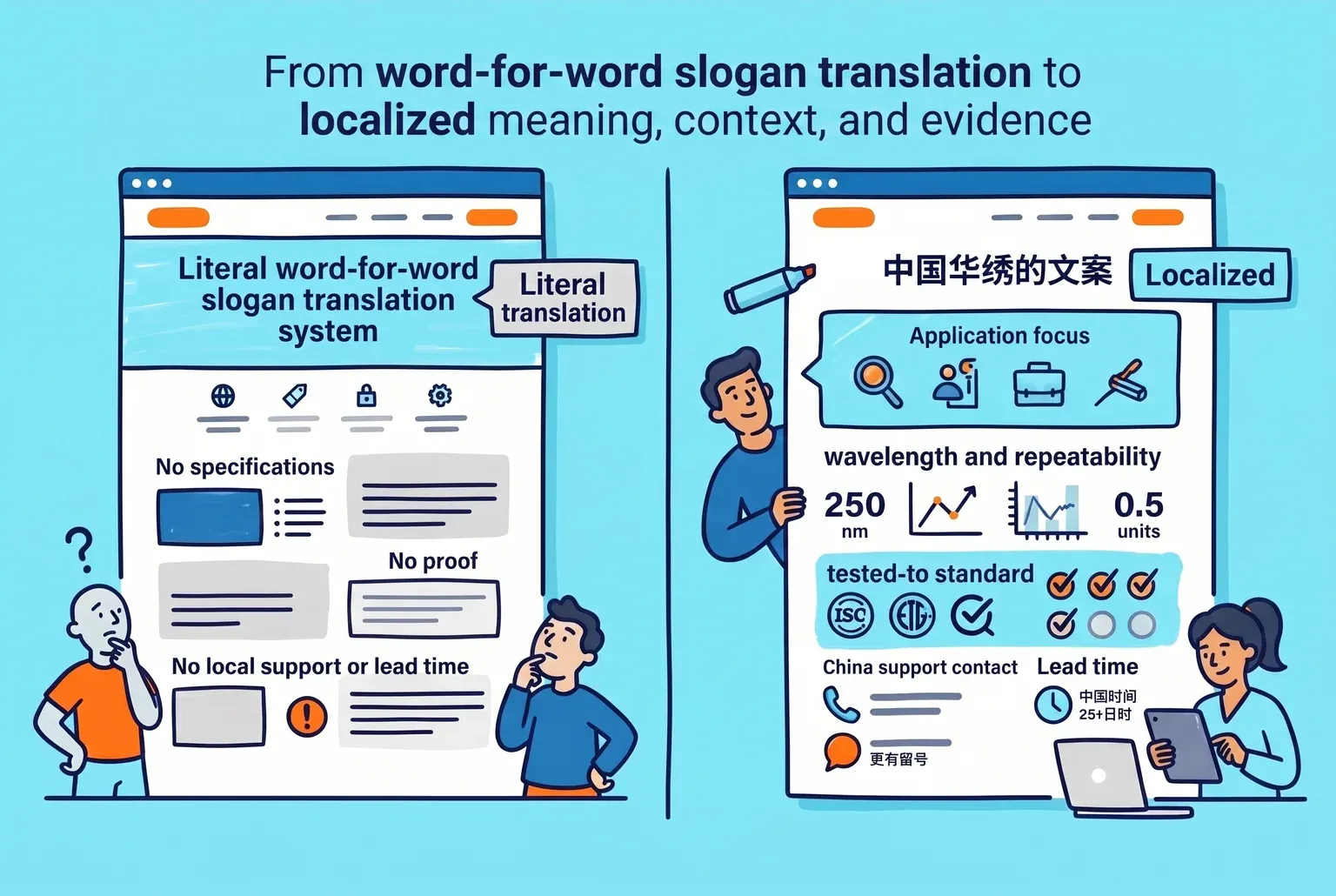
☐ Product descriptions explain use cases and differentiators instead of translating English slogans word for word.
☐ Geography-dependent claims, service coverage, inventory, certifications, support, and availability, are qualified accurately.
☐ Chinese pages answer practical questions about specifications, integration, lead times, support, and channel relationships.
☐ Native-language review is documented, with a named reviewer and date.
Localization changes meaning, context, and evidence, not only language. Watch what that looks like.
Literal: "Precision optics that push the boundaries of what's possible." Translated straight, this reads as an empty boast to a Chinese procurement engineer and offers nothing to verify.
Localized: "Fiber optic spectrometers with a stated wavelength range and repeatability figure, tested to [name the standard], with a China-based support contact and typical lead time." Same product, rebuilt around the buyer's application, the terminology they search, and the proof they will ask for.
Dimension 3: Entity Consistency Across Chinese AI Tools
Chinese AI tools assemble answers from many sources. If those sources disagree about your name, ownership, or credentials, the model will repeat the confusion or invent a version of you.
☐ One approved Chinese brand name is used consistently, with documented aliases where they exist.
☐ Legal entity, global brand, local office, distributor, and product brand relationships are explained without implying ties that do not exist.
☐ Chinese and English product names map to each other consistently.
☐ Founding dates, headquarters, ownership, credentials, certifications, and market presence agree across your own pages and third-party sources.
☐ Outdated distributors, discontinued products, old company descriptions, and unsupported superlatives are flagged for removal.
☐ Every high-risk factual claim has an authoritative source and a named review owner.
Build an entity fact sheet: approved fact, Chinese wording, English source, Chinese source, last-reviewed date, owner, and prohibited or outdated variants. You can cross-check company and trademark records through the national enterprise credit system and CNIPA's trademark search.
Red flags: multiple unexplained Chinese names, conflicting product claims, and credentials nobody can verify. Fix harmful identity and credential errors before you touch stylistic inconsistencies.
What Chinese Buyers Find When They Check You on Outside Sources
Mainland B2B buyers rarely trust your website alone. They cross-check you on Baidu, Zhihu, industry portals, and WeChat before they contact anyone. If those sources are thin, stale, or contradictory, AI tools inherit the same weak evidence base.
Search your Chinese and English brand names, executives, products, application terms, and a few competitors across Baidu and each major channel. Log every result in one inventory.
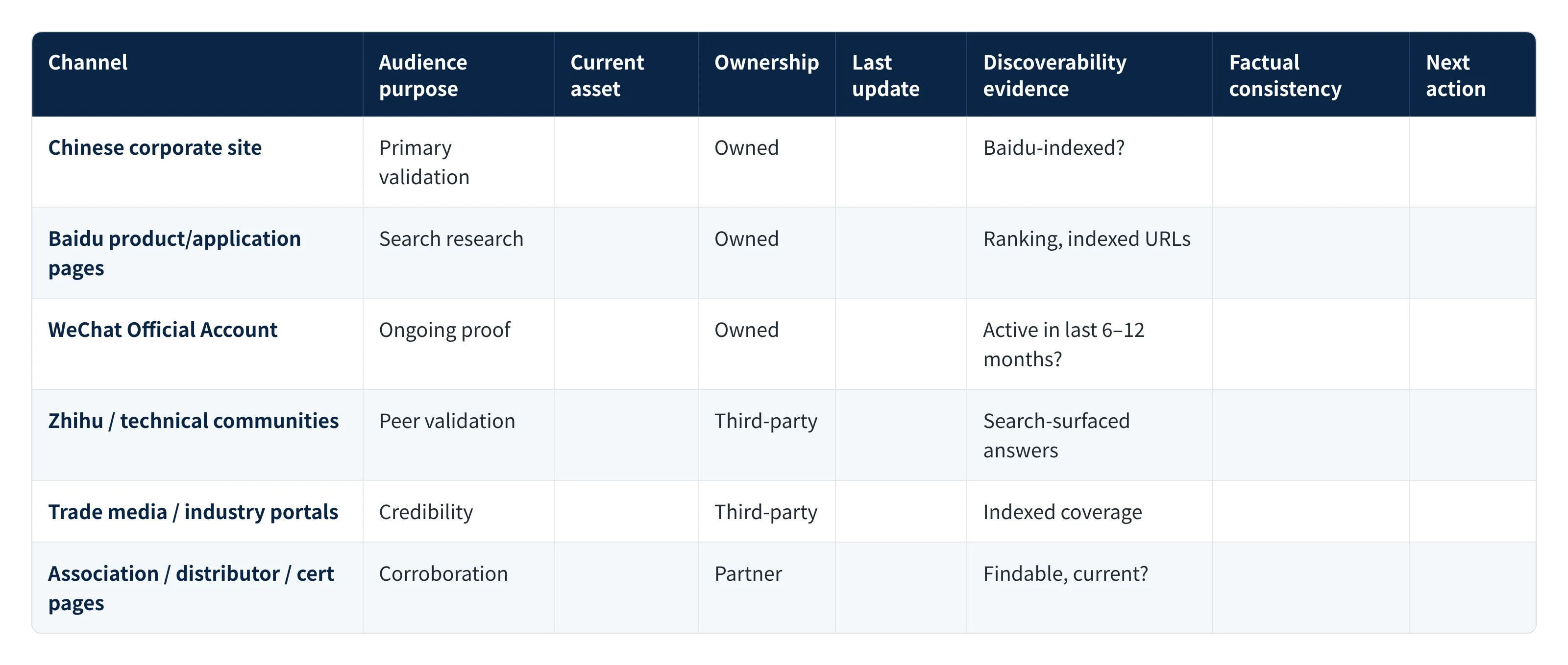
Two facts shape how you read this table. Zhihu answers behave as long-term assets because they fit Baidu's ranking logic, and Baijiahao content is indexed at close to 100% on Baidu. Both raise the odds that a source is seen, not that any AI tool will cite it.
Work through the checklist:
☐ The brand appears under approved Chinese and English names.
☐ Third-party profiles link the correct company, products, and contact routes.
☐ Distributor and partner claims are current.
☐ Priority expertise shows up as substantive Chinese content, not duplicated press releases.
☐ Important claims are corroborated by appropriate sources.
☐ Channel ownership and update cadence are documented.
Volume is not authority. Fabricated placements, low-quality syndication, stale distributor pages, and mismatched boilerplate are all high-risk. Fix your authoritative owned and partner records first, then expand channel count.
Can You Publish Chinese Content Without Leaving Risk Unmanaged?
This checklist helps you spot operational gaps. It is not legal advice. Get qualified counsel for your specific entity, hosting, data, advertising, sector, and publishing arrangements before you rely on any of it.
China's Interim Measures for the Management of Generative AI Services, in force since 15 August 2023, require providers to run content-review and complaint-handling workflows. Your side of that world is advertising law and personal-information rules, both of which shape what you can claim and collect. Treat the checklist below as issue-spotting, not a compliance sign-off.
Work through it:
☐ A named owner approves Chinese brand and product claims.
☐ Legal or compliance review triggers are defined by claim type and risk, not applied inconsistently at the end.
☐ Credentials, performance claims, customer names, testimonials, and comparison statements have supporting records.
☐ Personal-information collection through Chinese forms, downloads, chat, events, and newsletters has an identified review path.
☐ Website, hosting, domain, ICP, and local operating questions have been reviewed for your actual setup.
☐ AI-generated drafts get factual, linguistic, technical, and compliance review before publication.
☐ Teams can request corrections when an owned or partner page becomes inaccurate.
☐ A harmful AI answer has an escalation owner, an evidence pack, and a response log.
Turn this into a one-page review matrix: content type, risk trigger, required reviewer, evidence required, turnaround target, publication owner, and review date. When a claim clears review, the matrix row is your record if a platform or regulator asks how it was approved.
How to Test What DeepSeek, ERNIE, Doubao, and Qwen Say About Your Brand
Now the working test. Ask real buyer questions across DeepSeek, ERNIE, Doubao, and Qwen, in Chinese, and record what comes back.
Start with a baseline prompt set spanning the buyer journey:
Discovery:
→ 在中国市场,有哪些适合[行业/应用]的[产品类别]供应商?
→ 中国的[买方类型]选择[产品类别]时应考虑哪些因素?
Category and comparison:
→ 哪些[产品类别]适合[具体应用或技术要求]?
→ [品牌]与[竞争品牌]在[应用、规格或服务]方面有什么区别?
→ 有哪些能够在中国提供[本地支持要求]的[产品类别]品牌?
Brand validation:
→ [品牌英文名/中文名]是一家什么公司?主要产品是什么?
→ [品牌]在中国是否有官方网站、办事处、授权合作伙伴或服务支持?
→ [品牌产品]是否具备[认证、规格或应用能力]?请提供来源。
→ 使用[品牌产品]服务[应用]时,有哪些限制或风险?
Adapt the wording to how your buyers actually phrase things, and run each brand-validation prompt against your approved Chinese name, English name, aliases, and common misspellings where they matter commercially.
Log every run in one worksheet with these fields: prompt ID, journey stage, exact Chinese prompt, platform, current product or mode, test date, raw answer, visible in answer, brand mentioned, mention context, citation or named source, source URL, source reachable, factual accuracy, positioning, material omissions, harmful inaccuracies, supporting evidence, auditor interpretation, severity, and remediation owner.
Score factual accuracy on a three-point scale as a decision aid, not a universal benchmark: 0 = materially wrong or harmful, 1 = mixed or incomplete, 2 = materially accurate. Keep mention and citation as separate observations, not folded into the accuracy number. Treat "not mentioned" as a visibility finding, not proof that you are excluded. Flag false certifications, false local presence, wrong distributor relationships, unsafe technical guidance, or brand confusion for immediate review regardless of score.
Behavior differs by surface and mode. In standard mode without search enabled, DeepSeek frequently invents URLs when citing publishers; with its Internet Search toggle on, it fetches live URLs and shows a Sources panel. Baidu's platform exposes citation and source-tracing controls, and Doubao displays search sources above the answer. Record toggle state, sign-in status, and retrieval date every time, verify each platform detail on your test day, and require side-by-side results for all four before you draw conclusions.
Which platform is telling Chinese buyers something about you that you would not sign off on?
Sources
- China GEO for Western B2B: Get Cited by Chinese AI Tools — dminorstudio
- 文小言(原文心一言)-百度旗下新搜索智能助手 - Hello123工具导航 — Hello123
- Test Your Website in China — AppInChina
- Free Website Access Check Across Mainland China — Vector.cool
- Crawl JavaScript SEO — Screaming Frog
- Full Guide to the Canonical Tag — Sitebulb
- Is Your Website Blocked or Slow in China? A Practical Diagnosis Guide for Western Companies | gala digital — gala digital
- Index — Gov
- Zhihu User Demographics 2026 | Nanjing Marketing Group — Nanjing Marketing Group
- What is Baijiahao? - — Baidu SEO Pro
- Interim Measures for the Management of Generative AI Services - Wikipedia — Cyberspace Administration of China
- The Complete Guide to Chinese Advertising Law — AppInChina
- How DeepSeek stacks up when citing news publishers — Nieman Lab
- DeepSeek Internet Search announcement — DeepSeek API Docs
- 用户协议 - 豆包 — 北京春田知韵科技有限公司
About The Author

Stephen Tseng
Co-founder of dminorstudio. regularly writes about the intersection of AI, SEO, and B2B growth strategy.
Frequently Asked Questions About China GEO Audits
What is a China GEO audit and why does it matter for Western B2B companies?
A China GEO audit tests how well your brand is represented inside Chinese AI tools such as DeepSeek, ERNIE, Doubao, and Qwen. For Western B2B companies selling into mainland China, this matters because buyers increasingly use these tools to research suppliers, compare products, and validate credentials before making contact. If these tools return inaccurate, incomplete, or missing information about your brand, you lose ground before the conversation even starts.
How is China GEO different from standard international SEO?
Standard international SEO focuses on how search engines like Google index and rank your pages. China GEO focuses on how Chinese AI tools retrieve, interpret, and cite your content when a buyer asks a question. Baidu indexing helps, but it does not confirm that DeepSeek or Qwen can read or reference your page. You need to test both layers separately, since a page can rank on Baidu and still be invisible or misrepresented inside Chinese AI answers.
Which Chinese AI platforms should I include in my brand audit?
At a minimum, run your audit across DeepSeek, ERNIE (文小言), Doubao, and Qwen. These four tools represent a significant share of Chinese AI usage and each has different retrieval behavior, citation logic, and search mode settings. Testing only one gives you an incomplete picture. Record toggle state, sign-in status, and test date for every run so your results are comparable across platforms.
How often should I re-run a China GEO audit?
Run a full audit at least once before any major China market push or campaign investment. After that, re-run it quarterly or whenever you make significant changes to your Chinese content, distributor relationships, or product positioning. Platform behavior, indexing logic, and AI retrieval patterns shift regularly, so a six-month-old result should not be treated as current.
What should I do if a Chinese AI tool is saying something wrong about my brand?
Start by documenting the finding: screenshot the answer, log the platform, record the date and toggle settings, and identify the specific inaccuracy. Then trace the likely source. Wrong answers in AI tools usually come from conflicting third-party content, outdated distributor pages, or inconsistent entity information across your own web properties. Fix the source first. Updating your owned content and authoritative third-party records is the most reliable path to improving what these tools say about you over time.
Do I need a Chinese legal entity to run this audit?
No. You can run the accessibility checks, localization review, entity consistency audit, and AI answer testing without a Chinese legal entity. However, if your audit surfaces questions about ICP licensing, data collection, advertising claims, or local hosting, you will need qualified legal counsel for your specific situation. The governance checklist in this guide helps you spot those questions early, but it is not a substitute for legal advice.
Can Chinese AI tools cite my English-language content, or does everything need to be in Chinese?
Chinese AI tools can sometimes reference English-language content, but their primary retrieval and citation patterns favor Chinese-language sources. If your key product claims, credentials, and proof points only exist in English, there is a meaningful risk that these tools will either ignore them or produce incomplete answers. Localized Chinese content distributed through credible channels such as Baidu, Zhihu, and Baijiahao gives AI tools more accurate and citable material to work with.