
What Is China GEO? A Plain-English Definition
China GEO is the practice of making your company's Chinese-language expertise easier for AI answer tools used by mainland Chinese buyers to find, understand, represent, and reference. When a buyer in Shanghai asks a Chinese AI assistant which vendor solves their problem, GEO is the work that decides whether your company shows up in that answer, and whether it shows up accurately.
Think of it as an extension of your SEO and content strategy, not a replacement. Traditional SEO earns a ranked link. GEO aims to get your content pulled into a generated response rather than just listed as one blue link among ten. The underlying content discipline is the same. The output surface is different.
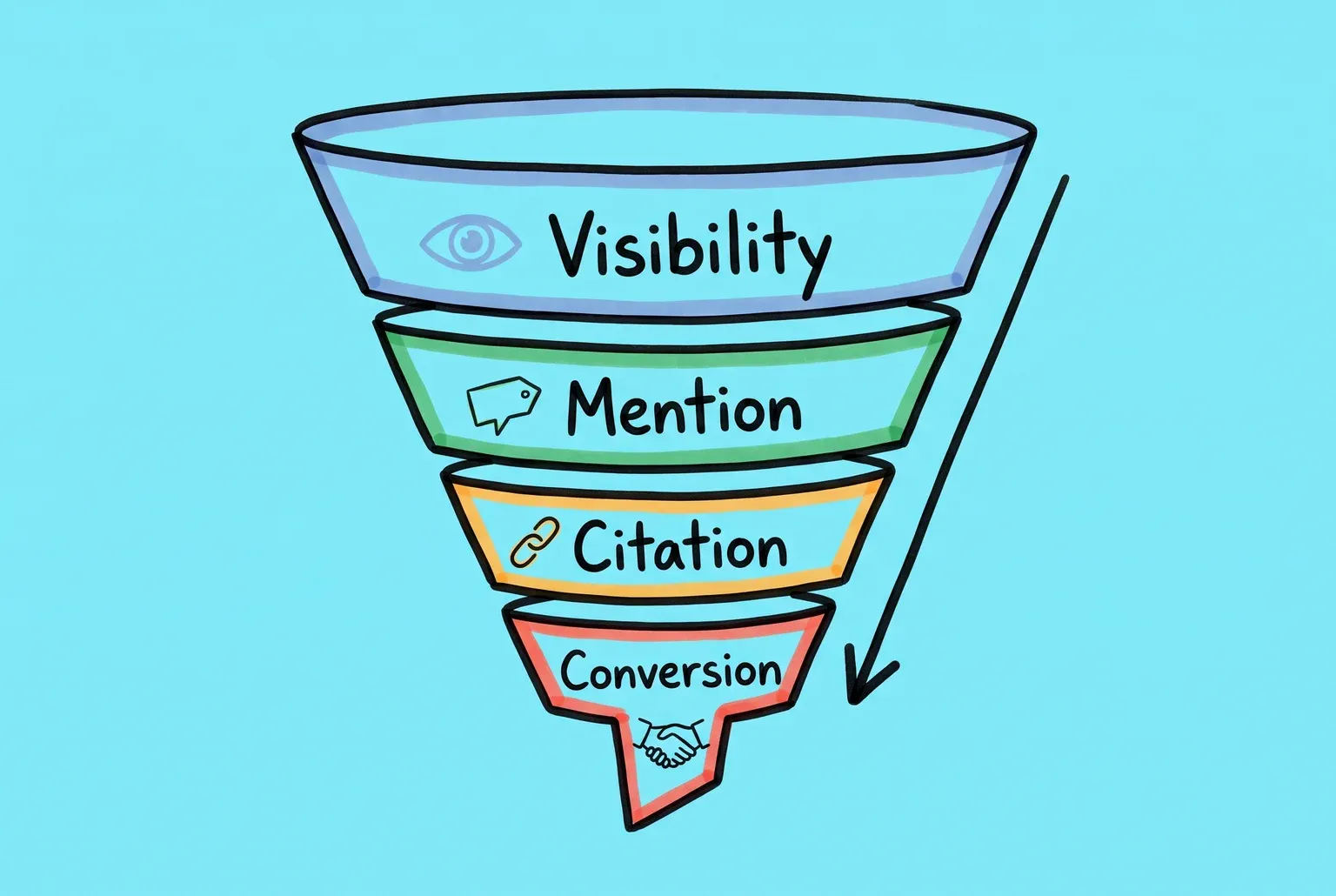
Four outcomes are worth keeping separate, because teams routinely blur them:
- Visibility means you appear in or around an answer.
- Mention means the AI names your brand.
- Citation means a source is referenced or linked.
- Conversion means a buyer takes a commercially meaningful action.
Visibility is not conversion. Grounded answer engines are usually evaluated through their observable outputs, so treat any visibility gain as a leading signal, not proof of pipeline.
Underneath the platforms sits a durable mental model: market fit, then accessible evidence, then credible distribution, then measurement and improvement. Those four steps hold up over time. The individual platforms, their interfaces, and how they cite sources can change fast. Build on the stable layer first, and treat platform specifics as the part you will keep adjusting.
Should You Invest in China GEO Now, or Fix Your Foundations First?
The Western GEO instinct assumes an open web where your own site can earn the citation. Mainland China works differently. The ecosystem runs on walled gardens, and the China GEO Playbook notes that third-party content dominates citations in Chinese generative search while direct corporate-site citation stays uncommon. Buyers research in Chinese, not English. Content moves through platforms most Western teams have never used. And everything published sits inside a regulatory system covering information security and permissible content that shapes what engines surface.
The demand signal is real. China had 602 million generative-AI users by December 2025, a 42.8% adoption rate, up from 249 million a year earlier. Enterprise adoption sits lower, closer to 20% by the 2024 census. Consumer usage is climbing fast. B2B buying behavior is still catching up. Treat both numbers as context, not proof that GEO will move your specific pipeline.
Run your team through six questions before committing budget:
- Are your target buyers actually in mainland China?
- Do those buyers research solutions in Chinese?
- Is China a sustained commercial priority, not a one-quarter experiment?
- Can prospects in China access useful Chinese content from you today?
- Is there a local or Chinese-fluent owner accountable for this work?
- Can legal and compliance reviews happen on a schedule you can actually run against?

Count your clear yes answers. This is a decision aid, not a benchmark, so read it against your own situation.
Mostly yes across all six: launch a pilot. You have the market fit, the owner, and the access to test whether citation work pays off.
Yes on demand and priority, but gaps on access, ownership, or compliance cadence: run a foundation sprint first. The next section covers exactly what that means.
No validated China demand or no way to serve buyers there: defer GEO and revisit when the commercial case firms up.
The "not yet" list is worth naming plainly. Hold off if you have no validated China demand, no Chinese sales path to convert interest, translation-only content dressed up as localization, pages your prospects cannot reliably reach, or no internal owner willing to carry the program.
Which of the six questions is your team least ready to answer?
What Are the 5 Capabilities to Build Before Chasing Citations?
Citation tactics fail on a weak base. Five capabilities have to exist first, and they hold up regardless of which engine leads next year.
- Chinese-language localization. Literal translation is not localization. Adapt the terminology your buyers use, the examples that match Chinese applications, units and standards they expect, the proof formats they trust, and the questions they actually type. Localization guides recommend adapting intent and idioms rather than translating word for word. The practical fix, echoed in the China GEO Playbook, is a bilingual glossary, native-Chinese drafts written per platform, and native-speaker review before anything ships.
- Accessible content. Content buyers cannot reach cannot get cited. Check load reliability from inside mainland China, mobile usability, clean page structure, indexability where it applies, and conversion paths that work for local users. Hosting choices carry compliance weight: a site on mainland servers needs ICP filing regardless of audience, which generally requires a mainland legal entity most foreign companies lack. Hosting in Hong Kong, Singapore, or the US avoids that requirement but can affect reliability.
- Local distribution. Plan how useful material reaches the channels and communities your buyers already use. No single platform wins for every B2B category, so map distribution to where your specific audience researches rather than betting on one universal winner. For most B2B companies entering China, WeChat marketing and Baidu are the natural starting points.
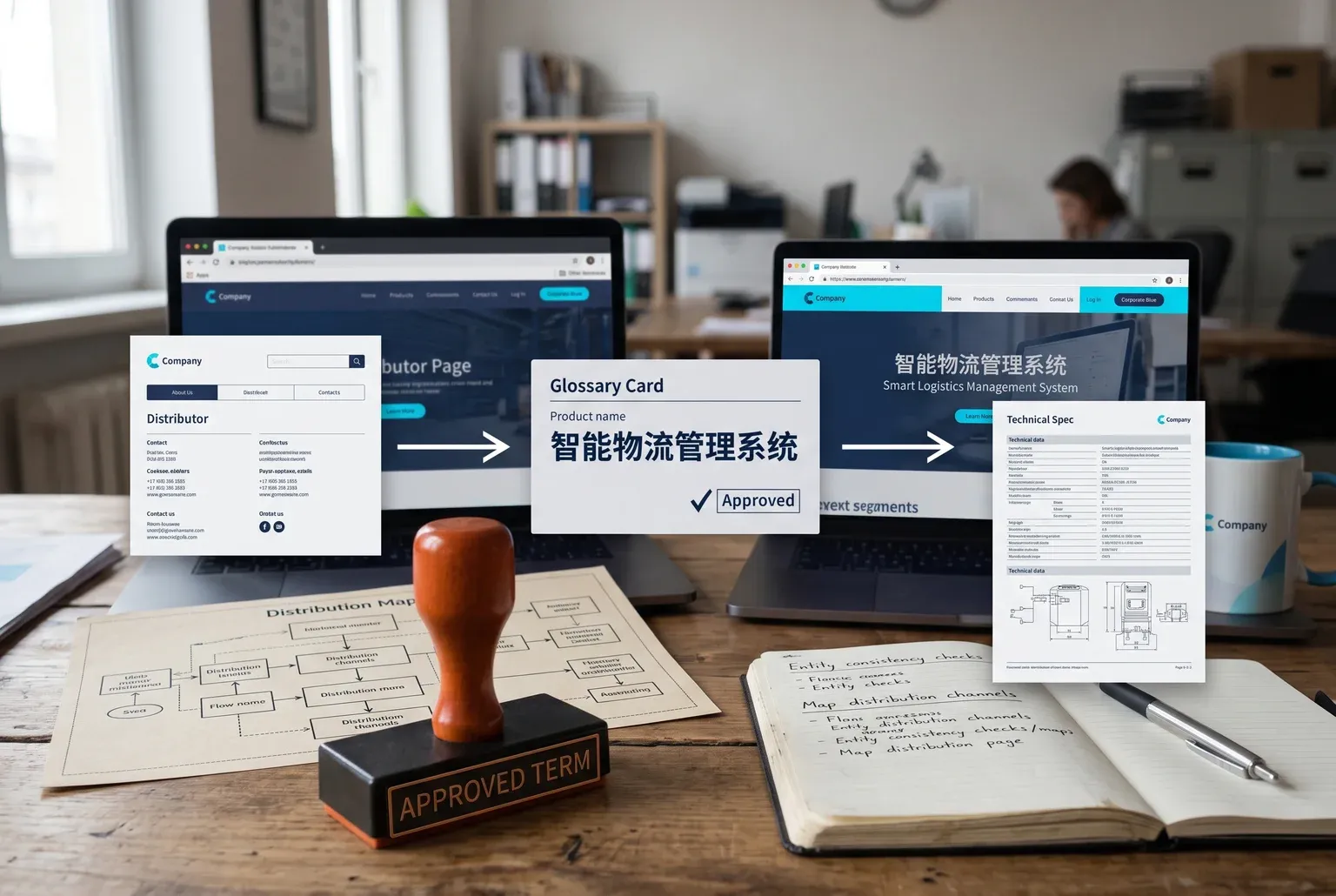
- Entity consistency. Keep one approved record of company names, product terminology, category descriptions, locations, named experts, specifications, and credentials, then apply it across owned and third-party sources. Picture an industrial cooling equipment maker: one Chinese product name, one set of technical specs, one distributor list, one application guide, matched everywhere. Separate what you claim from what an independent source can verify and from local authority signals, because engines and buyers weight those differently.
- Compliance and review. Set up legal, regulatory, privacy, and claim-substantiation reviews on a schedule you can run against. China's Personal Information Protection Law limits data collection to the minimum necessary and requires assessments for cross-border transfers. This guide is not legal advice; confirm your specific obligations with qualified Chinese counsel and your hosting provider.
Which of these five is thinnest in your organization right now?
How to Start With the Questions Your Buyers Actually Ask
Chasing whichever AI product trends this quarter is how budgets evaporate. Prioritize the commercially important buyer questions first, then decide which surfaces to work.
Map your buyer journey by stage: problem definition, category education, requirements, comparison, risk reduction, vendor validation, and implementation. Each stage generates different questions. A buyer defining a problem asks something broad. A buyer reducing risk asks about local support, delivery reliability, compliance, and comparable-customer proof.
Build a question inventory from real Chinese evidence, not guesses translated from your US market. Pull from sales-call notes, support tickets, distributor conversations, and Chinese site-search terms. Western search data does not stand in for mainland demand, so treat China as its own evidence and distribution environment. If you have no internal Chinese buyer data yet, that gap is your first assignment.
Score each question on five practical dimensions:
→ Buyer frequency: how often it actually comes up
→ Commercial relevance: how close it sits to a purchase decision
→ Evidence strength: whether you have approved proof to answer it
→ Content gap: whether a good Chinese-language answer already exists
→ Publishing feasibility: whether you can produce and distribute it soon
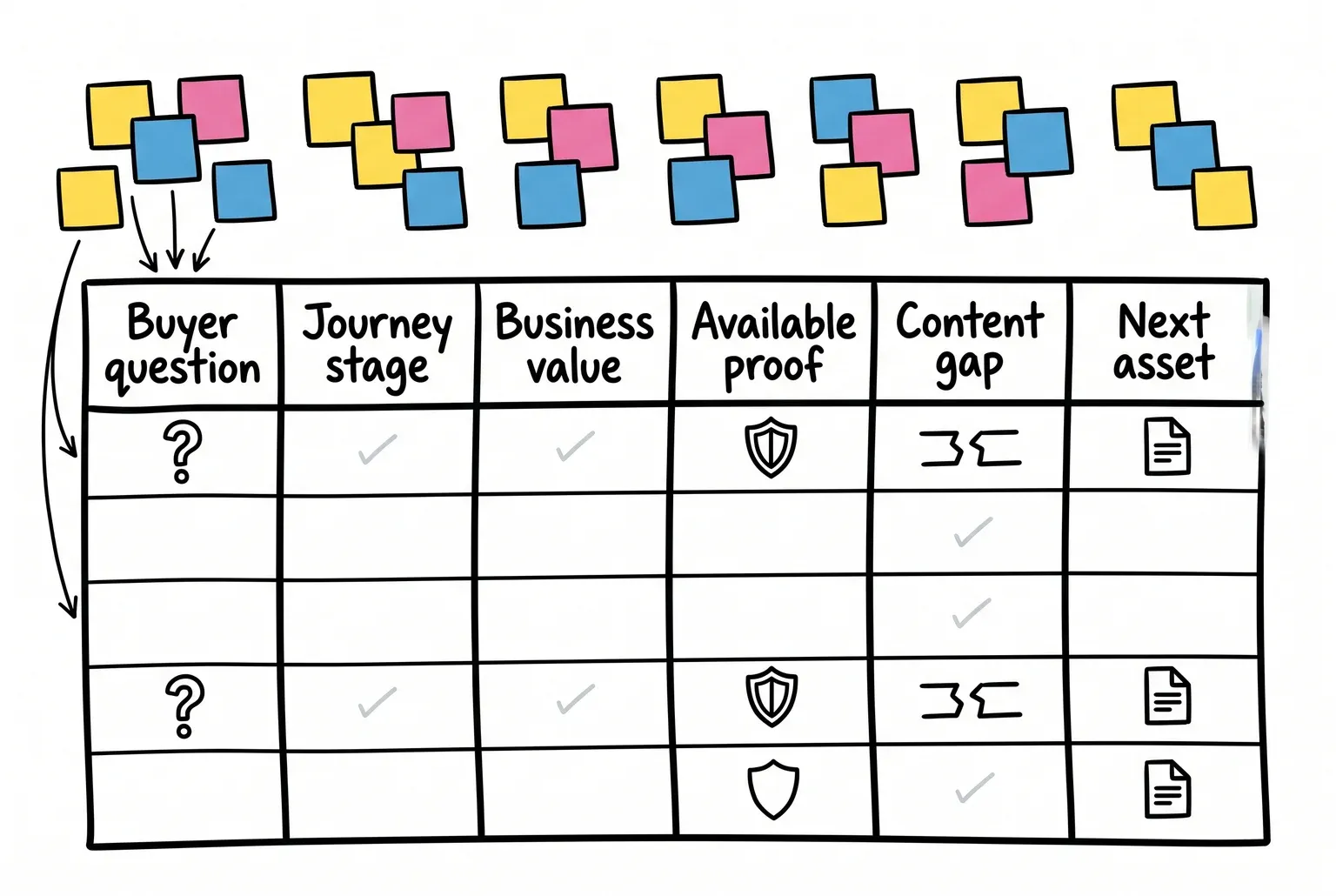
A compact decision table keeps this honest. One row per question, with columns for the buyer question, journey stage, business value, available proof, current content gap, and the next asset to build.
Platform selection comes after this, not before. Once you know your priority questions, investigate where those specific buyers ask them and read technical information, then verify each platform's current capabilities from first-party documentation rather than assuming a fixed market order. Chinese search and assistant tools change fast; several expose documented web-search and answer features aimed at different audiences.
For most B2B entrants, the China GEO Playbook points to WeChat and Baidu first, with LinkedIn, Xiaohongshu, and Douyin added later based on where your buyers actually are.
Which five questions would top your table today?
How to Run a 90-Day China GEO Pilot the Right Way
Treat the first quarter as a controlled validation exercise. You are testing whether your foundations hold up under real conditions, not chasing citations yet.
Days 1 to 30, audit and research. Appoint one named owner. Confirm your market fit decision from earlier still stands. Interview sales reps and local distributors, and inventory every Chinese asset you already have. Test whether those pages actually load from mainland locations, since hosting, DNS, CDN routing, and ICP filing status all affect access. Review whether your brand and product names appear consistently, flag compliance dependencies including any personal-information handling under PIPL, and pick a manageable baseline set of high-value buyer questions. A 10 to 20 question scope is a practical starting choice, not a rule. Record how AI tools answer those questions today. Outputs: a readiness decision, an issue log, a question map, a KPI baseline, and a responsibility matrix.
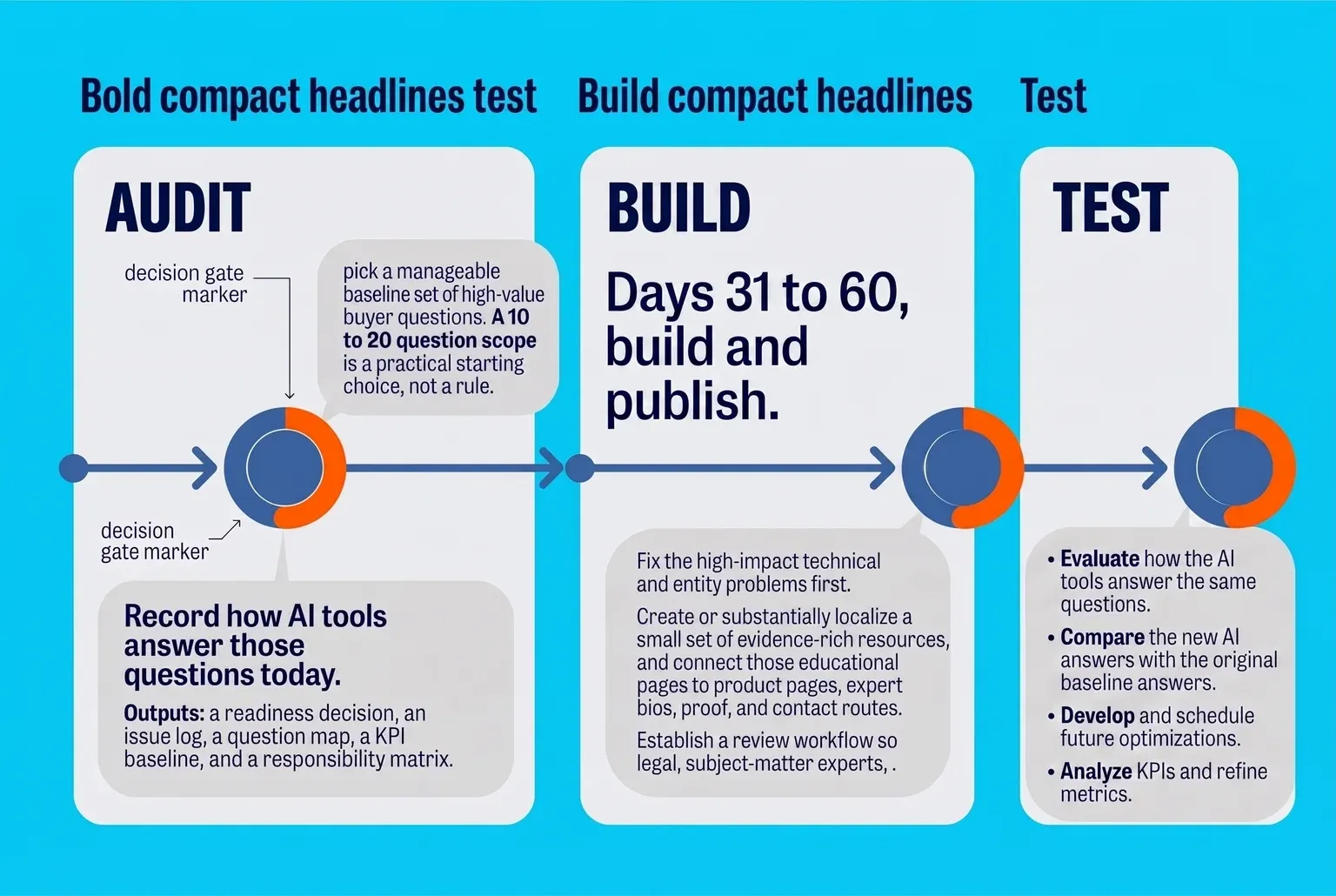
Days 31 to 60, build and publish. Fix the high-impact technical and entity problems first. Create or substantially localize a small set of evidence-rich resources, and connect those educational pages to product pages, expert bios, proof, and contact routes. Establish a review workflow so legal, subject-matter experts, and local staff sign off before anything ships. Distribute through the buyer-relevant local surfaces you identified. Outputs: a live content cluster, an approved terminology sheet, a source library, a distribution plan, and working tracking.
Days 61 to 90, test and iterate. Repeat your baseline questions under the same conditions. Document mentions, citations, source patterns, factual errors, and omissions. Improve anything unclear or weakly supported, review qualified engagement with sales, and decide: expand, revise, or pause. Judge readiness on approved questions, accessible measurable pages, consistent entities, a repeatable workflow, and named owners, not on citation counts.
Once your foundation clears that gate and you want engine-specific distribution and citation tactics, the dminorstudio China GEO citation playbook supplies the execution moves. This guide gets you ready to use it.
A KPI Ladder That Keeps Your China GEO Measurement Honest
Measure in four rungs, and never let a lower rung take credit for a higher one.
Foundation indicators are leading signals you control directly: the percentage of priority content that is accessible from mainland locations, fully localized, legally approved, and entity-consistent. These move first and predict everything above them.
Visibility indicators track how AI answers treat your stable baseline query set: answer presence, brand mentions, cited pages, source diversity, and factual accuracy. Run the same questions at regular intervals and record the date, account state, location, exact wording, and platform every time. Generative engines are non-deterministic, so identical queries can return different responses and citations run to run. Single-run numbers look precise and mislead you. Report ranges, not point estimates. As the China GEO Playbook notes, brand presence in training data does not guarantee citation in an answer.

Engagement indicators are qualified visits, downloads, contact actions, and interactions with sales-useful content. Tag referrals and campaigns cleanly in GA4, then treat its attribution reports as model-based views that shift credit depending on the model selected. AI answer traffic often loses its referrer and lands in Direct, so expect undercounting.
Business indicators are lagging outcomes: influenced inquiries, accepted leads, opportunities, and what sales actually says about deal origin. Preserve source and campaign data in your CRM at the lead, contact, and deal level, and let sales correct it. Relying on a single first-touch field as the sole source of revenue truth misses later influence and offline conversations that dominate long B2B cycles.
Three warnings hold across all four rungs. A mention is not a citation. A citation is not a visit. A visit is not pipeline.
Ownership stays light. Global marketing sets strategy and governance. A Chinese-fluent market owner validates language and buyer relevance. Subject-matter experts supply evidence. Web and analytics teams handle publishing and measurement. Legal or compliance reviews any regulated claims before they ship.
Which rung is your team currently mistaking for the one above it?
7 Mistakes That Keep Foreign B2B Brands Invisible to Chinese AI Tools
Each of these is fixable. Most trace back to treating China as a translation project instead of a market.
- Literal translation. Running English copy through machine translation produces wording that reads as unnatural and erodes trust. Research and write around how Chinese buyers actually phrase the problem, then adapt the argument, not just the words.
- Publishing only on your global site. If a page loads slowly or breaks from mainland locations, it may as well not exist. Test accessibility from inside China, then build buyer-relevant presence on the surfaces your audience already uses.
- Chasing every AI engine. Reformatting one press release across every platform is why most foreign companies stay invisible to Chinese AI engines. Prioritize by where your buyers research and which commercial questions they ask.
- Promotional claims without proof. Repeated sales pitches don't land with technical audiences, and Nanjing Marketing Group notes this holds true for Zhihu users specifically. Publish specific, substantiated material a skeptical engineer would accept.
- Inconsistent Chinese names and terms. When your company name or product term varies across pages and distributor sites, engines and buyers lose the thread. Keep one approved entity and terminology record everyone works from.
- Treating GEO as a one-off. A single content push decays fast. Assign an owner and a recurring review loop.
- Treating citations as the finish line. A mention is not pipeline. Connect visibility to qualified engagement and to what sales learns from real deals.
Which of these is quietly costing you right now?
Where you go from here
Your decision comes down to three paths. If China demand is still unproven, defer. Confirm that buyers exist and research in Chinese before spending on visibility. If demand is real but localization, mainland access, ownership, or compliance are weak, fix those foundations first. Engine tactics built on a broken base waste money. If demand and operating readiness are both present, launch the 90-day pilot: one engine, one platform, one real buyer question.
Durable capabilities come before fast-changing platform mechanics. Get the readiness conditions solid, and the specific tactics become easier to apply and easier to change when platforms shift.
When you reach execution, the China GEO citation playbook covers the engine-specific work this guide intentionally left out, including how citation surfaces like Baidu Baike, Zhihu, WeChat, and trade media fit together. This guide sets strategy, readiness, and operating foundations. That one gives you the next-stage tactics.
So which gap is biggest for you right now: market fit, content foundations, local distribution, or measurement?
Sources
- GEO: Generative Engine Optimization — Princeton University
- China's internet user base hits 1.125 billion as AI adoption surges — CNNIC
- Now Hiring: Firm-Level Adoption of Generative AI in China — World Bank
- 非经营性互联网信息服务备案 — Ministry of Industry and Information Technology (MIIT)
- Personal Information Protection Law of the People's Republic of China — National People's Congress of the People's Republic of China
- B2B buying jobs and buying-group research — Gartner
- Baidu marketing and analytics resources — Baidu
- 联网搜索- 智谱AI开放文档 — 智谱 AI / Zenlayer
- ICP Filing Requirements for a Regular Website — Alibaba Cloud
- Personal Information Protection Law of the People’s Republic of China — Supreme People’s Procuratorate of the People’s Republic of China
- China GEO Playbook: Get Cited by DeepSeek, ERNIE & Doubao — dminorstudio
- Quantifying Uncertainty in AI Visibility A Statistical Framework for Generative Search Measurement — IQRush
- GA4 Attribution Report: How to Read It Without Getting Misled — 1ClickReport
- Source Attribution in HubSpot: A Practical Guide — SalesPlaybook
About The Author

Stephen Tseng
Co-founder of dminorstudio. regularly writes about the intersection of AI, SEO, and B2B growth strategy.
FAQ
What is the difference between China GEO and regular SEO?
Regular SEO earns your page a ranked link in search results. China GEO focuses on getting your content pulled into a generated answer by AI tools like DeepSeek, ERNIE, or Doubao. With SEO, a buyer clicks a link from a list of results. With GEO, your brand or content appears as part of the AI's direct answer to a buyer's question. Both disciplines share the same content foundation, but they target different output surfaces and require different distribution strategies.
Which Chinese AI platforms should B2B companies focus on for GEO?
For most B2B companies entering China, Baidu and WeChat are the right starting points. From there, the platforms to add depend entirely on where your specific buyers research and ask questions. Chinese AI tools and search assistants change quickly, so verify each platform's current capabilities using their own documentation rather than assuming a fixed ranking. Avoid spreading effort across every platform at once, since that is one of the most common reasons foreign brands stay invisible.
Do I need a Chinese website to get cited by Chinese AI tools?
You do not need a site hosted in mainland China, but your content does need to be accessible from inside mainland China and written in natural Chinese. A site hosted in Hong Kong, Singapore, or the US can work, but hosting in mainland China requires ICP filing, which generally requires a mainland legal entity. More importantly, your content needs to be genuinely localized, not just translated, and distributed through platforms your buyers already use. A global English site alone will not earn citations from Chinese AI answer tools.
How long does China GEO take to show results?
A well-run 90-day pilot gives you a reliable signal on whether your foundations are solid and whether citation work is gaining traction. The first 30 days are about auditing and research. The next 30 days focus on building and publishing localized content. The final 30 days are for testing and measuring. Do not expect pipeline outcomes in the first quarter. Treat the pilot as a validation exercise, not a lead generation campaign, and use the results to decide whether to expand, revise, or pause.
What is entity consistency and why does it matter for China GEO?
Entity consistency means keeping one approved version of your company name, product names, technical terms, and credentials, and applying that same version across every page, platform, and third-party source. When your company name or product term appears differently on your website, distributor pages, and trade media, AI engines and buyers lose confidence in who you are. Inconsistent entities make it harder for AI tools to recognize and reference you accurately. A shared bilingual terminology sheet that your whole team works from is the simplest fix.
Can small B2B companies with limited budgets do China GEO?
Yes, but scope matters. Start with a narrow question inventory of 10 to 20 high-value buyer questions rather than trying to cover every topic. Focus your first content effort on the two or three questions that sit closest to a purchase decision. Assign one named owner, even if it is a part-time responsibility. A small, well-executed pilot on a tight budget teaches you more than a large, scattered program. The goal in the first 90 days is validation, not scale.
What compliance rules do B2B companies need to know before running China GEO?
China's Personal Information Protection Law (PIPL) limits data collection to what is strictly necessary and requires impact assessments for cross-border data transfers. Content published for Chinese audiences also sits inside a regulatory system that shapes what AI engines will surface. ICP filing rules apply if you host content on mainland servers. This guide is not legal advice. Before launching any China GEO program, confirm your specific obligations with qualified Chinese legal counsel and your hosting provider.