
Start With Where Your Buyers Actually Search
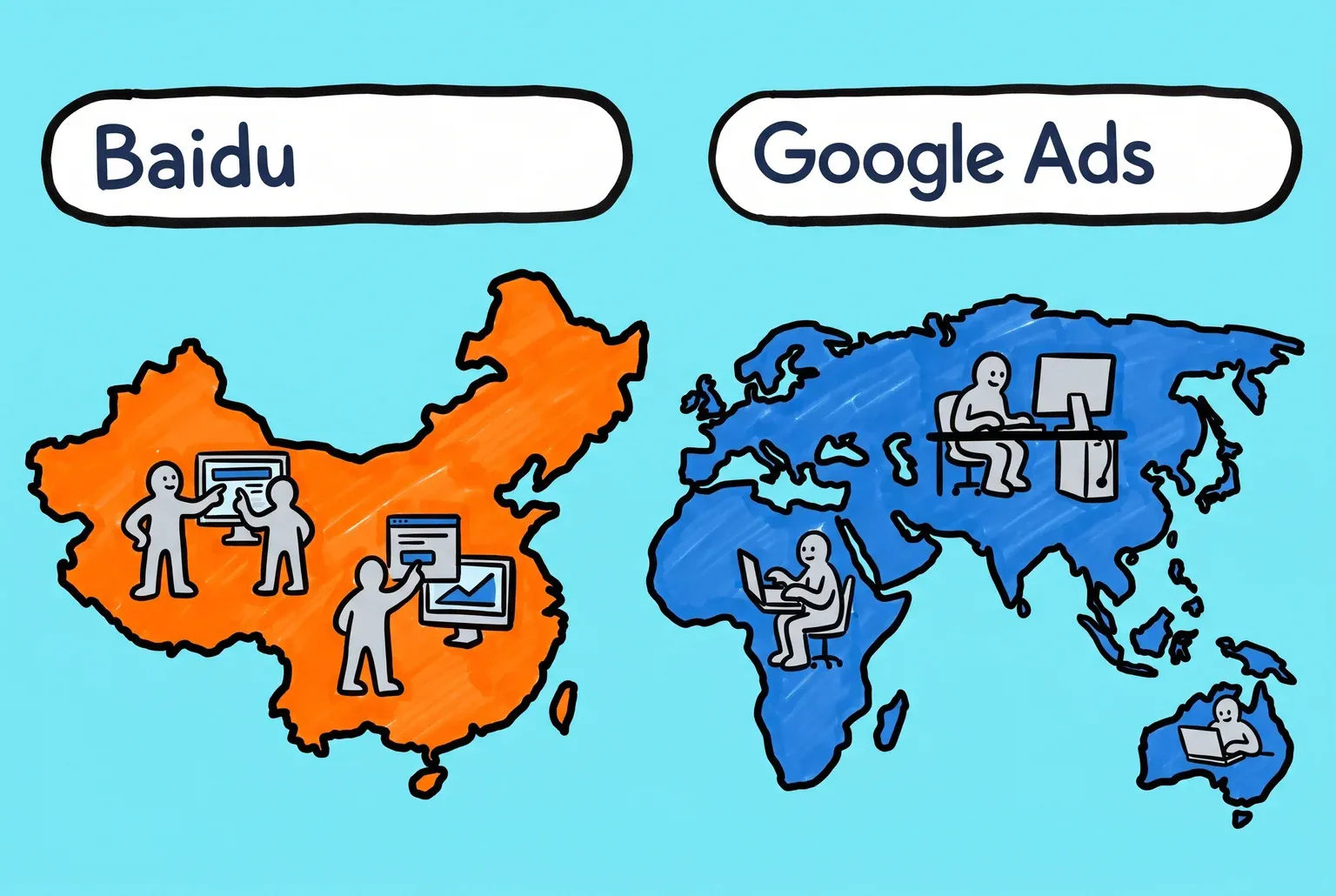
The short answer to the comparison query: your platform choice follows market access, not feature preference. Baidu is the practical paid-search platform for reaching ordinary search users inside mainland China, because Google and other major foreign services are blocked or restricted there. Google Ads is the relevant choice across international markets where Google Search is accessible and widely used. If you sell into both contexts, you generally need two separate programs, one on each platform.
These are not interchangeable worldwide alternatives. Both run intent-driven keyword auctions, but their inventories, onboarding, and lead-capture formats differ enough that a plan for one does not transfer to the other.
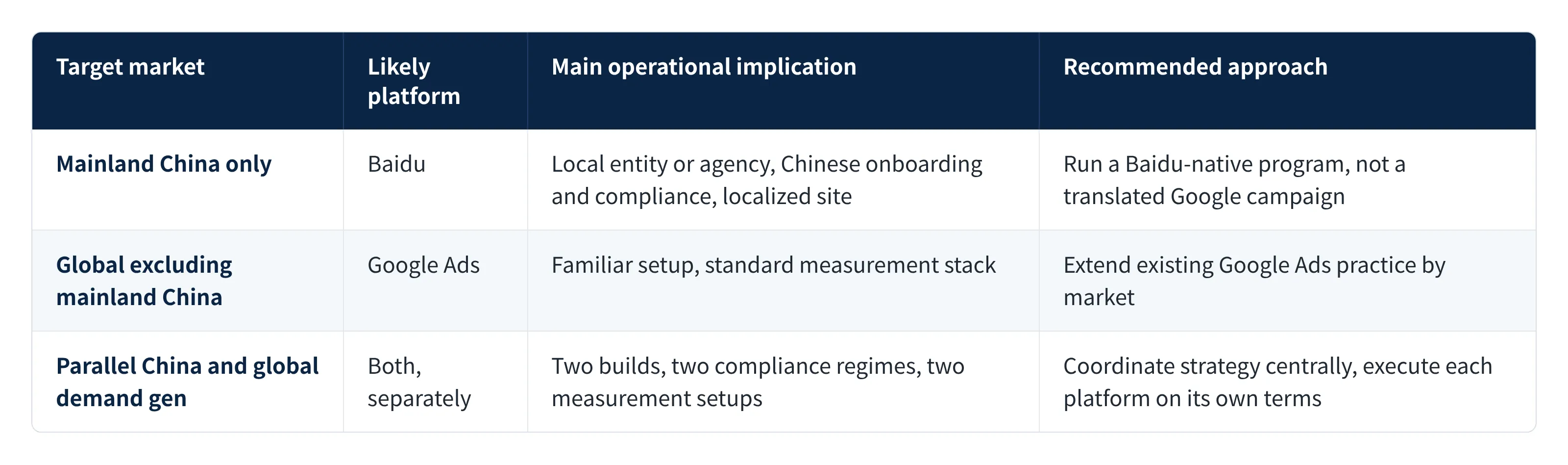
The sections that follow work through what each row means in practice.
How Reach Is Decided for China vs. Global Markets
Reach is the first filter, and it runs on geography, not preference. Inside mainland China, Google Search has been blocked since 2012, and a range of Google services including Maps, Translate, Docs, Drive, Scholar, and Analytics remained blocked through the 2024 reporting period. A 2024 U.S. congressional review documented roughly 60,000 unique censorship rules across major Chinese platforms and concluded that in-country discovery depends on domestic search engines. If your buyer sits at a desk in Shenzhen, Google Ads cannot reach them through ordinary search.
The same restrictions do not apply everywhere Chinese is spoken. Hong Kong, Macao, and Taiwan sit outside mainland censorship policy, and audiences there generally keep normal access to Google Search and Google Ads. So a Chinese-language landing page does not automatically point you to Baidu, and a sales office in Hong Kong does not give you reach into a factory buyer in Suzhou. Language and physical presence are separate questions from platform access.
That distinction matters most for the way B2B buying committees actually research. A procurement lead sourcing spectrometers, industrial coolers, or fiber-optic components inside mainland China uses different search engines, different technical terminology, and different content sources than the R&D director evaluating the same category from Germany or the US. The specifier, the engineer, and the finance approver may not even sit in the same country.
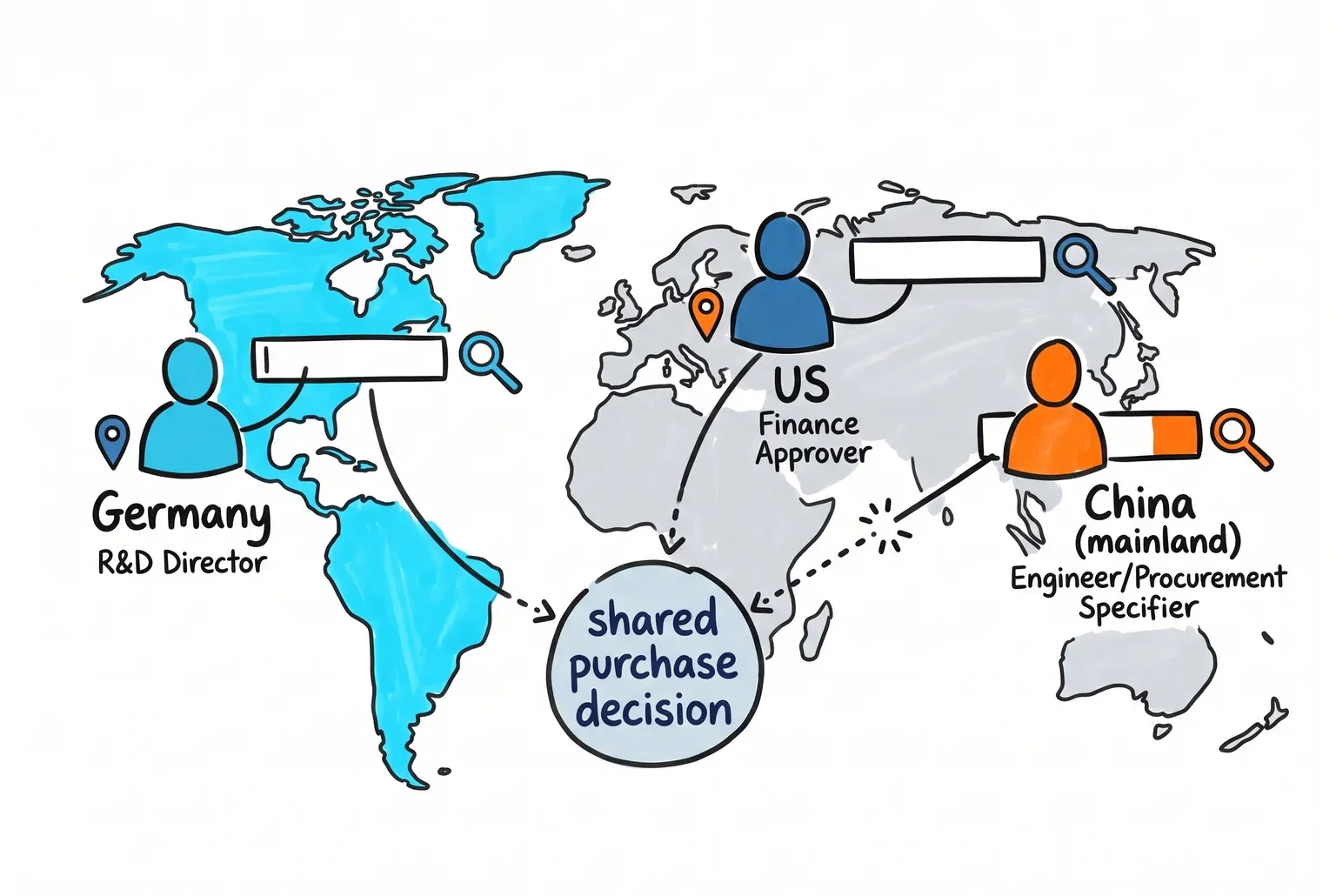
Before you pick Baidu, Google, or both, map where each member of the buying committee runs their research. The five dimensions that follow, setup and eligibility, localization, targeting, measurement, and cost, only matter once that reach question is settled.
What Does It Take to Get a Baidu or Google Ads Account Live?
A Google Ads account can be created in minutes with a business email and a payment method. Verification exists, but it usually runs in parallel with delivery. Google may require advertiser identity and business operations verification, and some regulated categories carry country-specific requirements, yet most B2B advertisers start spending before every check clears.
Baidu front-loads that work. Accounts are opened through an entity-verification process, not a self-serve signup, and the account cannot go live until qualification review is complete. Baidu requires B2B advertisers to verify the business entity and supply sector-specific licenses before delivery starts. Common materials include a valid Chinese business license, legal-representative identification, and corporate bank-account information used for verification, often alongside an ICP filing. An ICP filing is the record China's regulator requires for a website hosted or served to mainland users, and its registered subject is expected to match the advertiser entity.
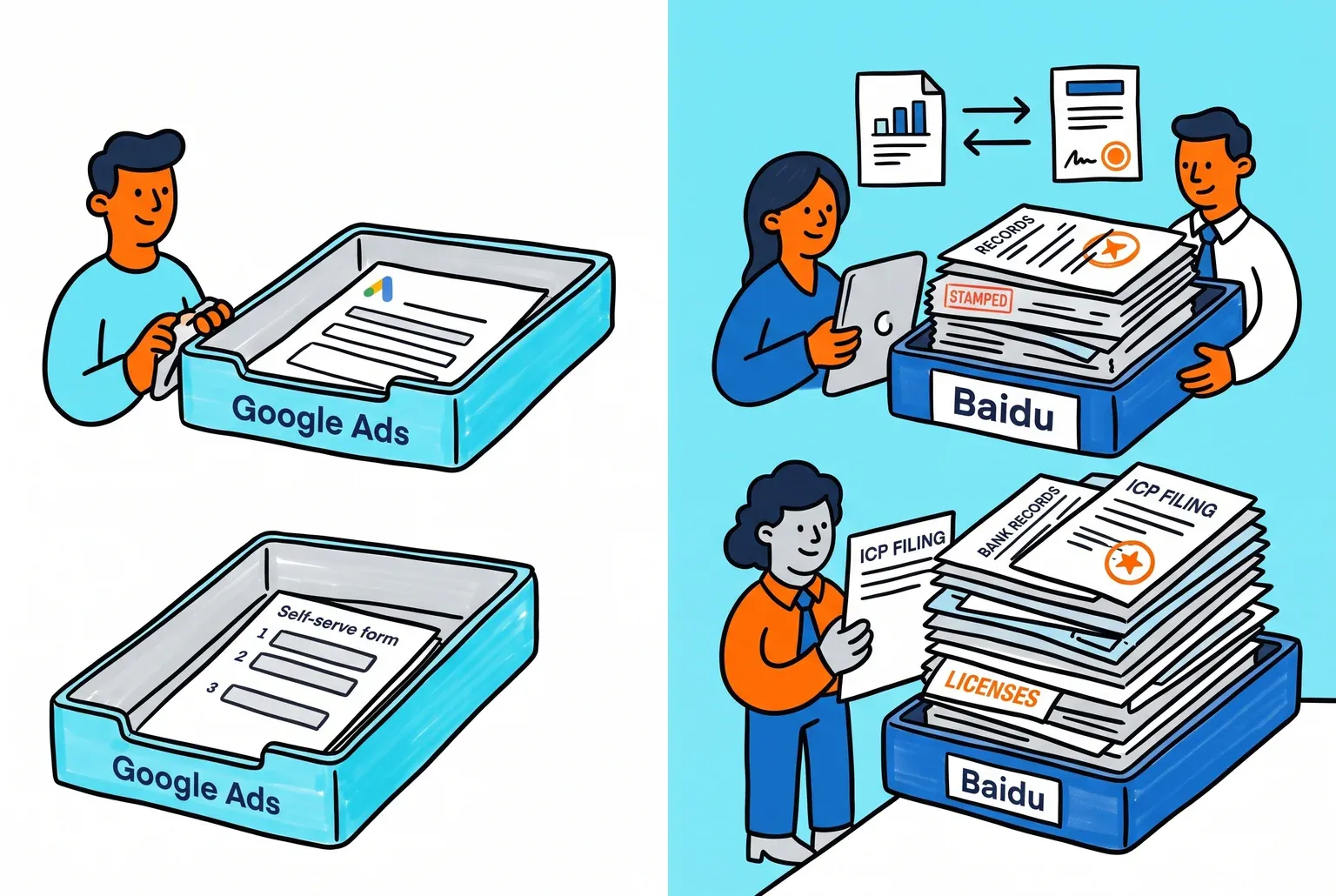
The steps map differently:
→ Account application: Google is self-serve; Baidu runs through a verified onboarding process, frequently with a reseller or authorized agent.
→ Business verification: Google verifies identity and operations, often after launch; Baidu verifies the entity before launch.
→ Industry review: Baidu separates ordinary from special industries, requiring extra certification for regulated sectors like medical, education, and finance. Baidu also maintains a dynamically updated list of prohibited categories, so eligibility can change.
→ Billing: Baidu typically works on prepayment into the account rather than post-pay billing.
→ Ad approval: Both review creative and destinations. Baidu may check consistency across the advertiser, website, and landing page, and your promoted business scope must match your documents.
Not every overseas advertiser needs the same paperwork. Requirements vary by advertiser location, industry, account route, and current policy, and the mandatory legal items differ from what a particular agent prefers to collect. Treat any fixed timeline you read online as an estimate, not a promise.
Before you commit, answer four planning questions. Who owns the account, your entity or an agent's? Who produces and translates the company documents? Who handles policy appeals when an ad or landing page is rejected? And can you legally promote this specific offer to mainland buyers? The step-by-step mechanics live in our Baidu Ads beginner guide; here, the point is planning lead time.
Why a Translated Campaign Fails on Baidu
Running your English keyword list through a translation tool produces phrases no Chinese buyer types. Localization is a different job. A procurement engineer in Shenzhen searches with mainland technical vocabulary, industry shorthand, and product names that may differ from your global branding. The intent behind a query shifts too, so keyword research has to start from how Chinese buyers describe the problem, not from a mirror of your Google Ads account.
That work runs through the whole funnel. Ad copy, proof points, spec sheets, forms, and the contact methods buyers expect all need native versions. A Chinese buyer often wants a WeChat contact or a phone number, not just an email form. Simplified Chinese is the standard for mainland China. English assets still have a place on multinational accounts, for global spec documents or headquarters credibility, but they support localized buyer content rather than replace it.
The landing page carries its own requirements. Google expects destinations to be reachable and functional in the target region, to use secure HTTPS when collecting personal information, and to work well on mobile. For China, page-load speed for mainland users, mobile-first design, visible trust signals, local contact details, and low form friction all affect whether paid clicks convert. Baidu also reviews destinations, and many advertisers build landing pages on its Jimuyu (基木鱼) platform, though the public documentation does not publish a complete rule list for page behavior.
Hosting location and ICP filing are related but separate planning questions. Where the site is served affects speed, and whether it needs an ICP filing depends on your setup. No single infrastructure model fits every company. Some run a localized China section on the global domain, some build a dedicated China site, and each carries different speed, control, and compliance tradeoffs.
Before buying traffic, test five things:
→ Language: written by a native marketer, not translated
→ Speed: fast for mainland mobile users
→ Compliance: hosting and filing questions resolved
→ Conversion path: local contact methods, short forms
→ Lead ownership: someone in-region follows up in Chinese
Which of these five is weakest for you right now?
How Baidu and Google Ads Targeting Actually Compare
The controls look similar on paper. They do not always behave the same way in practice, so validate current capabilities in the live account rather than assuming your Google Ads mental model transfers.
On Google Search, campaign structure follows the decisions you already know. You pick keyword match types, where phrase match covers the meaning of a term and exact match keeps tighter control, with documented overlap between them. You set location targeting, layer audience segments as Targeting or Observation, where Targeting restricts delivery and Observation only monitors, and choose a bidding approach. Smart Bidding sets bids at auction time using signals like device, location, and audience, feeding on conversion data you supply.
For a lab equipment or industrial components advertiser, the hard part is not the interface. It is low search volume on high-value technical terms. A phrase like a specific spectrometer configuration might draw a handful of searches a month, each worth far more than a thousand generic clicks. That changes how you work. Automated bidding needs conversion volume to learn, and specialized B2B terms rarely provide it, so tighter match types, manual review of the search-query report, and disciplined negative keywords often matter more than any bid algorithm.

Baidu offers its own keyword, geo, and bidding tooling, and the beginner guide walks through the basics. Treat similarly named settings as unverified until you confirm behavior in-account.
The operational friction is separate from the controls. The Baidu interface and support run in Chinese. You are working across time zones, around mainland holidays, and inside local approval cycles for ad and landing-page review. Someone needs live account access and Chinese-language optimization skill, whether that is an in-region hire or a local partner. A translated keyword list run by a remote English-only team tends to stall.
Who actually logs into the account each morning?
How to Compare Baidu and Google Ads Cost and Measurement Honestly
Two dashboards can show the same chart and mean different things. Data quality depends on what feeds the tracking, not on how the report looks.
Google's measurement path is well documented. You can connect ad clicks to downstream outcomes through offline conversion imports, match records back with enhanced conversions for leads using hashed CRM data, and account for consent signals that can suppress attribution when fields are missing. There are constraints, like the 63-day import window for enhanced-conversion lead uploads, which matter for long B2B cycles.
Baidu offers several conversion-data methods, including APIs, JavaScript monitoring, hosted landing pages, phone-data authorization, and SDKs. Downstream CRM attribution is less predictable in practice, and Baidu itself notes that platform and advertiser figures can diverge because of traffic scope, bidding method, anti-fraud filtering, and different definitions of an effective lead, with discrepancies around 10% treated as normal. Build your reporting expecting that gap.
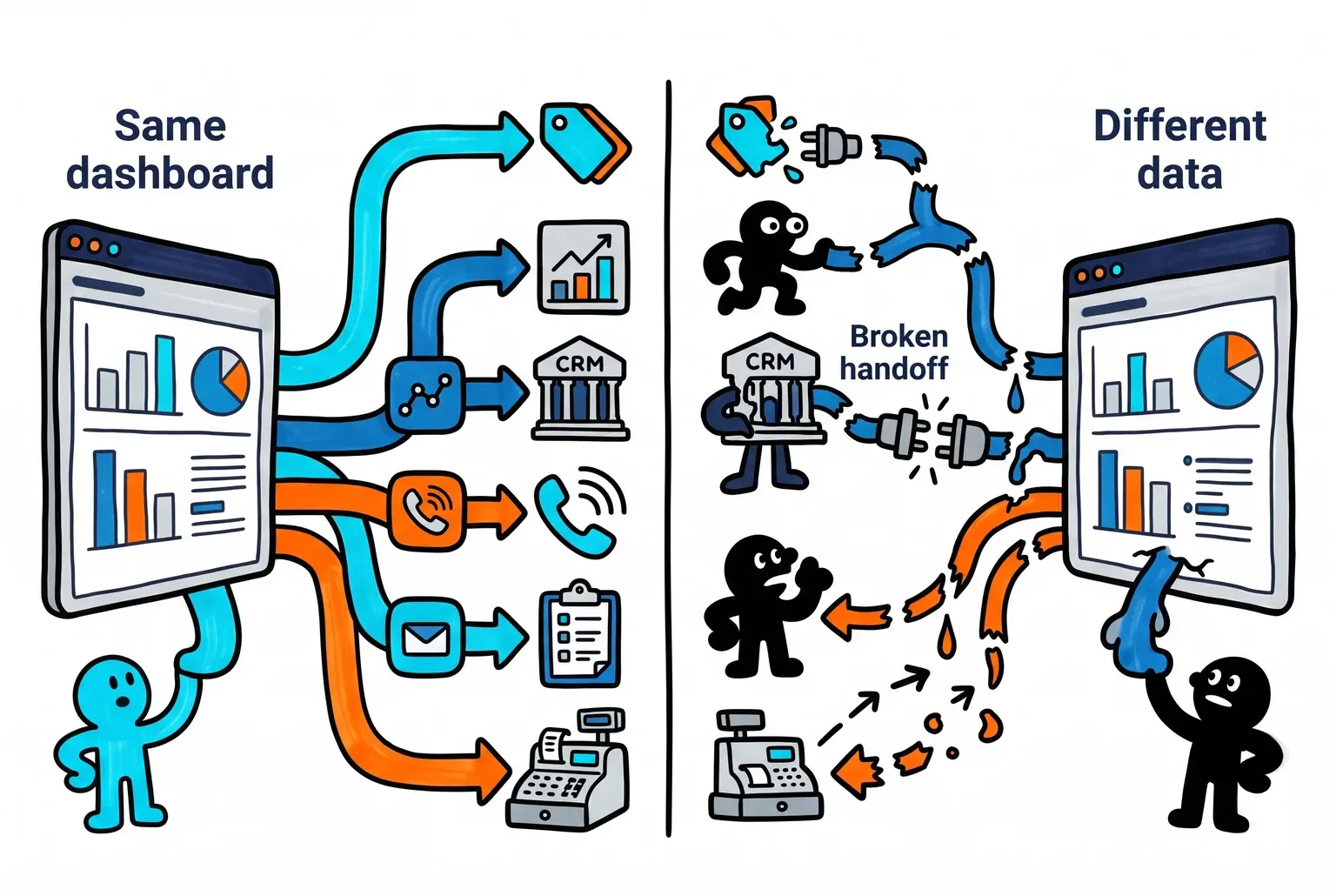
Do not compare the two platforms on CPC, raw cost per lead, or platform-reported ROAS. Those numbers move with industry, location, keyword competition, offer maturity, and how you define a conversion. A cheap click in one market and an expensive click in another tell you nothing on their own.
Frame cost as total program economics. Fully loaded acquisition cost includes media spend, account setup, localization, landing pages and hosting, tracking and CRM integration, compliance review, day-to-day management, sales follow-up, and the learning time before either account stabilizes. Leave any of these out and the comparison flatters whichever platform you already prefer.
Use one shared B2B scorecard across both markets: qualified search terms, valid inquiries, marketing-qualified leads, sales-accepted leads, opportunity value, conversion lag, and pipeline contribution. Then normalize on cost per sales-accepted lead and sourced pipeline rather than clicks, while keeping the market context attached to each number. A higher cost per accepted lead in China is not automatically worse if the deals are larger or the cycle is different.
Same definitions, same funnel stages, same currency, same revenue basis. Compare after that, not before.
Which Platform Should B2B Marketers Choose for China?
Three scenarios cover most B2B situations.
China-only demand generation. Prioritize Baidu when there is real mainland-China search demand for what you sell, an offer buyers can act on, localized conversion pages, and Chinese-language sales coverage to follow up. The main risk is buying clicks you cannot convert because the site or the sales handoff sits outside China. First validation step: confirm search volume on your actual technical terms before committing budget. The Baidu Ads beginner guide walks through the setup. For the wider channel mix, see our China B2B digital marketing guide.
Global demand generation excluding mainland China. Use Google Ads where your buyers use Google and the country and subnational locations are targetable. Do not add Baidu just because Chinese-language keywords exist. The risk is spreading budget into a market with no local follow-up. First step: verify your target regions in the geo-targets data.
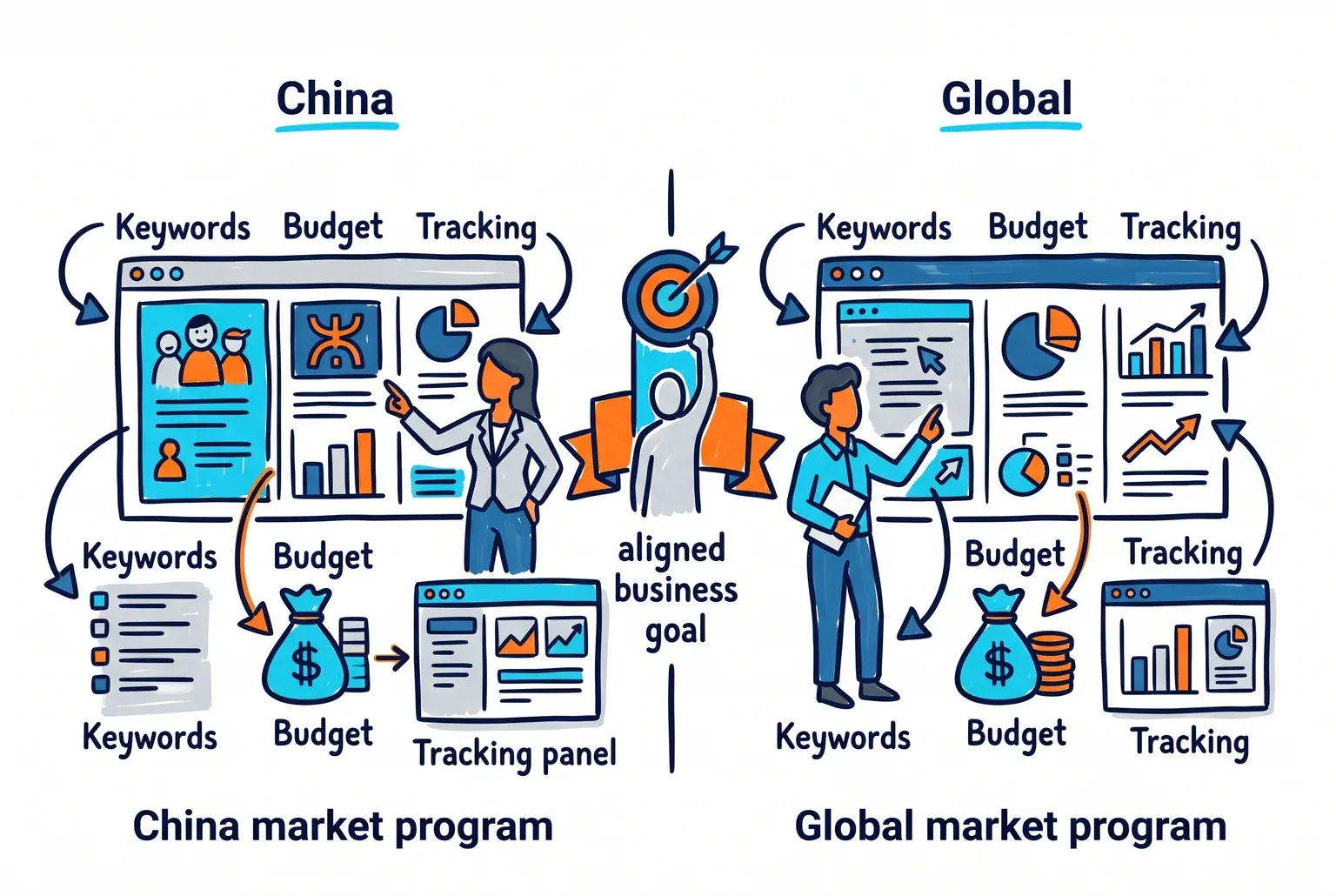
Parallel global and China programs. Run both as separate market programs with aligned business goals but distinct keywords, landing pages, budgets, and tracking. The risk is copy-pasting one market's strategy onto the other. First step: build two scorecards, not one blended report.
Secondary cases: test China before a full launch with a limited Baidu pilot, support a local distributor with co-managed campaigns, or reach Chinese-speaking buyers outside the mainland through Google in Hong Kong, Singapore, or Taiwan.
Not ready for either: if you lack market access, compliance documentation, localized sales follow-up, or ready landing pages, fix those first. Paid search will only expose the gap faster.
How to Run a Controlled China Paid-Search Pilot
Treat the first campaign as a validation exercise, not a launch. Work through it in stages.
Confirm demand and eligibility first. Verify there is real search volume on your technical terms, then check whether your entity, ICP filing, hosting, and business license clear Baidu's review. Regulated sectors like finance, healthcare, education, and supplements need extra qualification before ads run.
Research Chinese buyer terminology rather than translating your English keywords. Assess whether your website gives Chinese visitors a reachable, workable conversion path. Define what counts as a qualified lead before spending anything, and document who owns inquiries, the response language, the follow-up SLA, and CRM handoff rules.
Set up tracking that covers forms, calls, chats, and downstream CRM events. Then launch a constrained campaign: one offer, a narrow high-intent keyword set, one or two Simplified Chinese landing pages. A phased pilot commonly runs a two-week setup, a ¥100 to 300 daily budget, and an initial deposit around ¥2,400, with a 4 to 8 week window before inquiry and lead-cost data stabilizes. Review search terms and accepted-lead quality, not just clicks, before deciding whether to scale.
Set the learning budget from your deal economics and launch requirements, not by copying a Google Ads number or a quoted minimum. A full 90-day market-entry pilot with localization and setup often runs $10,000 to $20,000. Paid search cannot fix an unlocalized offer, weak sales follow-up, or an unclear China plan. If you want tactical prep, the Baidu Ads beginner guide covers the mechanics.
If you want coordinated market, website, compliance, media, and measurement support, evaluate our China market-entry program.
Do you have the market evidence, localized infrastructure, and sales capacity to launch responsibly?
Sources
- 2023 Country Reports on Human Rights Practices: China — U.S. Department of State
- Freedom on the Net 2024 - China — Freedom House
- Censorship Practices of the People's Republic of China — U.S.-China Economic and Security Review Commission
- Advertiser verification — Google Ads Policy Help
- Country-specific requirements — Google Ads Policy Help
- 开户过程中需要提供哪些行业和公司资质的相关证明文件_百度营销推广 — 百度营销
- 百度营销开户全攻略!从咨询到上线,官方开户不踩坑(建议收藏)_百度开户 — 百度营销
- 百度推广聚屏广告物料审核与开户资质要求!_百度推广 — 百度营销
- Baidu Ads for Western B2B: A Beginner Guide — dminorstudio
- Google Ads:数据收集与使用 — Google Ads Policy Center
- Merchant Center:移动链接属性 — Google Merchant Center
- 风云计划-基木鱼平台Q&A常见问题_百度营销开户_企业网站网络推广_百度关键词推广 — 百度营销
- About keyword match types — Google Ads Help
- About location targeting — Google Ads Help
- About audience targeting and observation settings — Google Ads Help
- About Smart Bidding — Google Ads Help
- About offline conversion imports — Google Ads Help
- Set up enhanced conversions for leads — Google Ads Help
- Consent-related conversion measurement — Google Ads Help
- Enhanced conversions for leads data requirements and upload limits — Google Ads Help
- Explanation of discrepancies between Baidu and advertiser data — Baidu Marketing
- Import offline conversions — Google Ads Help
- Geo-targets — Google Ads API Documentation
- China B2B Digital Marketing — dminorstudio
About The Author

Stephen Tseng
Co-founder of dminorstudio. regularly writes about the intersection of AI, SEO, and B2B growth strategy.
Frequently Asked Questions About Baidu Ads vs. Google Ads
Can I run Google Ads to reach buyers in mainland China?
No. Google Search has been blocked in mainland China since 2012, which means Google Ads cannot reach ordinary search users there through standard campaigns. If your target buyers are located in mainland China, Baidu is the relevant paid-search platform. Google Ads remains the right choice for Chinese-speaking audiences in Hong Kong, Taiwan, Singapore, and other markets where Google is accessible.
How long does it take to get a Baidu Ads account approved?
Unlike Google Ads, which uses self-serve signup, Baidu requires a full entity verification process before an account goes live. This includes submitting a Chinese business license, legal-representative identification, and often an ICP filing. Setup timelines vary depending on your industry, entity type, and whether you work through an authorized agent. Treat any specific timeline you read online as an estimate. Budget several weeks for compliance review before your first ad runs.
Do I need a separate website for Baidu Ads campaigns?
Not always, but your existing global website may not be enough. Mainland China users need fast load times, Simplified Chinese content, local contact methods like WeChat, and a conversion path that works on mobile. Some companies add a localized China section to their global domain. Others build a dedicated China site. The right setup depends on your hosting, ICP filing situation, and how much traffic you plan to run. Page speed and compliance are more important than which domain structure you choose.
What is an ICP filing and do I need one to run Baidu Ads?
An ICP (Internet Content Provider) filing is a registration required by China's regulator for websites hosted or served to mainland users. Whether you need one depends on your hosting setup and business model. Baidu often expects the ICP filing entity to match the advertiser entity during account review. If your site is hosted outside mainland China, you generally do not need an ICP filing, but slower load times and Baidu's review may still push you toward local hosting. Confirm your specific situation with a qualified local partner before starting the account process.
How should I measure and compare results between Baidu and Google Ads?
Do not compare the two platforms on CPC or platform-reported cost per lead alone. Those numbers are shaped by industry, competition, offer type, and how each platform defines a conversion. Instead, use a shared B2B scorecard that tracks qualified search terms, valid inquiries, marketing-qualified leads, sales-accepted leads, and pipeline contribution. Normalize on cost per sales-accepted lead and sourced revenue, and always keep the market context attached to each number. Baidu also notes that platform and advertiser data can diverge by around 10% due to differences in traffic scope and lead definitions, so build that expected gap into your reporting from day one.
Is Baidu PPC worth it for a small B2B budget?
It depends on your offer and your market readiness, not just your budget size. A small budget can validate demand if you have the right technical keywords, localized landing pages, and a Chinese-speaking sales team ready to follow up. A large budget spent without those foundations will not produce results either. A phased pilot with a narrow keyword set and one or two landing pages is a more reliable starting point than scaling up too quickly. Confirm real search volume on your specific terms before committing any spend.
What are the biggest mistakes B2B companies make when running Baidu Ads?
The most common mistakes include translating an English keyword list instead of researching how Chinese buyers actually search, sending paid traffic to a global website with no Simplified Chinese content, skipping the ICP and hosting compliance steps, and having no Chinese-language sales follow-up in place. Many companies also compare Baidu and Google results using different definitions of a lead or different funnel stages, which makes the comparison meaningless. Treat each market as its own program with its own keywords, landing pages, tracking setup, and sales process.