
Why Copying Google Ads Into Baidu Does Not Work for China
Copying a Google Ads campaign into Baidu is not a China market-entry strategy. Chinese search language, buyer terminology, landing-page expectations, account readiness, conversion tracking, and Baidu's own platform workflows all demand dedicated execution. Direct translation of your ad copy will not carry the intent your Chinese buyers actually search on, and localization alone does not guarantee performance.
Dminorstudio runs this as a managed acquisition service for Western and international B2B companies. We assess your eligibility and China readiness, research native-Chinese keywords, localize copy and landing pages, build and launch the account, then monitor and report. We work as the hands-on operator, not an advisor handing you a slide deck, with teams in Shanghai and the United States bridging Western expectations and China-specific delivery.
The starting point is a consultation to review your fit, your website, and a lean pilot scope. Book a 30-minute free consultation through the contact form.
Four Gaps That Break a Lift-and-Shift from Google Ads to Baidu
Reusing a Google Ads account on Baidu fails in four specific places, and each one has a fix.
→ English keywords miss Chinese demand language. Chinese industrial buyers often search 恒湿空调 (constant-humidity HVAC) rather than "dehumidifier." We research native Chinese terms and build intent-organized ad groups, which Baidu recommends structuring around a single search intent with similar-semantic keywords per unit.
→ Translated ads miss technical and commercial intent. Direct translation carries words, not buying signals. We write Chinese copy tied to the query the buyer actually types, within Baidu's creative structure.
→ Landing pages need a message and conversion-path review. A translated page rarely matches Chinese buyer expectations or a clean form-to-lead flow. We review message match and the conversion path before spend starts.
→ Account, category, documentation, and tracking readiness affect launch. Baidu uses a hierarchical account structure built from the account level down, and conversion events must be wired correctly. We review your specific situation and prepare accordingly.
None of this guarantees results. It removes the failure modes that waste your first budget.
Our Five-Phase Baidu PPC Launch and Management Process
Every engagement moves through five phases. Onboarding paths differ by category and account status, so treat this as the working structure, not a fixed timetable.
Phase 1: Fit and readiness assessment. We audit your commercial goals, target buyers, offer, category, current account status, available documentation, website, tracking, and internal capacity to answer Chinese-language leads. Your team provides business objectives, product and sector detail, existing assets, and an honest picture of who responds to inquiries.
Phase 2: Search-market and competitor analysis. We study how Chinese buyers actually search, map competitor visibility, identify demand themes and correct technical terminology, and flag exclusions. Your team provides product specifications, approved claims, regions served, and terms to avoid.
Phase 3: Localization and preparation. We build the Chinese keyword framework, write ad messaging adapted to buyer intent rather than translated, design campaign structure, recommend landing-page and conversion-path changes, and set the measurement plan. Note that Chinese advertising law bars superlatives like "best" or "number one," so compliant copy matters. Your team provides brand guidelines, offer approvals, and access to make page edits.
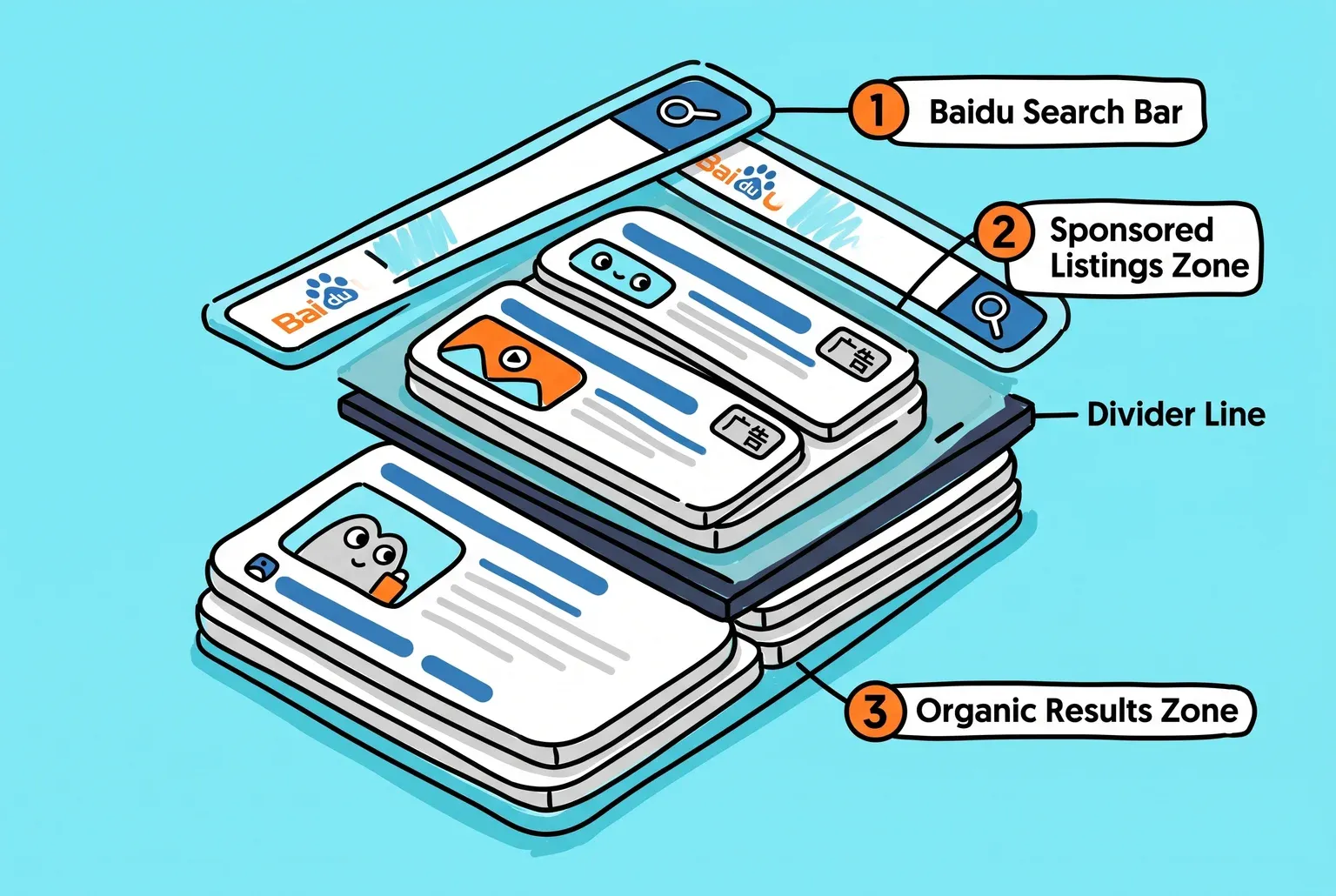
Phase 4: Build, QA, and launch. We implement campaigns and ad groups, review settings, and verify conversion tracking, with each goal assigned its own conversion ID. Launch depends on entity and website compliance review, and for regulated categories, industry-specific licenses. Your team provides required qualifications and billing details. Approval timing sits partly with Baidu, not with us.
Phase 5: Management and optimization. We review search terms, refine keywords, allocate bids and budget, iterate creative, and observe landing-page behavior. Your team provides lead-quality feedback so we optimize toward revenue-relevant inquiries, not raw volume.
What Gets Delivered at Each Stage of Your Baidu Campaign
By stage, here is what we hand over or coordinate.
Assessment and readiness: written findings on account status, category qualification, documentation gaps, and the launch dependencies that must clear before spend begins.
Market analysis: a summary of how your Chinese buyers search, competitor visibility notes, correct technical terminology, and terms to exclude.
Localization and build: a Chinese keyword framework organized by search intent, ad messaging written for buyer intent and compliant with local advertising standards, and campaign architecture grouped by product line or segment. We also give landing-page and conversion-path recommendations, including load-speed and hosting notes, since slow Chinese pages degrade conversion.
Launch: tracking configuration or coordination within the agreed scope, plus pre-launch QA on settings and conversion firing.
Ongoing: optimization records documenting keyword, bid, budget, and creative changes, and performance reporting with recommended next actions.
Final scope depends on account condition, market complexity, the assets you can provide, and tracking access. We do not claim proprietary Baidu access or a fixed asset count. We confirm exact deliverables in your proposal.
Is Your B2B Company a Good Fit for Baidu Ads Management?
We qualify every prospect before confirming a launch approach. Baidu reviews account, category, website, and documentation readiness case by case, so we do too.
You are a good fit if you are a Western B2B company with a defined China growth objective, identifiable buyer segments, a credible offer, internal sales follow-up capacity, and a willingness to adapt messaging based on market evidence. China is a deliberate market for you, not a side experiment.
Your team provides the inputs we build on: product and commercial priorities, target sectors and regions, approved technical claims, any existing Chinese assets, account or advertiser information available for review, website and analytics access where relevant, named approval contacts, and honest lead-quality feedback once campaigns run.
You are a poor fit if you want guaranteed leads or a fixed CPL, instant results, a direct Google Ads clone, a campaign with no viable landing destination or response process, or a hands-off vendor relationship where no one on your side reviews and decides.
If you recognize your team in the first group, a consultation is worth booking.
What the Baidu Campaign Launch Sequence Looks Like in Practice
Think in phases, not a fixed calendar. We start with the consultation and fit review, then assess account, category, documentation, website, and tracking readiness. From there we handle Chinese keyword research and localization, build and QA the pilot campaign, and launch once the required conditions are satisfied.
Dminorstudio controls the build work. Several steps depend on you: documentation, advertiser and website access, approved technical claims, and named approvals. Platform review, category considerations, and any technical changes are variables we manage but do not dictate.
Phase 0 setup runs roughly weeks 0 to 2, assuming timely inputs and a workable account. Going live is a milestone. Early traffic starts a 2 to 4 week learning period, not a finished campaign.
How We Report Baidu PPC Performance and What We Need from You
Our baseline is a monthly analysis built on Baidu Tongji and related web analytics. We agree the exact cadence and granularity during scoping, tied to your goals rather than a fixed template.
Each report covers spend and traffic quality, clicks and search-term relevance, keyword performance, on-site behavior, and cost per lead against segment norms. Search-term data does real work here: in one manufacturing pilot, it showed that roughly 40 to 50% of inquiries came from job seekers and small firms, so we cut those queries. We report the numbers, explain what they mean commercially, and recommend the next actions.
The half we cannot supply is yours. Tell us which leads were valid, which reached sales, and which turned into opportunities. Without CRM access or offline sales feedback, attribution stops at lead cost and inquiry volume. We will not claim revenue impact we cannot measure. Feed us sales-stage data and we optimize toward pipeline, not just form fills.
How Does Baidu PPC Compare to Baidu SEO for Long-Term B2B Growth?
Paid search buys visibility while the budget runs. Once we launch an eligible campaign, Baidu PPC captures high-intent traffic and generates demand signals within the first weeks, but that presence stops when spend or active management stops.
Baidu SEO builds more slowly. Through technical audits, Chinese content, and authority work, it can develop a more durable organic presence over time, though we report rankings and traffic monthly rather than promise specific results.
We recommend a combined roadmap only when it fits your goals, resources, website readiness, and the market evidence PPC surfaces. If PPC alone answers your current question, we say so.
Book a Baidu Ads Consultation for Your China Market Entry
Ready to test whether Baidu PPC fits your China goals? Book a free consultation through the Contact Us form.
Come prepared. The conversation covers your China growth goals, who your target customers are, the products or services you want to prioritize, and your current Baidu account status if you know it. We also review your Chinese website or landing-page readiness, the documents you have available, your tracking setup, and the launch context you have in mind.
Bring relevant URLs, any existing campaign information, and internal constraints you already know about. You will leave with an honest fit assessment and a clear next step, not a promise on approval, cost per lead, lead volume, or launch date.
Fill out the form with your contact information and needs. A reply follows within one business day.
Sources
- Digital Marketing Services in New York, NY and Shanghai — dminorstudio
- Test Before You Localize: Baidu Ads as China Market Entry — dminorstudio
- Mastering Baidu PPC: A Comprehensive Guide to China Paid Advertising in 2026 — Mates Asia
- Why Baidu PPC Outperforms Google Ads for B2B in China — dminorstudio
- Why must western companies take Baidu marketing seriously? — dminorstudio
- Baidu and Google PPC Case Study: How We Increase Website Traffic to Generate Leads — dminorstudio
- Baidu Ads for Western B2B: A Beginner's Pilot Guide — dminorstudio
- Premier Baidu SEO Agency | Tailored Solutions for China Market Growth — dminorstudio
- Why Choosing an Experienced Baidu SEO Agency Is the Key to B2B Success in China — dminorstudio
About The Author

Stephen Tseng
Co-founder of dminorstudio. regularly writes about the intersection of AI, SEO, and B2B growth strategy.
Frequently Asked Questions About Baidu Ads for Western B2B Companies
Can a Western company run Baidu ads without a Chinese business entity?
It is possible in some cases, but Baidu's account eligibility depends on your category, the documents you can provide, and your website setup. Some categories may require a locally registered entity or a licensed Chinese partner. We assess your specific situation during the readiness phase before recommending a launch approach.
How long does it take to launch a Baidu PPC campaign?
Phase 0 setup typically runs two weeks, assuming your team provides the required documentation, access, and approvals on time. Regulated categories may take longer due to Baidu's compliance review. Going live is a milestone, not the finish line. The first 2 to 4 weeks after launch are a learning period, not a finished campaign.
How much should a Western B2B company budget for Baidu advertising?
Budget requirements vary by category, competition, and targeting scope. We do not publish fixed minimums because the right starting budget depends on your market, offer, and goals. We cover this during the consultation and set a pilot scope that reflects what your category realistically requires.
Why can't I just translate my existing Google Ads campaigns into Chinese?
Translated ads carry words, not buying intent. Chinese B2B buyers use different terminology, search patterns, and commercial signals than English-speaking buyers. Beyond copy, Baidu's account structure, platform rules, advertising law requirements, and landing-page expectations all differ from Google. A direct translation misses most of what makes a campaign perform.
What happens if Baidu rejects my ad or landing page?
Baidu reviews accounts, ad copy, and landing pages against its own compliance standards. Rejections can happen due to missing documentation, non-compliant claims, restricted categories, or website issues. We flag likely risk areas during the readiness phase, but approval decisions sit with Baidu. We help you prepare correctly so rejections are less likely, but we cannot guarantee approval outcomes.
Do I need a Chinese-language website before starting Baidu ads?
You need a functional landing destination that Chinese buyers can access and that meets Baidu's standards. A full Chinese website is not always required at the pilot stage, but a relevant, accessible, and fast-loading Chinese landing page is. Page load speed matters significantly because slow-loading pages hosted outside China can reduce conversion rates.
Can Baidu PPC work alongside a Baidu SEO strategy?
Yes, and the two complement each other well. Paid search generates immediate visibility and surfaces real demand signals about how your buyers search. Organic SEO builds a more durable presence over time. We recommend a combined approach only when it fits your goals and resources. If PPC alone answers your current question, we will tell you.